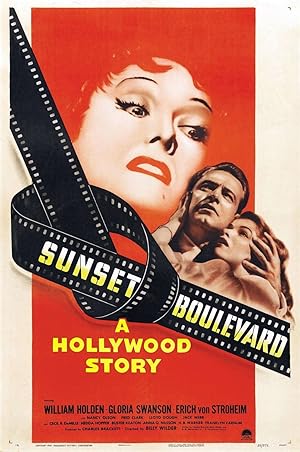
Sunset Boulevard
In Hollywood of the 50's, the obscure screenplay writer Joe Gillis is not able to sell his work to the studios, is full of debts and is thinking in returning to his hometown to work in an office. While trying to escape from his creditors, he has a flat tire and parks his car in a decadent mansion in Sunset Boulevard. He meets the owner and former silent-movie star Norma Desmond, who lives alone with her butler and driver Max Von Mayerling. Norma is demented and believes she will return to the cinema industry, and is protected and isolated from the world by Max, who was her director and husband in the past and still loves her. Norma proposes Joe to move to the mansion and help her in writing a screenplay for her comeback to the cinema, and the small-time writer becomes her lover and gigolo. When Joe falls in love for the young aspirant writer Betty Schaefer, Norma becomes jealous and completely insane and her madness leads to a tragic end.
Despite its small-scale budget of $1.8M, Sunset Boulevard became a financial success, earning $5.0M worldwide—a 185% return.
3 Oscars. 21 wins & 20 nominations
Plot Structure
Story beats plotted across runtime


Narrative Arc
Emotional journey through the story's key moments
Story Circle
Blueprint 15-beat structure
Arcplot Score Breakdown
Weighted: Precision (70%) + Arc (15%) + Theme (15%)
Sunset Boulevard (1950) reveals precise narrative design, characteristic of Billy Wilder's storytelling approach. This structural analysis examines how the film's 13-point plot structure maps to proven narrative frameworks across 1 hour and 50 minutes. With an Arcplot score of 5.2, the film takes an unconventional approach to traditional narrative frameworks.
Structural Analysis
The Status Quo at 1 minutes (1% through the runtime) establishes Joe Gillis floats face-down in Norma Desmond's pool, dead. Voiceover establishes him as a failed Hollywood screenwriter, broke and desperate, being chased by repo men.. Notably, this early placement immediately immerses viewers in the story world.
The inciting incident occurs at 11 minutes when Joe's car gets a flat tire and he pulls into the driveway of a decaying mansion on Sunset Boulevard to hide from repo men. This chance event disrupts his trajectory completely.. At 10% through the film, this Disruption aligns precisely with traditional story structure. This beat shifts the emotional landscape, launching the protagonist into the central conflict.
The First Threshold at 24 minutes marks the transition into Act II, occurring at 22% of the runtime. This shows the protagonist's commitment to Joe makes the conscious choice to stay at Norma's mansion, accept her employment to edit her script, and move into the room above her garage. He sells his integrity for financial security., moving from reaction to action.
At 50 minutes, the Midpoint arrives at 45% of the runtime—arriving early, accelerating into Act IIb complications. The analysis reveals that this crucial beat On New Year's Eve, Norma throws a party - but Joe is the only guest. She declares her love and attempts to seduce him. He rejects her and flees to a party with his own age group, but the false victory of escape collapses - stakes are raised as Norma's obsession intensifies., fundamentally raising what's at risk. The emotional intensity shifts, dividing the narrative into clear before-and-after phases.
The Collapse moment at 73 minutes (66% through) represents the emotional nadir. Here, Norma calls Betty and reveals that Joe is her kept man, living in her house, wearing clothes she bought. Betty arrives and sees the truth. Joe's chance at genuine love and honest work dies. His self-respect is destroyed., indicates the protagonist at their lowest point. This beat's placement in the final quarter sets up the climactic reversal.
The Synthesis at 80 minutes initiates the final act resolution at 72% of the runtime. As Joe walks away, Norma - fully delusional - shoots him three times. He falls into the pool. Police and newsreel cameras arrive. Max orchestrates Norma's final "scene," telling her the cameras are from Paramount for her DeMille picture. She descends the staircase in full delusion, believing she's returned to stardom., demonstrating the transformation achieved throughout the journey.
Emotional Journey
Sunset Boulevard's emotional architecture traces a deliberate progression across 13 carefully calibrated beats.
Narrative Framework
This structural analysis employs proven narrative structure principles that track dramatic progression. By mapping Sunset Boulevard against these established plot points, we can identify how Billy Wilder utilizes or subverts traditional narrative conventions. The plot point approach reveals not only adherence to structural principles but also creative choices that distinguish Sunset Boulevard within the drama genre.
Billy Wilder's Structural Approach
Among the 10 Billy Wilder films analyzed on Arcplot, the average structural score is 5.6, showcasing experimental approaches to narrative form. Sunset Boulevard takes a more unconventional approach compared to the director's typical style. For comparative analysis, explore the complete Billy Wilder filmography.
Comparative Analysis
Additional drama films include Eye for an Eye, South Pacific and Kiss of the Spider Woman. For more Billy Wilder analyses, see The Seven Year Itch, Witness for the Prosecution and The Apartment.
Plot Points by Act
Act I
SetupStatus Quo
Joe Gillis floats face-down in Norma Desmond's pool, dead. Voiceover establishes him as a failed Hollywood screenwriter, broke and desperate, being chased by repo men.
Theme
Joe's voiceover reflects on Hollywood: "The poor dope - he always wanted a pool. Well, in the end he got himself a pool." Theme of Hollywood dreams vs. reality, success vs. soul.
Worldbuilding
Flashback begins six months earlier. Joe is a struggling screenwriter in debt, dodging repo men trying to take his car. His scripts are rejected by Paramount producer Sheldrake. Joe is desperate, broke, and running out of options in Hollywood.
Disruption
Joe's car gets a flat tire and he pulls into the driveway of a decaying mansion on Sunset Boulevard to hide from repo men. This chance event disrupts his trajectory completely.
Resistance
Joe encounters Norma Desmond, a forgotten silent film star living in delusion. She mistakes him for an undertaker for her dead monkey, then discovers he's a writer. She insists he read her terrible screenplay "Salome." Joe debates whether to stay and take her money or maintain his integrity.
Act II
ConfrontationFirst Threshold
Joe makes the conscious choice to stay at Norma's mansion, accept her employment to edit her script, and move into the room above her garage. He sells his integrity for financial security.
Premise
Joe becomes Norma's kept man - a gigolo in a gilded cage. She lavishes him with expensive gifts, clothes, watches. He edits her delusional screenplay while becoming increasingly trapped. Max von Mayerling, her butler, enables Norma's fantasy by writing fake fan letters. Joe lives in luxury but loses himself.
Midpoint
On New Year's Eve, Norma throws a party - but Joe is the only guest. She declares her love and attempts to seduce him. He rejects her and flees to a party with his own age group, but the false victory of escape collapses - stakes are raised as Norma's obsession intensifies.
Opposition
Norma attempts suicide, manipulating Joe into staying. She tightens her control. Meanwhile, Joe secretly collaborates with Betty on a screenplay at night, finding creative fulfillment and falling in love. His double life becomes unsustainable as both women's demands intensify. Norma grows increasingly possessive and unstable.
Collapse
Norma calls Betty and reveals that Joe is her kept man, living in her house, wearing clothes she bought. Betty arrives and sees the truth. Joe's chance at genuine love and honest work dies. His self-respect is destroyed.
Crisis
Joe brutally exposes the truth to Betty about what he's become, driving her away to protect her. He then confronts Norma, telling her the harsh reality: her fame is dead, her fan mail is fake (written by Max), and the studios aren't calling. He packs to leave.
Act III
ResolutionSynthesis
As Joe walks away, Norma - fully delusional - shoots him three times. He falls into the pool. Police and newsreel cameras arrive. Max orchestrates Norma's final "scene," telling her the cameras are from Paramount for her DeMille picture. She descends the staircase in full delusion, believing she's returned to stardom.
Transformation
Norma delivers her final line to the cameras: "All right, Mr. DeMille, I'm ready for my close-up." She has descended completely into madness. Joe's body remains in the pool - the ultimate price of Hollywood corruption. The transformation is tragic and complete.


