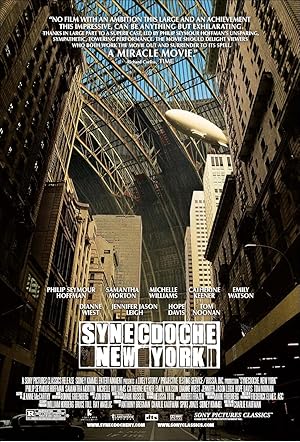
Synecdoche, New York
Theater director Caden Cotard is mounting a new play. Fresh off of a successful production of Death of a Salesman, he has traded in the suburban blue-hairs and regional theater of Schenectady for the cultured audiences and bright footlights of Broadway. Armed with a MacArthur grant and determined to create a piece of brutal realism and honesty, something into which he can put his whole self, he gathers an ensemble cast into a warehouse in Manhattan's theater district. He directs them in a celebration of the mundane, instructing each to live out their constructed lives in a small mock-up of the city outside. As the city inside the warehouse grows, Caden's own life veers wildly off the tracks. The shadow of his ex-wife Adele, a celebrated painter who left him years ago for Germany's art scene, sneers at him from every corner. Somewhere in Berlin, his daughter Olive is growing up under the questionable guidance of Adele's friend, Maria. He's helplessly driving his marriage to actress Claire into the ground. Sammy Barnathan, the actor Caden has hired to play himself within the play, is a bit too perfect for the part, and is making it difficult for Caden to revive his relationship with the alluringly candid Hazel. Meanwhile, his therapist, Madeline Gravis, is better at plugging her best-seller than she is at counselling him. His second daughter, Ariel, is disabled. And a mysterious condition is systematically shutting down each of his autonomic functions, one by one. As the years rapidly pass, Caden buries himself deeper into his masterpiece. Populating the cast and crew with doppelgangers, he steadily blurs the line between the world of the play and that of his own deteriorating reality. As he pushes the limits of his relationships, both personally and professionally, a change in creative direction arrives in Millicent Weems, a celebrated theater actress who may offer Caden the break he needs.
The film box office disappointment against its mid-range budget of $20.0M, earning $4.4M globally (-78% loss). While initial box office returns were modest, the film has gained appreciation for its unconventional structure within the drama genre.
8 wins & 29 nominations


Plot Structure
Story beats plotted across runtime


Narrative Arc
Emotional journey through the story's key moments
Story Circle
Blueprint 15-beat structure
Arcplot Score Breakdown
Weighted: Precision (70%) + Arc (15%) + Theme (15%)
Synecdoche, New York (2008) showcases precise narrative design, characteristic of Charlie Kaufman's storytelling approach. This structural analysis examines how the film's 15-point plot structure maps to proven narrative frameworks across 2 hours and 4 minutes. With an Arcplot score of 5.0, the film takes an unconventional approach to traditional narrative frameworks.
Characters
Cast & narrative archetypes

Caden Cotard
Hazel
Adele Lack
Claire Keen
Olive
Sammy Barnathan
Ellen Bascomb
Maria
Main Cast & Characters
Caden Cotard
Played by Philip Seymour Hoffman
A theater director consumed by existential dread who attempts to create a brutally honest theatrical replica of his life inside a warehouse.
Hazel
Played by Samantha Morton
A box office worker who loves Caden but settles for a life in a perpetually burning house, representing acceptance of mortality.
Adele Lack
Played by Catherine Keener
Caden's wife, a painter who leaves him to pursue her art career in Berlin, creating miniature paintings.
Claire Keen
Played by Michelle Williams
An actress in Caden's play who becomes his romantic interest and later collaborator in his increasingly elaborate production.
Olive
Played by Sadie Goldstein
Caden and Adele's daughter who grows up estranged from her father, eventually becoming tattooed and bitter.
Sammy Barnathan
Played by Tom Noonan
A man who has been following and studying Caden for 20 years, eventually hired to play Caden in his own production.
Ellen Bascomb
Played by Dianne Wiest
A mysterious woman who delivers instructions to Caden through an earpiece, directing the final phase of his life/play.
Maria
Played by Jennifer Jason Leigh
Adele's friend and confidant who helps raise Olive in Berlin, becoming a maternal figure after Adele's death.
Structural Analysis
The Status Quo at 1 minutes (1% through the runtime) establishes Caden Cotard wakes to a radio announcing the first day of fall, beginning a mundane morning routine in Schenectady. His disconnected marriage to Adele and their daughter Olive establish his emotionally isolated existence.. Notably, this early placement immediately immerses viewers in the story world.
The inciting incident occurs at 14 minutes when Adele takes Olive to Berlin for her art show and never returns, abandoning Caden. His marriage ends, his daughter is taken, and his health continues to mysteriously deteriorate with seizures and other symptoms.. At 11% through the film, this Disruption aligns precisely with traditional story structure. This beat shifts the emotional landscape, launching the protagonist into the central conflict.
The First Threshold at 28 minutes marks the transition into Act II, occurring at 23% of the runtime. This illustrates the protagonist's commitment to Caden decides to use his MacArthur grant to create an ambitious theatrical work of brutal honesty in a massive warehouse in Manhattan—a life-sized replica of New York where actors will live out their lives in perpetual rehearsal., moving from reaction to action.
At 56 minutes, the Midpoint arrives at 46% of the runtime—arriving early, accelerating into Act IIb complications. Notably, this crucial beat Caden casts Sammy Barnathan to play himself, and Sammy reveals he's been watching Caden for twenty years. The false defeat: Caden realizes someone else understands his life better than he does, and his project may be capturing something he cannot see himself., fundamentally raising what's at risk. The emotional intensity shifts, dividing the narrative into clear before-and-after phases.
The Collapse moment at 83 minutes (67% through) represents the emotional nadir. Here, Olive dies in Berlin, never having forgiven Caden for abandonment she never actually experienced. He weeps at her deathbed, apologizing for crimes he didn't commit. Every relationship has failed; his life's work remains unfinished and unperformable., reveals the protagonist at their lowest point. This beat's placement in the final quarter sets up the climactic reversal.
The Second Threshold at 89 minutes initiates the final act resolution at 72% of the runtime. Caden surrenders directorial control to Millicent, who has been playing his cleaning lady Ellen. She gives him an earpiece and begins directing him as a character in his own play, finally allowing him to stop controlling and simply exist., demonstrating the transformation achieved throughout the journey.
Emotional Journey
Synecdoche, New York's emotional architecture traces a deliberate progression across 15 carefully calibrated beats.
Narrative Framework
This structural analysis employs a 15-point narrative structure framework that maps key story moments. By mapping Synecdoche, New York against these established plot points, we can identify how Charlie Kaufman utilizes or subverts traditional narrative conventions. The plot point approach reveals not only adherence to structural principles but also creative choices that distinguish Synecdoche, New York within the drama genre.
Charlie Kaufman's Structural Approach
Among the 2 Charlie Kaufman films analyzed on Arcplot, the average structural score is 4.7, showcasing experimental approaches to narrative form. Synecdoche, New York represents one of the director's most structurally precise works. For comparative analysis, explore the complete Charlie Kaufman filmography.
Comparative Analysis
Additional drama films include After Thomas, South Pacific and Dirty Dancing: Havana Nights. For more Charlie Kaufman analyses, see I'm Thinking of Ending Things.
Plot Points by Act
Act I
SetupStatus Quo
Caden Cotard wakes to a radio announcing the first day of fall, beginning a mundane morning routine in Schenectady. His disconnected marriage to Adele and their daughter Olive establish his emotionally isolated existence.
Theme
The pastor at a funeral declares that everyone is dying, that we all share this condition from birth. This articulates the film's central meditation on mortality, authenticity, and the passage of time that haunts Caden throughout.
Worldbuilding
Caden's world is established: his deteriorating marriage to painter Adele, his hypochondria and mysterious ailments, his directing of "Death of a Salesman," his flirtation with box office attendant Hazel, and the burning house she considers buying.
Disruption
Adele takes Olive to Berlin for her art show and never returns, abandoning Caden. His marriage ends, his daughter is taken, and his health continues to mysteriously deteriorate with seizures and other symptoms.
Resistance
Caden struggles with abandonment and illness. He begins a relationship with leading lady Claire, visits various doctors who find nothing conclusive, and learns he's been awarded a MacArthur "genius grant" fellowship.
Act II
ConfrontationFirst Threshold
Caden decides to use his MacArthur grant to create an ambitious theatrical work of brutal honesty in a massive warehouse in Manhattan—a life-sized replica of New York where actors will live out their lives in perpetual rehearsal.
Mirror World
Hazel re-enters Caden's life, becoming his assistant on the warehouse project. Their unspoken love and her perpetually burning house represent the authentic connection Caden craves but cannot fully embrace, embodying the theme of lives consumed while being lived.
Premise
Caden builds his replica city, casting actors to play everyone in his life including himself. The simulation grows increasingly recursive—actors playing actors, the warehouse containing another warehouse. Years pass in montage as his real relationships with Claire and Hazel deteriorate.
Midpoint
Caden casts Sammy Barnathan to play himself, and Sammy reveals he's been watching Caden for twenty years. The false defeat: Caden realizes someone else understands his life better than he does, and his project may be capturing something he cannot see himself.
Opposition
The project spirals beyond control. Caden travels to Berlin to find Olive, now tattooed and dying, who rejects him with Adele's poisoned memories. Hazel dies in her burning house. Claire leaves. Sammy commits suicide. Everyone Caden loves disappears.
Collapse
Olive dies in Berlin, never having forgiven Caden for abandonment she never actually experienced. He weeps at her deathbed, apologizing for crimes he didn't commit. Every relationship has failed; his life's work remains unfinished and unperformable.
Crisis
Caden wanders his decaying simulation, now an old man in a dying replica of a city. He has outlived everyone—Hazel, Claire, Olive, Sammy, Adele. The project has consumed decades without ever opening. He is utterly alone.
Act III
ResolutionSecond Threshold
Caden surrenders directorial control to Millicent, who has been playing his cleaning lady Ellen. She gives him an earpiece and begins directing him as a character in his own play, finally allowing him to stop controlling and simply exist.
Synthesis
Caden becomes Ellen, cleaning houses in the simulation, following Millicent's whispered directions. He finally experiences life as someone else, living a small authentic existence instead of trying to capture the totality of life in art.
Transformation
Millicent whispers "Die" through the earpiece. Caden lies down among the ruins of his simulation and closes his eyes. The screen fades to white. He has finally stopped trying to understand life and simply surrendered to its end.