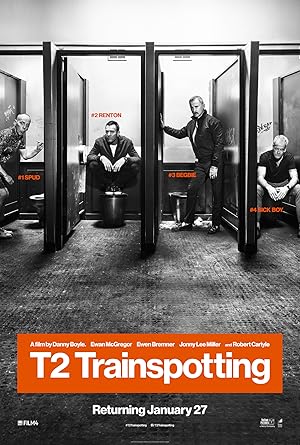
T2 Trainspotting
First there was an opportunity......then there was a betrayal. Twenty years have gone by. Much has changed but just as much remains the same. Mark Renton (Ewan McGregor) returns to the only place he can ever call home. They are waiting for him: Spud (Ewen Bremner), Sick Boy (Jonny Lee Miller), and Begbie (Robert Carlyle). Other old friends are waiting too: sorrow, loss, joy, vengeance, hatred, friendship, love, longing, fear, regret, diamorphine, self-destruction and mortal danger, they are all lined up to welcome him, ready to join the dance.
Despite a mid-range budget of $18.0M, T2 Trainspotting became a financial success, earning $41.7M worldwide—a 132% return.
6 wins & 8 nominations


Plot Structure
Story beats plotted across runtime


Narrative Arc
Emotional journey through the story's key moments
Story Circle
Blueprint 15-beat structure
Arcplot Score Breakdown
Weighted: Precision (70%) + Arc (15%) + Theme (15%)
T2 Trainspotting (2017) reveals deliberately positioned narrative architecture, characteristic of Danny Boyle's storytelling approach. This structural analysis examines how the film's 15-point plot structure maps to proven narrative frameworks across 1 hour and 57 minutes. With an Arcplot score of 7.0, the film balances conventional beats with creative variation.
Characters
Cast & narrative archetypes

Mark Renton
Simon 'Sick Boy' Williamson
Daniel 'Spud' Murphy
Francis 'Franco' Begbie
Veronika
Main Cast & Characters
Mark Renton
Played by Ewan McGregor
Returns to Edinburgh after 20 years, still running from his past and the friends he betrayed. Struggles with aging, nostalgia, and unresolved guilt.
Simon 'Sick Boy' Williamson
Played by Jonny Lee Miller
Now running his aunt's pub and blackmailing clients with his girlfriend Veronika. Bitter, manipulative, still chasing schemes while harboring deep resentment toward Renton.
Daniel 'Spud' Murphy
Played by Ewen Bremner
Still addicted, unemployed, and suicidal after losing his family. Finds purpose in writing down the stories of his friends' exploits.
Francis 'Franco' Begbie
Played by Robert Carlyle
Violent sociopath released from prison after 20 years, seeking revenge on Renton for the betrayal. Reconnects with his estranged son while plotting murder.
Veronika
Played by Anjela Nedyalkova
Sick Boy's Bulgarian girlfriend and partner in crime. Smart, ambitious, and ultimately more ruthless than Sick Boy himself.
Structural Analysis
The Status Quo at 1 minutes (1% through the runtime) establishes Mark Renton runs on a treadmill in Amsterdam, collapses from a heart attack. His seemingly successful life abroad is revealed as empty and unfulfilling—twenty years of running from his past have led nowhere.. Of particular interest, this early placement immediately immerses viewers in the story world.
The inciting incident occurs at 14 minutes when Mark finds Simon "Sick Boy" and is immediately attacked. Simon beats him savagely, releasing twenty years of rage over the betrayal. The violent reunion makes clear that Mark cannot simply slip back into his old life—the past demands a reckoning.. At 12% through the film, this Disruption aligns precisely with traditional story structure. This beat shifts the emotional landscape, launching the protagonist into the central conflict.
The First Threshold at 29 minutes marks the transition into Act II, occurring at 25% of the runtime. This illustrates the protagonist's commitment to Mark actively chooses to partner with Simon on the scheme to open a "sauna" (brothel) using EU renovation grants. This is his commitment to stay, to try rebuilding rather than running—an active choice to engage with his past rather than flee from it., moving from reaction to action.
At 59 minutes, the Midpoint arrives at 50% of the runtime—precisely centered, creating perfect narrative symmetry. The analysis reveals that this crucial beat Mark and Simon successfully secure the EU grant money for their scheme—a false victory. Everything appears to be going well; their partnership seems restored, the con is working. But this success is built on lies and avoidance; the real reckoning has only been delayed., fundamentally raising what's at risk. The emotional intensity shifts, dividing the narrative into clear before-and-after phases.
The Collapse moment at 88 minutes (75% through) represents the emotional nadir. Here, Begbie attacks Mark at Simon's flat in a terrifying home invasion. Mark is nearly killed, the violence of the past literally crashing through the door. The "whiff of death" is palpable—Begbie's murderous rage represents everything Mark tried to escape by stealing the money and fleeing., demonstrates the protagonist at their lowest point. This beat's placement in the final quarter sets up the climactic reversal.
The Second Threshold at 94 minutes initiates the final act resolution at 80% of the runtime. Mark makes the decision to stay and confront Begbie rather than flee. This time he will not run from his past. He chooses to face the consequences of his actions twenty years ago, accepting that some debts cannot be escaped—only settled., demonstrating the transformation achieved throughout the journey.
Emotional Journey
T2 Trainspotting's emotional architecture traces a deliberate progression across 15 carefully calibrated beats.
Narrative Framework
This structural analysis employs a 15-point narrative structure framework that maps key story moments. By mapping T2 Trainspotting against these established plot points, we can identify how Danny Boyle utilizes or subverts traditional narrative conventions. The plot point approach reveals not only adherence to structural principles but also creative choices that distinguish T2 Trainspotting within the comedy genre.
Danny Boyle's Structural Approach
Among the 12 Danny Boyle films analyzed on Arcplot, the average structural score is 6.6, demonstrating varied approaches to story architecture. T2 Trainspotting represents one of the director's most structurally precise works. For comparative analysis, explore the complete Danny Boyle filmography.
Comparative Analysis
Additional comedy films include The Bad Guys, Ella Enchanted and The Evening Star. For more Danny Boyle analyses, see Yesterday, Millions and Trainspotting.
Plot Points by Act
Act I
SetupStatus Quo
Mark Renton runs on a treadmill in Amsterdam, collapses from a heart attack. His seemingly successful life abroad is revealed as empty and unfulfilling—twenty years of running from his past have led nowhere.
Theme
The theme of nostalgia as a trap is established as Mark returns to Edinburgh. "You're a tourist in your own youth"—the film questions whether people can truly change or remain forever defined by their past choices.
Worldbuilding
Mark returns to Edinburgh after 20 years, visits his elderly father, discovers his childhood bedroom preserved like a museum. He learns of Tommy's death anniversary, sees how Spud is still struggling with addiction, and begins reconnecting with a city that has changed yet stayed the same.
Disruption
Mark finds Simon "Sick Boy" and is immediately attacked. Simon beats him savagely, releasing twenty years of rage over the betrayal. The violent reunion makes clear that Mark cannot simply slip back into his old life—the past demands a reckoning.
Resistance
Mark and Simon tentatively reconnect through their shared history. Meanwhile, Begbie escapes from prison, creating the ticking clock of danger. Spud continues spiraling while Mark debates whether he can actually make amends or should simply flee again.
Act II
ConfrontationFirst Threshold
Mark actively chooses to partner with Simon on the scheme to open a "sauna" (brothel) using EU renovation grants. This is his commitment to stay, to try rebuilding rather than running—an active choice to engage with his past rather than flee from it.
Mirror World
Veronika is properly introduced as Simon's Bulgarian girlfriend and partner in the blackmail scheme. She represents the possibility of genuine connection and forward movement—someone not trapped in the past, offering Mark a different lens through which to view his choices.
Premise
The "fun and games" of the premise unfold: Mark and Simon run scams together, revisit old haunts, and indulge in nostalgia. The infamous "Choose Life" speech is updated for modern times. They visit the countryside where they once used to shoot air rifles, reveling in their reconnection while ignoring deeper wounds.
Midpoint
Mark and Simon successfully secure the EU grant money for their scheme—a false victory. Everything appears to be going well; their partnership seems restored, the con is working. But this success is built on lies and avoidance; the real reckoning has only been delayed.
Opposition
Begbie discovers Mark is back in Edinburgh and begins hunting him. Simon's resentment festers beneath the surface. Spud relapses. Mark and Simon's rekindled friendship shows cracks as old betrayals resurface. Veronika becomes caught between loyalties as the schemes grow more tangled.
Collapse
Begbie attacks Mark at Simon's flat in a terrifying home invasion. Mark is nearly killed, the violence of the past literally crashing through the door. The "whiff of death" is palpable—Begbie's murderous rage represents everything Mark tried to escape by stealing the money and fleeing.
Crisis
Mark recovers from the attack while grappling with his choices. He could run again—return to Amsterdam, disappear. But Spud's writing project (turning their stories into memoirs) and Veronika's presence force Mark to confront whether he'll repeat the past or finally break the cycle.
Act III
ResolutionSecond Threshold
Mark makes the decision to stay and confront Begbie rather than flee. This time he will not run from his past. He chooses to face the consequences of his actions twenty years ago, accepting that some debts cannot be escaped—only settled.
Synthesis
The final confrontation at the nightclub where their old pub once stood. Mark and Begbie face off amidst construction scaffolding—the old world literally being rebuilt around them. Begbie falls, is arrested. The money matters less than the resolution: Mark has stopped running.
Transformation
Mark returns to his childhood bedroom, puts on "Lust for Life," and dances alone. Unlike the opening where he ran on a treadmill going nowhere, he now moves freely in the space of his past. He has chosen life—not by escaping his history, but by finally facing it.