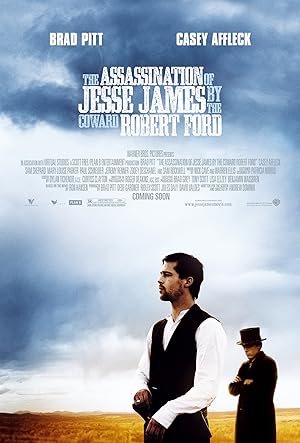
The Assassination of Jesse James by the Coward Robert Ford
Taking place in Missouri in the early 1880s, the film dramatizes the last seven months in the life of famed outlaw Jesse James, beginning with the Blue Cut train robbery of 1881 and culminating in his assassination at the hands of Robert Ford the following April. In the time between these two fateful events, the young and jealous Ford befriends the increasingly mistrustful outlaw, even as he plots his demise.
The film box office disappointment against its moderate budget of $30.0M, earning $14.7M globally (-51% loss). While initial box office returns were modest, the film has gained appreciation for its innovative storytelling within the biography genre.
Nominated for 2 Oscars. 25 wins & 69 nominations


Plot Structure
Story beats plotted across runtime


Narrative Arc
Emotional journey through the story's key moments
Story Circle
Blueprint 15-beat structure
Arcplot Score Breakdown
Weighted: Precision (70%) + Arc (15%) + Theme (15%)
The Assassination of Jesse James by the Coward Robert Ford (2007) exemplifies precise dramatic framework, characteristic of Andrew Dominik's storytelling approach. This structural analysis examines how the film's 15-point plot structure maps to proven narrative frameworks across 2 hours and 39 minutes. With an Arcplot score of 7.4, the film balances conventional beats with creative variation.
Characters
Cast & narrative archetypes

Robert Ford
Jesse James
Charley Ford
Dick Liddil
Wood Hite
Frank James
Zee James
Main Cast & Characters
Robert Ford
Played by Casey Affleck
A young, insecure admirer of Jesse James who seeks glory and becomes his eventual assassin.
Jesse James
Played by Brad Pitt
The legendary and increasingly paranoid outlaw leader living his final months.
Charley Ford
Played by Sam Rockwell
Robert's older brother who joins the James gang and participates in Jesse's assassination.
Dick Liddil
Played by Paul Schneider
A member of the James gang involved in internal conflicts and betrayals.
Wood Hite
Played by Jeremy Renner
Jesse's cousin and gang member who becomes involved in deadly internal disputes.
Frank James
Played by Sam Shepard
Jesse's older brother and fellow outlaw who eventually leaves the gang.
Zee James
Played by Mary-Louise Parker
Jesse's devoted wife who tries to maintain a normal family life.
Structural Analysis
The Status Quo at 2 minutes (1% through the runtime) establishes Robert Ford idolizes Jesse James from afar, reading dime novels about his exploits. The opening narration establishes Bob as a starstruck young man obsessed with the legendary outlaw, dreaming of joining his gang.. Of particular interest, this early placement immediately immerses viewers in the story world.
The inciting incident occurs at 19 minutes when The Blue Cut train robbery goes awry. The violence and chaos shatter Bob's romantic notions. Jesse's brutal, unpredictable nature becomes evident, and the gang begins to fracture under pressure from law enforcement and Jesse's paranoia.. At 12% through the film, this Disruption aligns precisely with traditional story structure. This beat shifts the emotional landscape, launching the protagonist into the central conflict.
The First Threshold at 39 minutes marks the transition into Act II, occurring at 25% of the runtime. This illustrates the protagonist's commitment to Bob makes the choice to stay close to Jesse, moving into his house with his brother Charley. This decision commits him to a path that will lead to intimacy with his idol but also to deadly consequences. He enters Jesse's private world., moving from reaction to action.
At 80 minutes, the Midpoint arrives at 50% of the runtime—precisely centered, creating perfect narrative symmetry. Significantly, this crucial beat Jesse confronts Bob about his loyalty and intentions in an intense, psychologically threatening encounter. Bob realizes Jesse suspects him and that his life is in danger. The power dynamic shifts—Bob's worship turns to fear and resentment. The stakes become life and death., fundamentally raising what's at risk. The emotional intensity shifts, dividing the narrative into clear before-and-after phases.
The Collapse moment at 119 minutes (75% through) represents the emotional nadir. Here, Bob fully accepts that he must kill Jesse James. His idol worship dies. This represents the death of Bob's innocent dreams and his transformation into the very thing he feared: a traitor and killer. The decision is made., illustrates the protagonist at their lowest point. This beat's placement in the final quarter sets up the climactic reversal.
The Second Threshold at 127 minutes initiates the final act resolution at 80% of the runtime. Jesse, in a moment that suggests he knows what's coming, removes his guns and turns his back to Bob. Bob understands this is his moment. The synthesis: Bob must become the coward the title names him to free himself from Jesse's shadow., demonstrating the transformation achieved throughout the journey.
Emotional Journey
The Assassination of Jesse James by the Coward Robert Ford's emotional architecture traces a deliberate progression across 15 carefully calibrated beats.
Narrative Framework
This structural analysis employs systematic plot point analysis that identifies crucial turning points. By mapping The Assassination of Jesse James by the Coward Robert Ford against these established plot points, we can identify how Andrew Dominik utilizes or subverts traditional narrative conventions. The plot point approach reveals not only adherence to structural principles but also creative choices that distinguish The Assassination of Jesse James by the Coward Robert Ford within the biography genre.
Andrew Dominik's Structural Approach
Among the 2 Andrew Dominik films analyzed on Arcplot, the average structural score is 7.4, reflecting strong command of classical structure. The Assassination of Jesse James by the Coward Robert Ford exemplifies the director's characteristic narrative technique. For comparative analysis, explore the complete Andrew Dominik filmography.
Comparative Analysis
Additional biography films include After Thomas, Taking Woodstock and The Fire Inside. For more Andrew Dominik analyses, see Killing Them Softly.
Plot Points by Act
Act I
SetupStatus Quo
Robert Ford idolizes Jesse James from afar, reading dime novels about his exploits. The opening narration establishes Bob as a starstruck young man obsessed with the legendary outlaw, dreaming of joining his gang.
Theme
Conversations among the gang members hint at the theme of hero worship versus reality. The gap between Jesse's mythic reputation and his paranoid, deteriorating reality is introduced through dialogue about trust and betrayal.
Worldbuilding
Introduction to Jesse James' world in 1881 Missouri. Bob Ford ingratiates himself with Jesse's gang. We see Jesse's paranoia, his deteriorating relationships with longtime gang members, and Bob's nervous excitement at being near his idol. The world of outlaws on the run is established.
Disruption
The Blue Cut train robbery goes awry. The violence and chaos shatter Bob's romantic notions. Jesse's brutal, unpredictable nature becomes evident, and the gang begins to fracture under pressure from law enforcement and Jesse's paranoia.
Resistance
Bob struggles with the reality of outlaw life versus his fantasies. Jesse begins to suspect and test Bob. The gang disperses. Bob debates whether to stay close to Jesse or distance himself. Jesse's mental state deteriorates as he becomes increasingly isolated and suspicious.
Act II
ConfrontationFirst Threshold
Bob makes the choice to stay close to Jesse, moving into his house with his brother Charley. This decision commits him to a path that will lead to intimacy with his idol but also to deadly consequences. He enters Jesse's private world.
Mirror World
Bob develops a complex relationship with Jesse that mirrors his internal conflict. Jesse becomes both mentor and tormentor. Their relationship embodies the theme: the destruction that occurs when idol meets worshipper, when myth confronts reality.
Premise
Bob lives in Jesse's shadow, experiencing both the intimacy he craved and the psychological torture of Jesse's paranoia. The promise of the premise: a character study of two men bound by fame, obsession, and inevitable betrayal. Jesse's deterioration accelerates.
Midpoint
Jesse confronts Bob about his loyalty and intentions in an intense, psychologically threatening encounter. Bob realizes Jesse suspects him and that his life is in danger. The power dynamic shifts—Bob's worship turns to fear and resentment. The stakes become life and death.
Opposition
Bob is trapped between his fear of Jesse and his inability to leave. Jesse's paranoia intensifies, killing former gang members. Bob and Charley are approached by authorities. The psychological pressure mounts as Bob realizes killing Jesse may be his only way out.
Collapse
Bob fully accepts that he must kill Jesse James. His idol worship dies. This represents the death of Bob's innocent dreams and his transformation into the very thing he feared: a traitor and killer. The decision is made.
Crisis
Bob and Charley plan the assassination. Bob grapples with what he's about to do—kill his hero. The emotional weight of betrayal and the darkness of his choice permeate this section. Bob steels himself for the act.
Act III
ResolutionSecond Threshold
Jesse, in a moment that suggests he knows what's coming, removes his guns and turns his back to Bob. Bob understands this is his moment. The synthesis: Bob must become the coward the title names him to free himself from Jesse's shadow.
Synthesis
Bob shoots Jesse James. The immediate aftermath and Bob's attempt to claim fame as Jesse's killer. Bob stages a theatrical reenactment of the murder, seeking the celebrity he craved. Instead, he's vilified as a coward and traitor, haunted by guilt and public scorn.
Transformation
Bob Ford is killed by someone seeking to avenge Jesse James. He dies as he lived—in Jesse's shadow. The final image shows Bob achieved infamy, not glory. He became the coward of legend, forever defined by the man he murdered, his identity consumed by Jesse's myth.