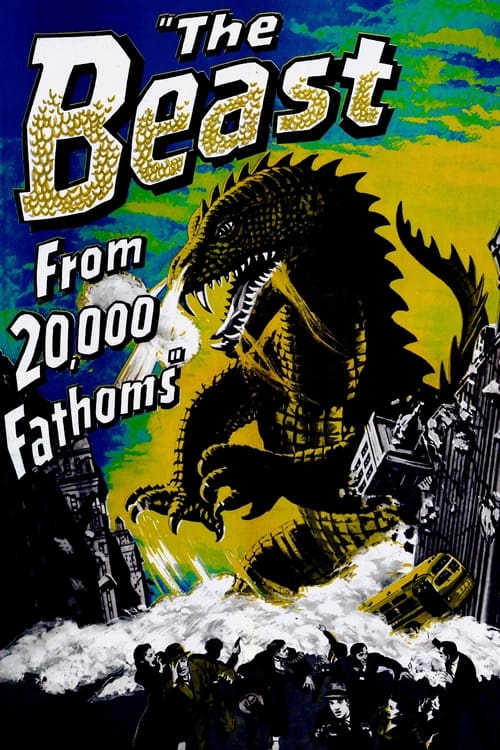
The Beast from 20,000 Fathoms
The controlled explosion of an atomic bomb in the Arctic Circle awakens a frozen dinosaur that will wreak havoc in New York City.
Despite its minimal budget of $210K, The Beast from 20,000 Fathoms became a massive hit, earning $5.0M worldwide—a remarkable 2281% return. The film's distinctive approach found its audience, demonstrating that strong storytelling can transcend budget limitations.


Plot Structure
Story beats plotted across runtime


Narrative Arc
Emotional journey through the story's key moments
Story Circle
Blueprint 15-beat structure
Arcplot Score Breakdown
Weighted: Precision (70%) + Arc (15%) + Theme (15%)
The Beast from 20,000 Fathoms (1953) exemplifies strategically placed dramatic framework, characteristic of Eugène Lourié's storytelling approach. This structural analysis examines how the film's 15-point plot structure maps to proven narrative frameworks across 1 hour and 20 minutes. With an Arcplot score of 6.8, the film balances conventional beats with creative variation.
Characters
Cast & narrative archetypes

Professor Tom Nesbitt
Lee Hunter
Professor Thurgood Elson
Colonel Jack Evans
Main Cast & Characters
Professor Tom Nesbitt
Played by Paul Hubschmid
A paleontologist who witnesses the thawed prehistoric beast and struggles to convince authorities of the threat
Lee Hunter
Played by Paula Raymond
A resourceful assistant who aids Nesbitt in his investigation and serves as his romantic interest
Professor Thurgood Elson
Played by Cecil Kellaway
A renowned paleontologist who provides expertise and initially dismisses Nesbitt's claims
Colonel Jack Evans
Played by Kenneth Tobey
A military officer who coordinates the defense response once the threat is confirmed
Structural Analysis
The Status Quo at 1 minutes (1% through the runtime) establishes Operation Experiment opens in the Arctic as scientists conduct atomic bomb tests, establishing the Cold War scientific world of nuclear testing and military operations.. Of particular interest, this early placement immediately immerses viewers in the story world.
The inciting incident occurs at 10 minutes when Following the atomic blast, Tom Nesbitt encounters the massive Rhedosaurus emerging from the ice. His colleague is killed in an avalanche triggered by the creature, and Tom is buried, left as the sole witness.. At 12% through the film, this Disruption aligns precisely with traditional story structure. This beat shifts the emotional landscape, launching the protagonist into the central conflict.
The First Threshold at 20 minutes marks the transition into Act II, occurring at 25% of the runtime. This reveals the protagonist's commitment to Tom actively seeks out paleontologist Thurgood Elson and his assistant Lee Hunter at the museum, choosing to pursue the truth despite ridicule. He commits to proving the creature's existence., moving from reaction to action.
At 40 minutes, the Midpoint arrives at 50% of the runtime—precisely centered, creating perfect narrative symmetry. Notably, this crucial beat Professor Elson encounters the Rhedosaurus underwater in his diving bell. The creature attacks and kills him—the first major on-screen death proving the beast's existence but at a devastating cost. The stakes become undeniably real., fundamentally raising what's at risk. The emotional intensity shifts, dividing the narrative into clear before-and-after phases.
The Collapse moment at 60 minutes (75% through) represents the emotional nadir. Here, The military's assault wounds the beast but releases its infectious blood into the streets. Soldiers fall ill and die from the ancient disease. Shooting the creature will only spread more plague—the situation seems hopeless., illustrates the protagonist at their lowest point. This beat's placement in the final quarter sets up the climactic reversal.
The Second Threshold at 64 minutes initiates the final act resolution at 80% of the runtime. Tom conceives the plan: use a radioactive isotope in a rifle grenade to destroy the beast from within. The same atomic science that awakened the creature will now be used precisely to destroy it—science redeemed through targeted application., demonstrating the transformation achieved throughout the journey.
Emotional Journey
The Beast from 20,000 Fathoms's emotional architecture traces a deliberate progression across 15 carefully calibrated beats.
Narrative Framework
This structural analysis employs structural analysis methodology used to understand storytelling architecture. By mapping The Beast from 20,000 Fathoms against these established plot points, we can identify how Eugène Lourié utilizes or subverts traditional narrative conventions. The plot point approach reveals not only adherence to structural principles but also creative choices that distinguish The Beast from 20,000 Fathoms within the drama genre.
Comparative Analysis
Additional drama films include After Thomas, South Pacific and Dirty Dancing: Havana Nights.
Plot Points by Act
Act I
SetupStatus Quo
Operation Experiment opens in the Arctic as scientists conduct atomic bomb tests, establishing the Cold War scientific world of nuclear testing and military operations.
Theme
A colleague warns about the unknown consequences of atomic power, stating that man cannot predict what forces he unleashes—foreshadowing the prehistoric terror that nuclear testing will awaken.
Worldbuilding
The Arctic expedition is established with its military and scientific personnel. Tom Nesbitt and his team monitor the atomic test. The detonation sequence shows the power and reach of nuclear weapons in the frozen landscape.
Disruption
Following the atomic blast, Tom Nesbitt encounters the massive Rhedosaurus emerging from the ice. His colleague is killed in an avalanche triggered by the creature, and Tom is buried, left as the sole witness.
Resistance
Tom recovers in a hospital where no one believes his account of the creature. Doctors suggest he hallucinated due to trauma. Reports of ship attacks along the Atlantic coast begin to surface, but authorities dismiss any connection.
Act II
ConfrontationFirst Threshold
Tom actively seeks out paleontologist Thurgood Elson and his assistant Lee Hunter at the museum, choosing to pursue the truth despite ridicule. He commits to proving the creature's existence.
Mirror World
Lee Hunter becomes Tom's ally and romantic interest. Her belief in him and scientific approach represents faith balanced with reason—the thematic counterpoint to blind skepticism and unchecked atomic ambition.
Premise
The investigation unfolds as Tom and Lee track sightings along the coast. Survivors identify the Rhedosaurus from sketches. Professor Elson becomes convinced and descends in a diving bell to find proof, delivering the promise of monster-hunt suspense.
Midpoint
Professor Elson encounters the Rhedosaurus underwater in his diving bell. The creature attacks and kills him—the first major on-screen death proving the beast's existence but at a devastating cost. The stakes become undeniably real.
Opposition
The beast surfaces in New York harbor and rampages through Manhattan. Military attempts to stop it fail; conventional weapons prove useless. Worse, the creature's blood carries a deadly prehistoric pathogen that infects anyone exposed.
Collapse
The military's assault wounds the beast but releases its infectious blood into the streets. Soldiers fall ill and die from the ancient disease. Shooting the creature will only spread more plague—the situation seems hopeless.
Crisis
New York is paralyzed with the beast loose and conventional options exhausted. Tom and the military brass desperately search for a solution that can kill the creature without spreading its toxic blood throughout the city.
Act III
ResolutionSecond Threshold
Tom conceives the plan: use a radioactive isotope in a rifle grenade to destroy the beast from within. The same atomic science that awakened the creature will now be used precisely to destroy it—science redeemed through targeted application.
Synthesis
The beast takes refuge in the Coney Island amusement park. Tom and sharpshooter Corporal Stone ascend the roller coaster to get a clear shot. In a tense climax amid the burning rides, Stone fires the isotope into the creature's wound.
Transformation
The Rhedosaurus collapses and dies as the roller coaster burns around it. Tom, once dismissed as delusional, stands validated. The atomic age's terror is conquered—not by brute force but by scientific precision and human courage.