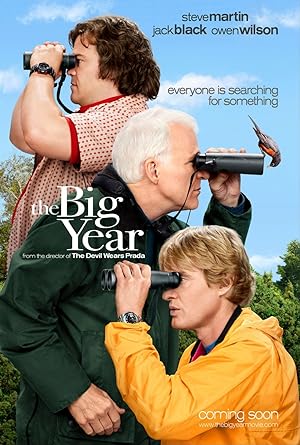
The Big Year
In birding, a Big Year is seeing or hearing as many different species of birds as possible in a calendar year. Three men pursue the Birder of the Year title: Kenny Bostick, who's seen a record 732 in a past big year, Stu Preissler, newly retired, and Brad Harris, who narrates the story. Life gets in the way: Bostick's wife wants a baby, Stu's firm needs him for sensitive negotiations, and Brad, divorced and underemployed at 36, has an encouraging mom and a disapproving dad. They criss-cross the continent (including a trip to Alaska's westernmost island), follow migration patterns, and head for storms that force birds to ground. Who will win, at what cost, and with what rewards?
The film box office disappointment against its respectable budget of $41.0M, earning $8.2M globally (-80% loss). While initial box office returns were modest, the film has gained appreciation for its unique voice within the comedy genre.


Plot Structure
Story beats plotted across runtime


Narrative Arc
Emotional journey through the story's key moments
Story Circle
Blueprint 15-beat structure
Arcplot Score Breakdown
Weighted: Precision (70%) + Arc (15%) + Theme (15%)
The Big Year (2011) showcases carefully calibrated narrative architecture, characteristic of David Frankel's storytelling approach. This structural analysis examines how the film's 15-point plot structure maps to proven narrative frameworks across 1 hour and 42 minutes. With an Arcplot score of 7.4, the film balances conventional beats with creative variation.
Characters
Cast & narrative archetypes

Brad Harris
Stu Preissler
Kenny Bostick
Ellie
Edith Preissler
Jessica Bostick
Main Cast & Characters
Brad Harris
Played by Jack Black
A hyper-competitive businessman and reigning birding champion determined to defend his Big Year record at any cost.
Stu Preissler
Played by Steve Martin
A retired executive pursuing his passion for birding while navigating family obligations and finding new purpose in life.
Kenny Bostick
Played by Owen Wilson
The reigning Big Year champion, a ruthless and obsessive birder willing to sacrifice everything to maintain his record.
Ellie
Played by Rashida Jones
Brad's supportive girlfriend who struggles with his obsessive birding commitment throughout the year.
Edith Preissler
Played by JoBeth Williams
Stu's loving wife who supports his birding dreams while dealing with family concerns.
Jessica Bostick
Played by Rosamund Pike
Kenny's wife who becomes increasingly frustrated with his obsessive birding and absence from their marriage.
Structural Analysis
The Status Quo at 1 minutes (1% through the runtime) establishes Brad Harris works at a nuclear power plant, dreams of birding while stuck in his ordinary corporate life. Stu Preissler is a successful CEO. Kenny Bostick defends his birding record. All three live lives defined by their current status - work, success, and achievement.. Of particular interest, this early placement immediately immerses viewers in the story world.
The inciting incident occurs at 11 minutes when January 1st arrives - the official start of a new Big Year. The calendar creates the disruption: all three men face the opportunity to attempt the record. This external event (the annual reset) disrupts their status quo and presents the challenge.. At 11% through the film, this Disruption aligns precisely with traditional story structure. This beat shifts the emotional landscape, launching the protagonist into the central conflict.
The First Threshold at 25 minutes marks the transition into Act II, occurring at 24% of the runtime. This demonstrates the protagonist's commitment to Brad quits his job to pursue the Big Year full-time. Stu commits to retirement and the competition. Kenny recommits despite his wife's unhappiness. All three make active, irreversible choices to enter the competitive birding world fully, leaving their safe ordinary worlds behind., moving from reaction to action.
At 51 minutes, the Midpoint arrives at 50% of the runtime—precisely centered, creating perfect narrative symmetry. Structural examination shows that this crucial beat Kenny (the defending champion) realizes Brad and Stu are legitimate threats to his record. He escalates tactics, lying and manipulating to maintain his lead. False defeat for our protagonists - they realize Kenny will do anything to win, and the fun competition becomes serious and cutthroat. Stakes raise significantly., fundamentally raising what's at risk. The emotional intensity shifts, dividing the narrative into clear before-and-after phases.
The Collapse moment at 75 minutes (73% through) represents the emotional nadir. Here, Brad's father has a heart attack, and Brad must choose between a crucial rare bird sighting and being with his father. The "whiff of death" is literal. Brad misses the bird to be with family. Stu similarly abandons the competition when his son needs him. Their dreams die., reveals the protagonist at their lowest point. This beat's placement in the final quarter sets up the climactic reversal.
The Second Threshold at 81 minutes initiates the final act resolution at 80% of the runtime. Brad and Stu realize that what they gained - friendship, adventure, and perspective on what matters - is more valuable than the record. They synthesis the Mirror World lesson (connection) with their original passion (birding) and see clearly: the journey and relationships were the real prize., demonstrating the transformation achieved throughout the journey.
Emotional Journey
The Big Year's emotional architecture traces a deliberate progression across 15 carefully calibrated beats.
Narrative Framework
This structural analysis employs proven narrative structure principles that track dramatic progression. By mapping The Big Year against these established plot points, we can identify how David Frankel utilizes or subverts traditional narrative conventions. The plot point approach reveals not only adherence to structural principles but also creative choices that distinguish The Big Year within the comedy genre.
David Frankel's Structural Approach
Among the 5 David Frankel films analyzed on Arcplot, the average structural score is 7.3, reflecting strong command of classical structure. The Big Year represents one of the director's most structurally precise works. For comparative analysis, explore the complete David Frankel filmography.
Comparative Analysis
Additional comedy films include The Bad Guys, Ella Enchanted and The Evening Star. For more David Frankel analyses, see Marley & Me, Collateral Beauty and One Chance.
Plot Points by Act
Act I
SetupStatus Quo
Brad Harris works at a nuclear power plant, dreams of birding while stuck in his ordinary corporate life. Stu Preissler is a successful CEO. Kenny Bostick defends his birding record. All three live lives defined by their current status - work, success, and achievement.
Theme
A character mentions that birding is about "what you're willing to sacrifice" - establishing the central thematic question about what we give up in pursuit of our obsessions and whether victory is worth the cost.
Worldbuilding
Introduction to the world of competitive birding and "The Big Year" competition. We meet all three protagonists in their ordinary worlds: Brad constrained by work, Stu by business obligations, Kenny by his need to maintain his record. The rules and culture of extreme birding are established.
Disruption
January 1st arrives - the official start of a new Big Year. The calendar creates the disruption: all three men face the opportunity to attempt the record. This external event (the annual reset) disrupts their status quo and presents the challenge.
Resistance
Brad debates whether to commit fully, facing resistance from his boss and practical concerns. Stu wrestles with retiring to pursue birding. Kenny debates defending his title. Each character has internal debate periods, mentors (other birders), and preparation montages as they gear up.
Act II
ConfrontationFirst Threshold
Brad quits his job to pursue the Big Year full-time. Stu commits to retirement and the competition. Kenny recommits despite his wife's unhappiness. All three make active, irreversible choices to enter the competitive birding world fully, leaving their safe ordinary worlds behind.
Mirror World
Brad and Stu form an unlikely friendship and alliance. This relationship subplot carries the theme - their camaraderie shows that connection and support matter more than solitary victory. The friendship will test whether competition must destroy relationships.
Premise
The promise of the premise: watching extreme competitive birding. Comic montages of the three men chasing rare birds across North America, from Alaska to Texas. Exotic locations, near-misses, triumphs, and the absurd lengths birders go to. The fun competition escalates.
Midpoint
Kenny (the defending champion) realizes Brad and Stu are legitimate threats to his record. He escalates tactics, lying and manipulating to maintain his lead. False defeat for our protagonists - they realize Kenny will do anything to win, and the fun competition becomes serious and cutthroat. Stakes raise significantly.
Opposition
The costs mount. Brad's girlfriend grows distant. Stu's son needs him but he chooses birding. Kenny's marriage crumbles. The obsession takes over, relationships suffer, and the pursuit becomes increasingly lonely and destructive. The opposition is their own obsession and Kenny's ruthlessness.
Collapse
Brad's father has a heart attack, and Brad must choose between a crucial rare bird sighting and being with his father. The "whiff of death" is literal. Brad misses the bird to be with family. Stu similarly abandons the competition when his son needs him. Their dreams die.
Crisis
Brad and Stu process their losses and what they've sacrificed. They sit with the realization that they won't break the record, won't achieve their goal. Meanwhile Kenny, still competing alone, faces his own dark reality: his wife leaves him, and his victory is hollow.
Act III
ResolutionSecond Threshold
Brad and Stu realize that what they gained - friendship, adventure, and perspective on what matters - is more valuable than the record. They synthesis the Mirror World lesson (connection) with their original passion (birding) and see clearly: the journey and relationships were the real prize.
Synthesis
The finale: December 31st arrives. Kenny breaks his own record but sits alone. Brad reconnects with his girlfriend and family with new appreciation. Stu bonds with his son through birding. They resolve their character arcs not through victory but through transformation and choosing relationships over obsession.
Transformation
Brad birds casually with his girlfriend, enjoying the moment without obsession. Stu birds with his son, building connection. Kenny stands alone with his record but no one to share it with. The closing images mirror the opening but show transformation: Brad and Stu chose life over achievement and are fulfilled.