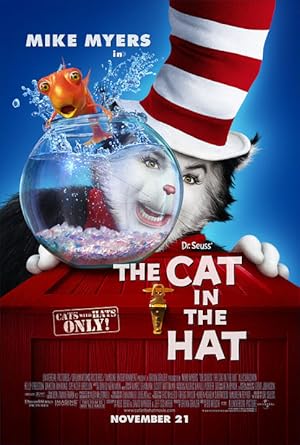
The Cat in the Hat
Conrad and Sally Walden (Spencer Breslin and Dakota Fanning) are home alone with their pet fish. It is raining outside, and there is nothing to do. Until The Cat in the Hat ('Mike Myers') walks in the front door. He introduces them to their imagination, and at first it's all fun and games, until things get out of hand, and The Cat must go, go, go, before their mother gets back, but their pompous neighbor has bigger plans for them.
Working with a substantial budget of $109.0M, the film achieved a respectable showing with $133.8M in global revenue (+23% profit margin).
7 wins & 22 nominations


Plot Structure
Story beats plotted across runtime


Narrative Arc
Emotional journey through the story's key moments
Story Circle
Blueprint 15-beat structure
Arcplot Score Breakdown
Weighted: Precision (70%) + Arc (15%) + Theme (15%)
The Cat in the Hat (2003) demonstrates strategically placed plot construction, characteristic of Bo Welch's storytelling approach. This structural analysis examines how the film's 15-point plot structure maps to proven narrative frameworks across 1 hour and 21 minutes. With an Arcplot score of 7.1, the film balances conventional beats with creative variation.
Characters
Cast & narrative archetypes

The Cat
Conrad
Sally
Joan Walden
Larry Quinn
Thing One
Thing Two
Main Cast & Characters
The Cat
Played by Mike Myers
A mischievous, chaotic magical cat who arrives to entertain two bored children and wreaks havoc in their home.
Conrad
Played by Spencer Breslin
A rebellious, imaginative 12-year-old boy who breaks rules and yearns for his absent father's approval.
Sally
Played by Dakota Fanning
Conrad's rule-following, responsible younger sister who tries to maintain order and keep things clean.
Joan Walden
Played by Kelly Preston
The children's stressed, overworked single mother who is a real estate agent preparing for an important party.
Larry Quinn
Played by Alec Baldwin
Joan's sleazy, controlling neighbor who wants to marry her and send Conrad to military school.
Thing One
Played by Dan Castellaneta
One of the Cat's diminutive, destructive helpers who speaks in high-pitched gibberish and causes chaos.
Thing Two
Played by Dan Castellaneta
The Cat's second helper, identical to Thing One, equally mischievous and chaotic.
Structural Analysis
The Status Quo at 1 minutes (1% through the runtime) establishes The pristine, overly controlled Walden household is established. Sally is the perfect rule-follower while Conrad is the troublemaker who can't stay out of mischief, with their exhausted single mother Joan struggling to keep order.. Of particular interest, this early placement immediately immerses viewers in the story world.
The inciting incident occurs at 10 minutes when The Cat in the Hat suddenly appears at the door on a rainy day while the children are left home alone with the fish. His chaotic, magical presence immediately upends the orderly household.. At 12% through the film, this Disruption aligns precisely with traditional story structure. This beat shifts the emotional landscape, launching the protagonist into the central conflict.
The First Threshold at 21 minutes marks the transition into Act II, occurring at 25% of the runtime. This demonstrates the protagonist's commitment to Conrad and Sally agree to let the Cat show them how to have fun, signing his contract. This is their active choice to embrace chaos and enter the Cat's world of consequence-free mischief., moving from reaction to action.
At 40 minutes, the Midpoint arrives at 49% of the runtime—precisely centered, creating perfect narrative symmetry. The analysis reveals that this crucial beat The Cat's magical crate is opened and its lock—the only thing keeping the chaos contained—is lost. The purple pollution begins spreading from the crate, threatening to consume the house and potentially the world. The stakes become catastrophically real., fundamentally raising what's at risk. The emotional intensity shifts, dividing the narrative into clear before-and-after phases.
The Collapse moment at 60 minutes (75% through) represents the emotional nadir. Here, The Cat admits he cannot fix what's been broken. The house is completely destroyed, the crate's chaos is about to explode, Joan is moments from arriving home, and Larry has the evidence he needs. Conrad faces being sent to military school and losing his family forever., demonstrates the protagonist at their lowest point. This beat's placement in the final quarter sets up the climactic reversal.
The Second Threshold at 65 minutes initiates the final act resolution at 80% of the runtime. Conrad realizes that he must take responsibility for his choices—combining the fun he's learned with genuine accountability. He finds the lock and chooses to fix the mess himself rather than relying on the Cat's magic., demonstrating the transformation achieved throughout the journey.
Emotional Journey
The Cat in the Hat's emotional architecture traces a deliberate progression across 15 carefully calibrated beats.
Narrative Framework
This structural analysis employs a 15-point narrative structure framework that maps key story moments. By mapping The Cat in the Hat against these established plot points, we can identify how Bo Welch utilizes or subverts traditional narrative conventions. The plot point approach reveals not only adherence to structural principles but also creative choices that distinguish The Cat in the Hat within the adventure genre.
Comparative Analysis
Additional adventure films include The Black Stallion, The Bad Guys and Puss in Boots.
Plot Points by Act
Act I
SetupStatus Quo
The pristine, overly controlled Walden household is established. Sally is the perfect rule-follower while Conrad is the troublemaker who can't stay out of mischief, with their exhausted single mother Joan struggling to keep order.
Theme
Joan tells the children they need to learn balance—that there's a time for fun and a time for responsibility. This establishes the film's central theme about finding harmony between order and chaos.
Worldbuilding
We meet the Walden family: overworked real estate agent Joan, rule-obsessed Sally, rebellious Conrad, and the scheming neighbor Larry Quinn who wants to marry Joan and send Conrad to military school. The stakes are set when Joan announces her important work party that evening.
Disruption
The Cat in the Hat suddenly appears at the door on a rainy day while the children are left home alone with the fish. His chaotic, magical presence immediately upends the orderly household.
Resistance
The Cat introduces himself and his brand of chaotic fun. Sally is resistant and suspicious while Conrad is intrigued. The Fish warns them repeatedly about the dangers of trusting the Cat. The children debate whether to let him stay or kick him out.
Act II
ConfrontationFirst Threshold
Conrad and Sally agree to let the Cat show them how to have fun, signing his contract. This is their active choice to embrace chaos and enter the Cat's world of consequence-free mischief.
Mirror World
Thing One and Thing Two are released from their crate, representing pure unbridled chaos. Their relationship with the children mirrors the theme—showing what happens when fun has absolutely no boundaries or responsibility.
Premise
The fun and games unfold as the Cat leads the children through increasingly wild adventures: the cupcake-making machine disaster, jumping on the couch, and exploring the magical crate that contains entire worlds. The house progressively descends into chaos.
Midpoint
The Cat's magical crate is opened and its lock—the only thing keeping the chaos contained—is lost. The purple pollution begins spreading from the crate, threatening to consume the house and potentially the world. The stakes become catastrophically real.
Opposition
The children must find the lock while avoiding Larry Quinn who is searching for evidence to get Conrad sent away. The Cat's magic begins failing, the house destruction worsens, and the purple chaos grows. Joan's party approaches and everything spirals further out of control.
Collapse
The Cat admits he cannot fix what's been broken. The house is completely destroyed, the crate's chaos is about to explode, Joan is moments from arriving home, and Larry has the evidence he needs. Conrad faces being sent to military school and losing his family forever.
Crisis
Conrad and Sally process their failure. Sally blames Conrad, Conrad accepts responsibility for once. The Cat prepares to leave, seemingly abandoning them. The Fish laments that he warned them all along. All hope appears lost.
Act III
ResolutionSecond Threshold
Conrad realizes that he must take responsibility for his choices—combining the fun he's learned with genuine accountability. He finds the lock and chooses to fix the mess himself rather than relying on the Cat's magic.
Synthesis
Conrad locks the crate, reversing the chaos. The Cat reveals his cleaning machine and the house is magically restored just before Joan arrives. Larry's schemes are exposed when the Dog reveals his true nature. The family is saved and Larry is defeated.
Transformation
The house is perfect again, but the children have transformed. Sally has learned to embrace appropriate fun and spontaneity, Conrad has learned responsibility. Joan sees her children working together happily. The Cat departs with a knowing wink, his lesson complete.