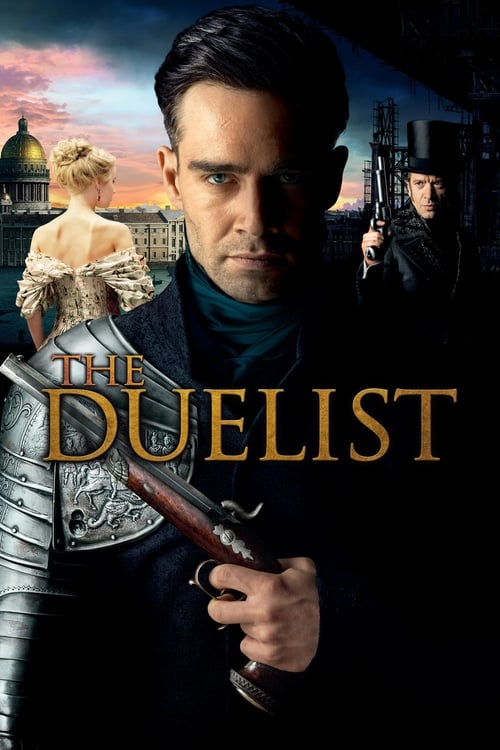
The Duelist
Returning to Saint Petersburg after a long exile, the dashing Yakovlev, a retired army officer, makes a comfortable living by winning other people's duels. An enigmatic, focused, and extremely skilled professional, he leaves a trail of dead bodies behind him as he swirls through polite society, frequently called upon to wield a pistol as a surrogate in duels at dawn. But when Yakovlev meets the naïve young Prince Tuchov and his beautiful sister, Princess Martha, the normally cold-hearted mercenary is surprised by hitherto undetected emotions. What transpires uncovers a series of revelations about his past and his present self.
The film commercial failure against its limited budget of $12.8M, earning $6.1M globally (-52% loss). While initial box office returns were modest, the film has gained appreciation for its innovative storytelling within the adventure genre.
9 wins & 11 nominations


Plot Structure
Story beats plotted across runtime


Narrative Arc
Emotional journey through the story's key moments
Story Circle
Blueprint 15-beat structure
Arcplot Score Breakdown
Weighted: Precision (70%) + Arc (15%) + Theme (15%)
The Duelist (2016) exemplifies carefully calibrated dramatic framework, characteristic of Aleksei Mizgiryov's storytelling approach. This structural analysis examines how the film's 15-point plot structure maps to proven narrative frameworks across 1 hour and 50 minutes. With an Arcplot score of 6.9, the film balances conventional beats with creative variation.
Characters
Cast & narrative archetypes

Yakovlev
Countess Martha
Count Beklemishev
Prince Tuchkov
Shvetsov
Main Cast & Characters
Yakovlev
Played by Petr Fedorov
A skilled retired duelist drawn back into the world of honor combat to investigate suspicious deaths in St. Petersburg high society.
Countess Martha
Played by Yuliya Khlynina
A mysterious and elegant noblewoman connected to the dueling conspiracy who becomes romantically involved with Yakovlev.
Count Beklemishev
Played by Vladimir Mashkov
A wealthy and cunning aristocrat manipulating duels for his own agenda, serving as the primary antagonist.
Prince Tuchkov
Played by Sergey Garmash
A high-ranking official who recruits Yakovlev to investigate the mysterious deaths in society.
Shvetsov
Played by Aleksandr Robak
Yakovlev's loyal friend and former military companion who assists in the investigation.
Structural Analysis
The Status Quo at 1 minutes (1% through the runtime) establishes Yakovlev arrives in the shadowy, rain-soaked streets of 19th century St. Petersburg, a solitary figure haunted by his past, establishing himself as a man living in moral darkness and isolation.. Structural examination shows that this early placement immediately immerses viewers in the story world.
The inciting incident occurs at 13 minutes when Yakovlev is approached by the sinister Count Beklemishev with a proposition that promises wealth and restored status, but requires him to become entangled in a conspiracy involving the Tuchkov family.. At 12% through the film, this Disruption aligns precisely with traditional story structure. This beat shifts the emotional landscape, launching the protagonist into the central conflict.
The First Threshold at 28 minutes marks the transition into Act II, occurring at 25% of the runtime. This demonstrates the protagonist's commitment to Yakovlev accepts Beklemishev's assignment and deliberately provokes Prince Tuchkov into a duel, committing himself fully to the conspiracy and crossing an irreversible moral threshold., moving from reaction to action.
At 55 minutes, the Midpoint arrives at 50% of the runtime—precisely centered, creating perfect narrative symmetry. Structural examination shows that this crucial beat Martha and Yakovlev consummate their relationship, a false victory where love seems to offer escape from his dark path. However, this connection now makes him vulnerable and complicates his mission for Beklemishev., fundamentally raising what's at risk. The emotional intensity shifts, dividing the narrative into clear before-and-after phases.
The Collapse moment at 83 minutes (75% through) represents the emotional nadir. Here, Martha discovers Yakovlev's true role in the conspiracy against her family. She rejects him completely, and Yakovlev finds himself alone, having lost the only person who made him feel human. His hope for redemption through love appears destroyed., indicates the protagonist at their lowest point. This beat's placement in the final quarter sets up the climactic reversal.
The Second Threshold at 88 minutes initiates the final act resolution at 80% of the runtime. Yakovlev chooses to turn against Beklemishev and expose the conspiracy, accepting that he may die in the process. He challenges Beklemishev to a duel, fighting not for money but for true honor for the first time., demonstrating the transformation achieved throughout the journey.
Emotional Journey
The Duelist's emotional architecture traces a deliberate progression across 15 carefully calibrated beats.
Narrative Framework
This structural analysis employs structural analysis methodology used to understand storytelling architecture. By mapping The Duelist against these established plot points, we can identify how Aleksei Mizgiryov utilizes or subverts traditional narrative conventions. The plot point approach reveals not only adherence to structural principles but also creative choices that distinguish The Duelist within the adventure genre.
Comparative Analysis
Additional adventure films include The Black Stallion, The Bad Guys and Puss in Boots.
Plot Points by Act
Act I
SetupStatus Quo
Yakovlev arrives in the shadowy, rain-soaked streets of 19th century St. Petersburg, a solitary figure haunted by his past, establishing himself as a man living in moral darkness and isolation.
Theme
A character observes that honor can be bought and sold like any commodity in this corrupt society, stating the film's central theme about the nature of true honor versus its hollow performance.
Worldbuilding
The aristocratic world of Imperial Russia is established through Yakovlev's work as a professional duelist. We see the corrupt social hierarchy, the rigid codes of honor, and Yakovlev's methodical, emotionless approach to his deadly trade as he fights duels on behalf of wealthy clients.
Disruption
Yakovlev is approached by the sinister Count Beklemishev with a proposition that promises wealth and restored status, but requires him to become entangled in a conspiracy involving the Tuchkov family.
Resistance
Yakovlev debates whether to take Beklemishev's offer, weighing his desperate circumstances against his instincts that something is wrong. He learns more about the Tuchkov family and begins to understand the scope of the conspiracy he would be joining.
Act II
ConfrontationFirst Threshold
Yakovlev accepts Beklemishev's assignment and deliberately provokes Prince Tuchkov into a duel, committing himself fully to the conspiracy and crossing an irreversible moral threshold.
Mirror World
Yakovlev encounters Princess Martha Tuchkova, the sister of his intended victim. Their immediate, electric connection introduces the love story that will challenge his mercenary worldview and offer a path to redemption.
Premise
Yakovlev navigates the dangerous world of aristocratic intrigue while his relationship with Martha deepens. He continues his work as a duelist while secretly falling in love, experiencing the tension between his deadly profession and his awakening humanity.
Midpoint
Martha and Yakovlev consummate their relationship, a false victory where love seems to offer escape from his dark path. However, this connection now makes him vulnerable and complicates his mission for Beklemishev.
Opposition
Beklemishev tightens his grip on Yakovlev, demanding he complete his assignment against the Tuchkovs. Yakovlev's attempts to protect Martha while satisfying his employer become increasingly impossible. The conspiracy's true scope is revealed, showing Beklemishev's ruthless ambition.
Collapse
Martha discovers Yakovlev's true role in the conspiracy against her family. She rejects him completely, and Yakovlev finds himself alone, having lost the only person who made him feel human. His hope for redemption through love appears destroyed.
Crisis
Yakovlev spirals into despair, confronting the emptiness of his existence. He must face who he has become and decide whether to continue as Beklemishev's pawn or risk everything to make things right, even if Martha can never forgive him.
Act III
ResolutionSecond Threshold
Yakovlev chooses to turn against Beklemishev and expose the conspiracy, accepting that he may die in the process. He challenges Beklemishev to a duel, fighting not for money but for true honor for the first time.
Synthesis
The climactic duel between Yakovlev and Beklemishev unfolds with deadly intensity. Yakovlev uses all his skills not as a mercenary but as a man fighting for justice. The conspiracy is exposed, and the Tuchkov family is saved from ruin.
Transformation
Yakovlev, wounded but victorious, stands in the light of dawn. Martha approaches him, offering the possibility of forgiveness. The man who once dealt in false honor has finally found the real thing through sacrifice and love.