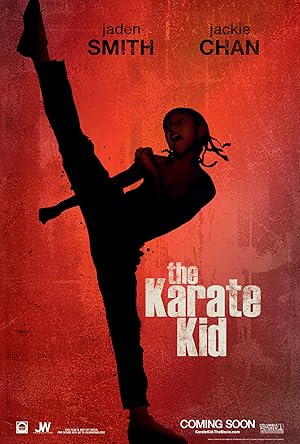
The Karate Kid
12-year-old Dre Parker has moved to China, and finds himself like a fish out of water. He befriends a fellow classmate, Mei Ying, only to make a rival, Cheng, who starts to bully and attack Dre. Soon, Mr Han, the maintenance man of Dre's apartment, fends off Cheng and his friends when they are attacking Dre and signs Dre up to fight in the Kung Fu tournament in return for the bullies laying off of Dre. Dre realizes Mr. Han is much more than a maintenance man, when he's revealed as a master of Kung Fu and Dre soon learns that Kung Fu is about self defense and peace, instead of violence and bloodshed.
Despite a mid-range budget of $40.0M, The Karate Kid became a massive hit, earning $359.1M worldwide—a remarkable 798% return.
5 wins & 12 nominations


Plot Structure
Story beats plotted across runtime


Narrative Arc
Emotional journey through the story's key moments
Story Circle
Blueprint 15-beat structure
Arcplot Score Breakdown
Weighted: Precision (70%) + Arc (15%) + Theme (15%)
The Karate Kid (2010) demonstrates deliberately positioned narrative architecture, characteristic of Harald Zwart's storytelling approach. This structural analysis examines how the film's 15-point plot structure maps to proven narrative frameworks across 2 hours and 20 minutes. With an Arcplot score of 7.7, the film showcases strong structural fundamentals.
Structural Analysis
The Status Quo at 2 minutes (1% through the runtime) establishes Dre Parker plays basketball with friends in Detroit, establishing his ordinary life before the move. He's carefree, confident in his familiar world.. Notably, this early placement immediately immerses viewers in the story world.
The inciting incident occurs at 17 minutes when Dre is brutally attacked by Cheng and his kung fu gang after connecting with Mei Ying. This violence shatters his sense of safety and reveals he's completely unprepared for this new world.. At 12% through the film, this Disruption aligns precisely with traditional story structure. This beat shifts the emotional landscape, launching the protagonist into the central conflict.
The First Threshold at 35 minutes marks the transition into Act II, occurring at 25% of the runtime. This shows the protagonist's commitment to Dre actively chooses to beg Mr. Han to train him after witnessing Han's mastery at the kung fu school. He commits to whatever it takes, entering the world of disciplined training., moving from reaction to action.
At 70 minutes, the Midpoint arrives at 50% of the runtime—precisely centered, creating perfect narrative symmetry. Structural examination shows that this crucial beat False victory: Dre realizes the jacket training was kung fu all along - he can defend himself. Han reveals the tournament. Stakes raise as Dre commits to compete against Cheng., fundamentally raising what's at risk. The emotional intensity shifts, dividing the narrative into clear before-and-after phases.
The Collapse moment at 103 minutes (74% through) represents the emotional nadir. Here, Dre's leg is deliberately broken by Cheng during the tournament semifinal. He cannot continue - the dream appears dead. Contains literal "whiff of death" for his tournament hopes., reveals the protagonist at their lowest point. This beat's placement in the final quarter sets up the climactic reversal.
The Second Threshold at 111 minutes initiates the final act resolution at 79% of the runtime. Mr. Han performs fire cupping/healing technique on Dre's leg. New information: ancient healing combined with Dre's inner strength allows him to continue. Han reminds him of his inner power., demonstrating the transformation achieved throughout the journey.
Emotional Journey
The Karate Kid's emotional architecture traces a deliberate progression across 15 carefully calibrated beats.
Narrative Framework
This structural analysis employs proven narrative structure principles that track dramatic progression. By mapping The Karate Kid against these established plot points, we can identify how Harald Zwart utilizes or subverts traditional narrative conventions. The plot point approach reveals not only adherence to structural principles but also creative choices that distinguish The Karate Kid within the action genre.
Harald Zwart's Structural Approach
Among the 6 Harald Zwart films analyzed on Arcplot, the average structural score is 7.0, demonstrating varied approaches to story architecture. The Karate Kid represents one of the director's most structurally precise works. For comparative analysis, explore the complete Harald Zwart filmography.
Comparative Analysis
Additional action films include The Bad Guys, Puss in Boots and Venom: The Last Dance. For more Harald Zwart analyses, see One Night at McCool's, Agent Cody Banks and The 12th Man.
Plot Points by Act
Act I
SetupStatus Quo
Dre Parker plays basketball with friends in Detroit, establishing his ordinary life before the move. He's carefree, confident in his familiar world.
Theme
Dre's mother tells him "You can be anything you want to be" and that change brings opportunity. This establishes the theme of transformation through adversity.
Worldbuilding
Setup of Dre's life in Detroit, his relationship with his mother, the announcement of moving to China, arrival in Beijing, culture shock, and initial isolation in a foreign land.
Disruption
Dre is brutally attacked by Cheng and his kung fu gang after connecting with Mei Ying. This violence shatters his sense of safety and reveals he's completely unprepared for this new world.
Resistance
Dre debates how to handle the bullying, attempts to learn kung fu from videos, gets beaten again, and resists when Mr. Han intervenes. He's not ready to commit to real training yet.
Act II
ConfrontationFirst Threshold
Dre actively chooses to beg Mr. Han to train him after witnessing Han's mastery at the kung fu school. He commits to whatever it takes, entering the world of disciplined training.
Mirror World
Mr. Han becomes Dre's mentor and father figure. Their relationship carries the theme - Han teaches that kung fu is about inner peace and maturity, not violence.
Premise
The training montage and philosophy lessons: jacket on/off, washing the car, the promise of the premise. Dre learns discipline, discovers kung fu through unconventional methods, and grows stronger.
Midpoint
False victory: Dre realizes the jacket training was kung fu all along - he can defend himself. Han reveals the tournament. Stakes raise as Dre commits to compete against Cheng.
Opposition
Training intensifies but problems mount: Mei Ying's parents forbid their relationship, Dre sneaks out and betrays Han's trust, Cheng and his teacher become more threatening. Everything gets harder.
Collapse
Dre's leg is deliberately broken by Cheng during the tournament semifinal. He cannot continue - the dream appears dead. Contains literal "whiff of death" for his tournament hopes.
Crisis
Dark night: Dre processes the devastating injury backstage. He wants to quit. This is his darkest moment, sitting in pain and defeat.
Act III
ResolutionSecond Threshold
Mr. Han performs fire cupping/healing technique on Dre's leg. New information: ancient healing combined with Dre's inner strength allows him to continue. Han reminds him of his inner power.
Synthesis
The finale: Dre returns to fight the final match against Cheng on one leg. He synthesizes everything Han taught him - technique, inner peace, and the cobra strike - to win the tournament.
Transformation
Dre stands victorious, lifted by the crowd with Mei Ying and his mother watching proudly. Mirrors the opening - but now he's confident, disciplined, and has earned respect through inner strength.