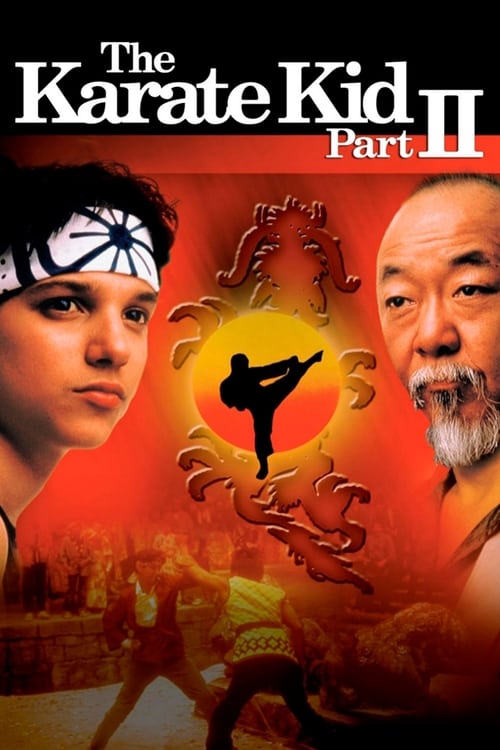
The Karate Kid Part II
Summoned by his dying father, Miyagi returns to his homeland of Okinawa, with Daniel, after a 40-year exile. There he must confront Yukie, the love of his youth, and Sato, his former best friend turned vengeful rival. Sato is bent on a fight to the death, even if it means the destruction of their village. Daniel finds his own love in Yukia's niece, Kumiko, and his own enemy in Sato's nephew, the vicious Chozen. Now, far away from the tournaments, cheering crowds and safety of home, Daniel will face his greatest challenge ever when the cost of honor is life itself.
Despite its modest budget of $13.0M, The Karate Kid Part II became a box office phenomenon, earning $115.1M worldwide—a remarkable 785% return. The film's unique voice resonated with audiences, proving that strong storytelling can transcend budget limitations.
Nominated for 1 Oscar. 4 wins & 3 nominations


Plot Structure
Story beats plotted across runtime


Narrative Arc
Emotional journey through the story's key moments
Story Circle
Blueprint 15-beat structure
Arcplot Score Breakdown
Weighted: Precision (70%) + Arc (15%) + Theme (15%)
The Karate Kid Part II (1986) exhibits precise narrative design, characteristic of John G. Avildsen's storytelling approach. This structural analysis examines how the film's 15-point plot structure maps to proven narrative frameworks across 1 hour and 53 minutes. With an Arcplot score of 7.8, the film showcases strong structural fundamentals.
Structural Analysis
The Status Quo at 2 minutes (2% through the runtime) establishes Daniel and Miyagi watch the All Valley Tournament aftermath in the parking lot. Daniel is victorious but Kreese attacks Johnny for losing, establishing the mentor-student bond and Daniel's new confident status quo.. Significantly, this early placement immediately immerses viewers in the story world.
The inciting incident occurs at 12 minutes when Miyagi and Daniel arrive in Okinawa, but they are too late - Miyagi's father has already died. The emotional weight of unresolved reconciliation and cultural displacement hits.. At 11% through the film, this Disruption aligns precisely with traditional story structure. This beat shifts the emotional landscape, launching the protagonist into the central conflict.
The First Threshold at 28 minutes marks the transition into Act II, occurring at 25% of the runtime. This shows the protagonist's commitment to Miyagi refuses to fight Sato despite threats and intimidation. He chooses honor and peace over violence, accepting potential consequences. This choice thrusts both him and Daniel deeper into the conflict with Sato and his nephew Chozen., moving from reaction to action.
At 57 minutes, the Midpoint arrives at 50% of the runtime—precisely centered, creating perfect narrative symmetry. Structural examination shows that this crucial beat The O-Bon festival celebration. Daniel and Chozen have a confrontation during the ice-breaking ceremony. Chozen publicly humiliates Daniel by breaking the ice Daniel was supposed to break, raising the stakes and intensifying the antagonism., fundamentally raising what's at risk. The emotional intensity shifts, dividing the narrative into clear before-and-after phases.
The Collapse moment at 82 minutes (73% through) represents the emotional nadir. Here, During the typhoon, Sato is trapped under a wooden beam and faces death. This is the symbolic death moment - the death of the old grudge, old honor code, and old hatred that has driven the conflict., illustrates the protagonist at their lowest point. This beat's placement in the final quarter sets up the climactic reversal.
The Second Threshold at 88 minutes initiates the final act resolution at 78% of the runtime. Daniel realizes he must face Chozen alone to save Kumiko. Armed with Miyagi's lessons about fighting only when necessary and the ceremonial drum technique Miyagi taught him, Daniel chooses to fight for love, not ego., demonstrating the transformation achieved throughout the journey.
Emotional Journey
The Karate Kid Part II's emotional architecture traces a deliberate progression across 15 carefully calibrated beats.
Narrative Framework
This structural analysis employs proven narrative structure principles that track dramatic progression. By mapping The Karate Kid Part II against these established plot points, we can identify how John G. Avildsen utilizes or subverts traditional narrative conventions. The plot point approach reveals not only adherence to structural principles but also creative choices that distinguish The Karate Kid Part II within the adventure genre.
John G. Avildsen's Structural Approach
Among the 10 John G. Avildsen films analyzed on Arcplot, the average structural score is 7.0, reflecting strong command of classical structure. The Karate Kid Part II represents one of the director's most structurally precise works. For comparative analysis, explore the complete John G. Avildsen filmography.
Comparative Analysis
Additional adventure films include The Black Stallion, The Bad Guys and Puss in Boots. For more John G. Avildsen analyses, see For Keeps, Rocky and 8 Seconds.
Plot Points by Act
Act I
SetupStatus Quo
Daniel and Miyagi watch the All Valley Tournament aftermath in the parking lot. Daniel is victorious but Kreese attacks Johnny for losing, establishing the mentor-student bond and Daniel's new confident status quo.
Theme
Miyagi receives a letter about his dying father. The theme of honor, family obligation, and confronting the past is introduced when Miyagi must return to Okinawa.
Worldbuilding
Setup of Miyagi and Daniel's life in California, Miyagi's emotional burden about his father, the revelation of Miyagi's past love Yukie, and Daniel's decision to accompany Miyagi to Okinawa for support.
Disruption
Miyagi and Daniel arrive in Okinawa, but they are too late - Miyagi's father has already died. The emotional weight of unresolved reconciliation and cultural displacement hits.
Resistance
Miyagi navigates his hometown, reconnects with Yukie (his lost love), and introduces Daniel to Okinawan culture. Tension builds as Sato (Miyagi's former best friend and rival) appears, demanding the death match Miyagi avoided decades ago.
Act II
ConfrontationFirst Threshold
Miyagi refuses to fight Sato despite threats and intimidation. He chooses honor and peace over violence, accepting potential consequences. This choice thrusts both him and Daniel deeper into the conflict with Sato and his nephew Chozen.
Mirror World
Daniel meets Kumiko, Yukie's niece, who becomes his romantic interest and thematic mirror. She represents the beauty of Okinawan culture and the possibility of peace and love amid conflict.
Premise
Daniel explores Okinawa with Kumiko, learning traditional dance and customs. Chozen escalates harassment, challenging Daniel repeatedly. The fun of cultural discovery is contrasted with mounting threats from Chozen and pressure from Sato on Miyagi.
Midpoint
The O-Bon festival celebration. Daniel and Chozen have a confrontation during the ice-breaking ceremony. Chozen publicly humiliates Daniel by breaking the ice Daniel was supposed to break, raising the stakes and intensifying the antagonism.
Opposition
Sato escalates by threatening Yukie's property and livelihood. Chozen becomes more violent and dangerous. A typhoon hits Okinawa, creating a natural disaster that forces everyone to confront what truly matters beyond honor duels.
Collapse
During the typhoon, Sato is trapped under a wooden beam and faces death. This is the symbolic death moment - the death of the old grudge, old honor code, and old hatred that has driven the conflict.
Crisis
Miyagi chooses to save Sato's life despite their death match agreement. Sato experiences shame and gratitude, leading to reconciliation. However, Chozen refuses to accept peace and becomes the true antagonist, kidnapping Kumiko.
Act III
ResolutionSecond Threshold
Daniel realizes he must face Chozen alone to save Kumiko. Armed with Miyagi's lessons about fighting only when necessary and the ceremonial drum technique Miyagi taught him, Daniel chooses to fight for love, not ego.
Synthesis
The final confrontation at the village festival. Daniel fights Chozen in a life-or-death battle, using the drum technique and everything Miyagi taught him. Daniel defeats Chozen by showing mercy, honking Chozen's nose instead of delivering a killing blow - choosing honor over vengeance.
Transformation
Daniel and Kumiko embrace as the village celebrates. Miyagi and Yukie reunite. The closing image shows reconciliation, love triumphant, and Daniel transformed from a boy seeking validation into a man who understands true honor and the karate way of peace.