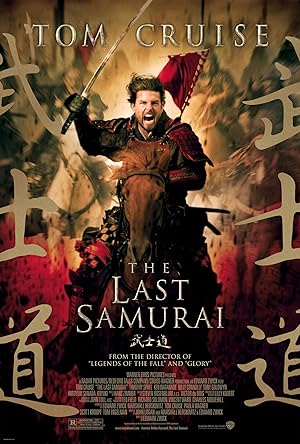
The Last Samurai
In the 1870s, Captain Nathan Algren (Tom Cruise), a cynical veteran of the American Civil War, who will work for anyone, is hired by Americans who want lucrative contracts with the Emperor of Japan to train the peasant conscripts for the first standing Imperial Army in modern warfare using firearms. The Imperial Omura (Masato Harada) cabinet's first priority is to repress a rebellion of traditionalist Samurai, hereditary warriors, who remain devoted to the sacred dynasty, but reject the Westernizing policy, and even refuse firearms. Yet, when his ill-prepared superior force sets out too soon, their panic allows the sword-wielding samurai to crush them. Badly wounded, Algren's courageous stand makes the samurai leader Katsumoto (Ken Watanabe) spare his life. Once nursed to health, he learns to know and respect the old Japanese way, and participates as advisor in Katsumoto's failed attempt to save the Bushido tradition, but Omura gets repressive laws enacted. He must now choose to honor his loyalty to one of the embittered sides when the conflict returns to the battlefield.
Despite a considerable budget of $140.0M, The Last Samurai became a financial success, earning $456.8M worldwide—a 226% return.
Nominated for 4 Oscars. 20 wins & 67 nominations


Plot Structure
Story beats plotted across runtime


Narrative Arc
Emotional journey through the story's key moments
Story Circle
Blueprint 15-beat structure
Arcplot Score Breakdown
Weighted: Precision (70%) + Arc (15%) + Theme (15%)
The Last Samurai (2003) exhibits carefully calibrated dramatic framework, characteristic of Edward Zwick's storytelling approach. This structural analysis examines how the film's 15-point plot structure maps to proven narrative frameworks across 2 hours and 34 minutes. With an Arcplot score of 6.7, the film balances conventional beats with creative variation.
Structural Analysis
The Status Quo at 2 minutes (1% through the runtime) establishes Algren is a broken, alcoholic war veteran haunted by nightmares of the massacre at Washita River. He performs humiliating demonstrations selling Winchester rifles, drowning his guilt and trauma in whiskey.. Structural examination shows that this early placement immediately immerses viewers in the story world.
The inciting incident occurs at 18 minutes when Algren accepts the job to go to Japan and train the Imperial Army to fight the samurai rebellion, setting him on a collision course with Katsumoto and the old ways of Japan.. At 12% through the film, this Disruption aligns precisely with traditional story structure. This beat shifts the emotional landscape, launching the protagonist into the central conflict.
The First Threshold at 39 minutes marks the transition into Act II, occurring at 25% of the runtime. This reveals the protagonist's commitment to In the disastrous Battle of the Foggy Forest, Algren's untrained troops are slaughtered. Algren fights valiantly but is captured by Katsumoto, who is intrigued by his warrior spirit. Algren crosses into the samurai world as a prisoner., moving from reaction to action.
At 77 minutes, the Midpoint arrives at 50% of the runtime—precisely centered, creating perfect narrative symmetry. Notably, this crucial beat Algren finally defeats Ujo in a sword training match, demonstrating his mastery and acceptance into the samurai way. He has transformed from prisoner to respected warrior. Katsumoto acknowledges him as a true student of the sword., fundamentally raising what's at risk. The emotional intensity shifts, dividing the narrative into clear before-and-after phases.
The Collapse moment at 116 minutes (75% through) represents the emotional nadir. Here, Katsumoto's son Nobutada is killed during their escape from Tokyo, sacrificing himself so his father can live. The death devastates Katsumoto and Algren, representing the inevitable destruction of the samurai way., illustrates the protagonist at their lowest point. This beat's placement in the final quarter sets up the climactic reversal.
The Second Threshold at 123 minutes initiates the final act resolution at 80% of the runtime. Algren fully commits to fighting alongside the samurai in their final battle, donning the armor of Taka's deceased husband. He has synthesized his warrior skills with the samurai code of honor, choosing to die with purpose rather than live without it., demonstrating the transformation achieved throughout the journey.
Emotional Journey
The Last Samurai's emotional architecture traces a deliberate progression across 15 carefully calibrated beats.
Narrative Framework
This structural analysis employs structural analysis methodology used to understand storytelling architecture. By mapping The Last Samurai against these established plot points, we can identify how Edward Zwick utilizes or subverts traditional narrative conventions. The plot point approach reveals not only adherence to structural principles but also creative choices that distinguish The Last Samurai within the action genre.
Edward Zwick's Structural Approach
Among the 10 Edward Zwick films analyzed on Arcplot, the average structural score is 6.8, demonstrating varied approaches to story architecture. The Last Samurai takes a more unconventional approach compared to the director's typical style. For comparative analysis, explore the complete Edward Zwick filmography.
Comparative Analysis
Additional action films include The Bad Guys, Puss in Boots and Venom: The Last Dance. For more Edward Zwick analyses, see Courage Under Fire, Jack Reacher: Never Go Back and The Siege.
Plot Points by Act
Act I
SetupStatus Quo
Algren is a broken, alcoholic war veteran haunted by nightmares of the massacre at Washita River. He performs humiliating demonstrations selling Winchester rifles, drowning his guilt and trauma in whiskey.
Theme
Omura's translator states that Japan is a nation seeking its soul, mirroring Algren's own search for redemption. The theme of finding one's true self through honor is introduced.
Worldbuilding
Algren's desperate circumstances are established: his alcoholism, his trauma from the Indian Wars, his resentment toward Colonel Bagley. He accepts the offer to train the Emperor's army in Japan for money, arriving in a nation torn between tradition and modernization.
Disruption
Algren accepts the job to go to Japan and train the Imperial Army to fight the samurai rebellion, setting him on a collision course with Katsumoto and the old ways of Japan.
Resistance
Algren arrives in Japan and begins training peasant conscripts. He observes Japanese culture with growing interest. Despite his warnings that the troops aren't ready, Omura forces them into battle against the samurai.
Act II
ConfrontationFirst Threshold
In the disastrous Battle of the Foggy Forest, Algren's untrained troops are slaughtered. Algren fights valiantly but is captured by Katsumoto, who is intrigued by his warrior spirit. Algren crosses into the samurai world as a prisoner.
Mirror World
Algren awakens in the mountain village, placed in the home of Taka, whose husband he killed in battle. Through Katsumoto and the village, Algren encounters a world built on honor, discipline, and spiritual purpose—everything his life lacks.
Premise
Algren immerses himself in samurai culture through the winter months. He trains in swordsmanship, learns Japanese, studies Bushido, and gradually earns the respect of the villagers. His nightmares begin to fade as he finds peace in their disciplined way of life.
Midpoint
Algren finally defeats Ujo in a sword training match, demonstrating his mastery and acceptance into the samurai way. He has transformed from prisoner to respected warrior. Katsumoto acknowledges him as a true student of the sword.
Opposition
Katsumoto travels to Tokyo to petition the Emperor, with Algren accompanying him. Omura's forces attempt to assassinate Katsumoto. Political pressure mounts as the Emperor, manipulated by Omura, orders Katsumoto to disband. The modern army grows stronger with new weapons.
Collapse
Katsumoto's son Nobutada is killed during their escape from Tokyo, sacrificing himself so his father can live. The death devastates Katsumoto and Algren, representing the inevitable destruction of the samurai way.
Crisis
The samurai return to the village to mourn and prepare for their final stand. Katsumoto grieves his son. Algren and Taka share a moment of connection. Both know the coming battle will likely mean death for all.
Act III
ResolutionSecond Threshold
Algren fully commits to fighting alongside the samurai in their final battle, donning the armor of Taka's deceased husband. He has synthesized his warrior skills with the samurai code of honor, choosing to die with purpose rather than live without it.
Synthesis
The final battle unfolds. The samurai use brilliant tactics against the modern army, but are ultimately overwhelmed by Gatling guns. Katsumoto commits seppuku with Algren's help, finding his perfect death. Algren survives and presents Katsumoto's sword to the Emperor, who rejects Omura's treaty.
Transformation
Algren returns to the mountain village to be with Taka. The haunted, alcoholic soldier has been transformed into a man of peace and honor. He has found redemption by embracing a way of life worth dying for—and living for.