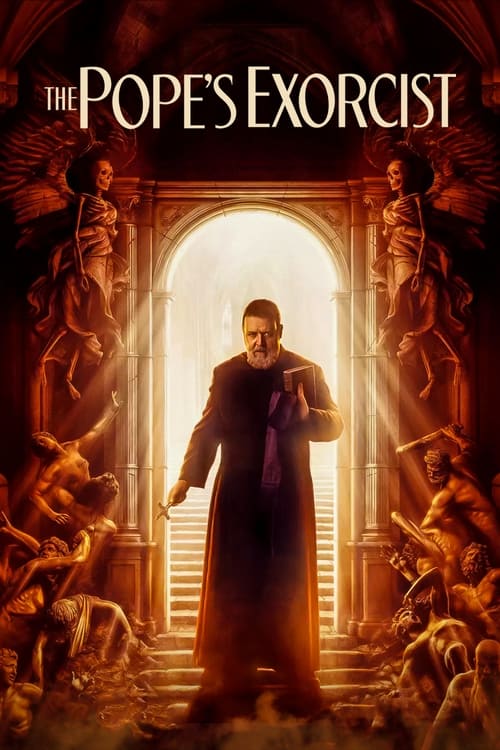
The Pope's Exorcist
Father Gabriele Amorth, Chief Exorcist of the Vatican, investigates a young boy's terrifying possession and ends up uncovering a centuries-old conspiracy the Vatican has desperately tried to keep hidden.
Despite a moderate budget of $18.0M, The Pope's Exorcist became a financial success, earning $77.0M worldwide—a 328% return.
1 win & 3 nominations


Plot Structure
Story beats plotted across runtime


Narrative Arc
Emotional journey through the story's key moments
Story Circle
Blueprint 15-beat structure
Arcplot Score Breakdown
Weighted: Precision (70%) + Arc (15%) + Theme (15%)
The Pope's Exorcist (2023) exemplifies carefully calibrated plot construction, characteristic of Julius Avery's storytelling approach. This structural analysis examines how the film's 15-point plot structure maps to proven narrative frameworks across 1 hour and 43 minutes. With an Arcplot score of 7.2, the film balances conventional beats with creative variation.
Structural Analysis
The Status Quo at 1 minutes (1% through the runtime) establishes Father Gabriele Amorth confidently performs an exorcism in Italy, riding his Vespa and showcasing his unorthodox methods as the Vatican's Chief Exorcist, respected yet rebellious.. Notably, this early placement immediately immerses viewers in the story world.
The inciting incident occurs at 12 minutes when Amorth is assigned to accompany Father Esquibel to Spain to investigate the case of a possessed boy, Henry, at an old abbey. The Church wants to discredit the case, but Amorth senses something genuinely dark.. At 11% through the film, this Disruption aligns precisely with traditional story structure. This beat shifts the emotional landscape, launching the protagonist into the central conflict.
The First Threshold at 25 minutes marks the transition into Act II, occurring at 25% of the runtime. This demonstrates the protagonist's commitment to Amorth decides to perform the exorcism on Henry despite the danger and the Church's desire to dismiss the case. He commits to battle this demon, which reveals itself to be far more powerful than expected., moving from reaction to action.
At 51 minutes, the Midpoint arrives at 49% of the runtime—precisely centered, creating perfect narrative symmetry. Structural examination shows that this crucial beat The demon reveals itself as Asmodeus, a King of Hell, and demonstrates its true power by possessing Julia. The stakes raise dramatically: this isn't just about saving Henry, but stopping a demon king's plan involving the Spanish Inquisition's sins., fundamentally raising what's at risk. The emotional intensity shifts, dividing the narrative into clear before-and-after phases.
The Collapse moment at 76 minutes (74% through) represents the emotional nadir. Here, The demon possesses Amorth himself, forcing him to confront his darkest secret: innocent people died because of his actions during the war. He faces spiritual death, losing his faith and connection to God in his moment of greatest shame., shows the protagonist at their lowest point. This beat's placement in the final quarter sets up the climactic reversal.
The Second Threshold at 82 minutes initiates the final act resolution at 80% of the runtime. Amorth accepts God's forgiveness and forgives himself, breaking free from possession. He realizes the demon's power comes from feeding on unconfessed sins and guilt. With renewed faith and Esquibel's help, he knows how to defeat Asmodeus., demonstrating the transformation achieved throughout the journey.
Emotional Journey
The Pope's Exorcist's emotional architecture traces a deliberate progression across 15 carefully calibrated beats.
Narrative Framework
This structural analysis employs proven narrative structure principles that track dramatic progression. By mapping The Pope's Exorcist against these established plot points, we can identify how Julius Avery utilizes or subverts traditional narrative conventions. The plot point approach reveals not only adherence to structural principles but also creative choices that distinguish The Pope's Exorcist within the horror genre.
Julius Avery's Structural Approach
Among the 2 Julius Avery films analyzed on Arcplot, the average structural score is 6.8, demonstrating varied approaches to story architecture. The Pope's Exorcist represents one of the director's most structurally precise works. For comparative analysis, explore the complete Julius Avery filmography.
Comparative Analysis
Additional horror films include Thinner, A Nightmare on Elm Street and Mary Reilly. For more Julius Avery analyses, see Overlord.
Plot Points by Act
Act I
SetupStatus Quo
Father Gabriele Amorth confidently performs an exorcism in Italy, riding his Vespa and showcasing his unorthodox methods as the Vatican's Chief Exorcist, respected yet rebellious.
Theme
During confession, someone tells Amorth that God works through flawed vessels. The film's theme: faith requires confronting one's own darkness and past sins to truly serve God.
Worldbuilding
Establish Amorth's world at the Vatican, his relationship with the Church hierarchy who doubt exorcism, his friendship with the Pope, and introduction to Father Esquibel, a skeptical young priest sent to investigate a possession in Spain.
Disruption
Amorth is assigned to accompany Father Esquibel to Spain to investigate the case of a possessed boy, Henry, at an old abbey. The Church wants to discredit the case, but Amorth senses something genuinely dark.
Resistance
Journey to Spain and investigation of the abbey. Amorth meets the American family, interviews young Henry, and discovers the possession is real and powerful. Esquibel remains skeptical, debating the nature of evil and possession.
Act II
ConfrontationFirst Threshold
Amorth decides to perform the exorcism on Henry despite the danger and the Church's desire to dismiss the case. He commits to battle this demon, which reveals itself to be far more powerful than expected.
Mirror World
Amorth bonds with Henry's mother Julia and begins mentoring the skeptical Esquibel, who represents doubt versus faith. Their growing partnership will teach Amorth that he cannot face this evil alone or hide from his past.
Premise
The exorcism battle intensifies. Amorth confronts the demon possessing Henry, which demonstrates shocking power and knowledge. The demon taunts Amorth about his past and reveals the possession is connected to the abbey's dark history and a much larger demonic plan.
Midpoint
The demon reveals itself as Asmodeus, a King of Hell, and demonstrates its true power by possessing Julia. The stakes raise dramatically: this isn't just about saving Henry, but stopping a demon king's plan involving the Spanish Inquisition's sins.
Opposition
Amorth investigates the abbey's history, uncovering a massacre during the Inquisition. The demon's power grows, possessing multiple people. Amorth's own guilt about his past as a partisan fighter surfaces. Esquibel's faith is tested as the horror escalates.
Collapse
The demon possesses Amorth himself, forcing him to confront his darkest secret: innocent people died because of his actions during the war. He faces spiritual death, losing his faith and connection to God in his moment of greatest shame.
Crisis
Amorth struggles in darkness, possessed and spiritually broken. Esquibel must find his own faith to help. Amorth confronts whether he can truly forgive himself and accept God's forgiveness for his wartime sins.
Act III
ResolutionSecond Threshold
Amorth accepts God's forgiveness and forgives himself, breaking free from possession. He realizes the demon's power comes from feeding on unconfessed sins and guilt. With renewed faith and Esquibel's help, he knows how to defeat Asmodeus.
Synthesis
Amorth and Esquibel work together to perform the final exorcism. Using confession and acceptance of sin rather than just ritual, they weaken the demon's hold. Amorth confronts Asmodeus with humility and faith, ultimately expelling the demon and saving the family.
Transformation
Amorth returns to the Vatican, spiritually renewed and at peace with his past. Esquibel has become a believer and Amorth's partner. Amorth rides his Vespa with newfound lightness, transformed from a guilt-haunted warrior to a forgiven servant of God.