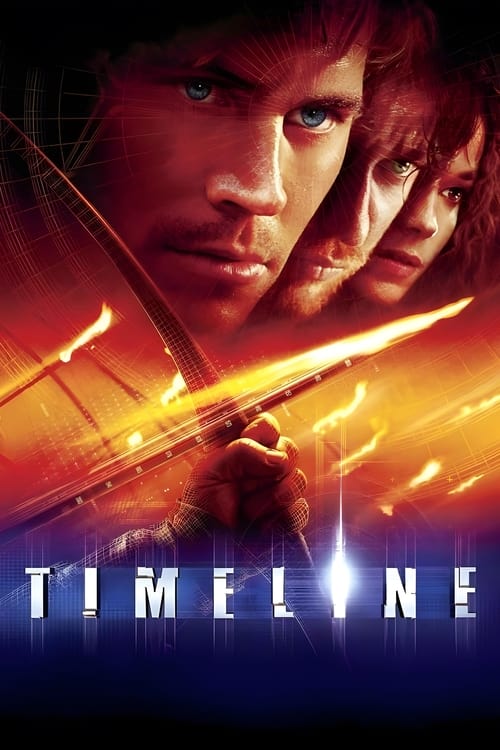
Timeline
A group of archaeological students become trapped in the past when they go there to retrieve their professor. The group must survive in 14th century France long enough to be rescued.
The film disappointed at the box office against its significant budget of $80.0M, earning $43.9M globally (-45% loss). While initial box office returns were modest, the film has gained appreciation for its compelling narrative within the action genre.


Plot Structure
Story beats plotted across runtime


Narrative Arc
Emotional journey through the story's key moments
Story Circle
Blueprint 15-beat structure
Arcplot Score Breakdown
Weighted: Precision (70%) + Arc (15%) + Theme (15%)
Timeline (2003) showcases strategically placed narrative design, characteristic of Richard Donner's storytelling approach. This structural analysis examines how the film's 15-point plot structure maps to proven narrative frameworks across 1 hour and 56 minutes. With an Arcplot score of 7.4, the film balances conventional beats with creative variation.
Characters
Cast & narrative archetypes

Chris Johnston
Kate Ericson
Professor Edward Johnston
André Marek
Robert Doniger
François
Lady Claire
Main Cast & Characters
Chris Johnston
Played by Paul Walker
A young archaeologist and leader of the group who must rescue his professor father from 14th century France.
Kate Ericson
Played by Frances O'Connor
A skilled archaeologist and Chris's colleague who becomes vital to the mission in medieval France.
Professor Edward Johnston
Played by Billy Connolly
The lead archaeologist trapped in 1357 France who left behind clues for his rescue.
André Marek
Played by Gerard Butler
A passionate history enthusiast and archaeologist who is most comfortable in the medieval setting.
Robert Doniger
Played by David Thewlis
The ambitious and ruthless CEO of ITC who developed the time travel technology.
François
Played by Lambert Wilson
A French knight who aids the time travelers in their quest through medieval France.
Lady Claire
Played by Anna Friel
A noblewoman in 14th century France who becomes connected to the time travelers.
Structural Analysis
The Status Quo at 1 minutes (1% through the runtime) establishes Archaeological dig in France. Students excavate 14th century monastery ruins, treating history as academic puzzle. Professor Johnston's son Chris is detached, doesn't share his father's passion for the past.. Significantly, this early placement immediately immerses viewers in the story world.
The inciting incident occurs at 13 minutes when ITC Corporation summons the team to New Mexico. Professor Johnston has disappeared. The students discover he went back to 1357 France through quantum technology and is trapped in the past during the Hundred Years War.. At 12% through the film, this Disruption aligns precisely with traditional story structure. This beat shifts the emotional landscape, launching the protagonist into the central conflict.
The First Threshold at 29 minutes marks the transition into Act II, occurring at 25% of the runtime. This reveals the protagonist's commitment to Chris, Marek, Kate, and Stern step into the quantum machine and are transported to 1357 France. No turning back - they have six hours to find Professor Johnston and return or be trapped forever., moving from reaction to action.
At 57 minutes, the Midpoint arrives at 50% of the runtime—precisely centered, creating perfect narrative symmetry. The analysis reveals that this crucial beat False defeat: Stern is killed trying to escape. The team finds Professor Johnston but he refuses to leave immediately - he's caught up in the conflict between Arnaut and the English. Stakes raised: they realize one of them won't make it back, and time is running out., fundamentally raising what's at risk. The emotional intensity shifts, dividing the narrative into clear before-and-after phases.
The Collapse moment at 86 minutes (74% through) represents the emotional nadir. Here, All is lost: Castle is falling, Kate is about to be killed by Arnaut, markers to return home are destroyed in the battle, time is nearly up. The team is scattered and it appears impossible to rescue everyone and escape. Death surrounds them., reveals the protagonist at their lowest point. This beat's placement in the final quarter sets up the climactic reversal.
The Second Threshold at 92 minutes initiates the final act resolution at 80% of the runtime. Synthesis: Chris realizes his historical knowledge can save them - using the secret passage Marek discovered earlier. Professor Johnston chooses to stay and fix his mistakes. Marek decides to remain with Claire. They act as a unified team using both modern and medieval knowledge., demonstrating the transformation achieved throughout the journey.
Emotional Journey
Timeline's emotional architecture traces a deliberate progression across 15 carefully calibrated beats.
Narrative Framework
This structural analysis employs systematic plot point analysis that identifies crucial turning points. By mapping Timeline against these established plot points, we can identify how Richard Donner utilizes or subverts traditional narrative conventions. The plot point approach reveals not only adherence to structural principles but also creative choices that distinguish Timeline within the action genre.
Richard Donner's Structural Approach
Among the 16 Richard Donner films analyzed on Arcplot, the average structural score is 6.9, demonstrating varied approaches to story architecture. Timeline represents one of the director's most structurally precise works. For comparative analysis, explore the complete Richard Donner filmography.
Comparative Analysis
Additional action films include The Bad Guys, Puss in Boots and Venom: The Last Dance. For more Richard Donner analyses, see Assassins, Superman and Lethal Weapon 2.
Plot Points by Act
Act I
SetupStatus Quo
Archaeological dig in France. Students excavate 14th century monastery ruins, treating history as academic puzzle. Professor Johnston's son Chris is detached, doesn't share his father's passion for the past.
Theme
Professor Johnston tells students: "We are not just studying history, we are standing where real people stood. They had lives, families, dreams." The theme: history is human, not just data.
Worldbuilding
Establish the dig site, team dynamics, Chris's romantic interest in Kate, Marek's obsession with medieval history, discovery of mysterious bifocals and plea for help with Professor's handwriting - anachronisms that shouldn't exist in 14th century ruins.
Disruption
ITC Corporation summons the team to New Mexico. Professor Johnston has disappeared. The students discover he went back to 1357 France through quantum technology and is trapped in the past during the Hundred Years War.
Resistance
ITC executive Doniger explains the technology, reveals the danger (6-hour limit, degradation with each trip). Team debates whether to go back. Marek wants to go immediately, Chris is reluctant. They learn the medieval world is violently real, not romantic. Preparation and training montage.
Act II
ConfrontationFirst Threshold
Chris, Marek, Kate, and Stern step into the quantum machine and are transported to 1357 France. No turning back - they have six hours to find Professor Johnston and return or be trapped forever.
Mirror World
Immediate violence: they witness a brutal hanging, narrowly escape English soldiers. Lady Claire appears - she becomes the emotional/thematic center, showing them medieval people are fully human. Marek is drawn to her, representing history coming alive.
Premise
The "fun and games" of navigating 1357: avoiding soldiers, using historical knowledge (Marek speaks period French), discovering Professor is helping Lord Arnaut, experiencing a medieval tournament, castle intrigue. The promise of the premise - archaeology students living in the period they studied.
Midpoint
False defeat: Stern is killed trying to escape. The team finds Professor Johnston but he refuses to leave immediately - he's caught up in the conflict between Arnaut and the English. Stakes raised: they realize one of them won't make it back, and time is running out.
Opposition
Everything gets harder: English army attacks the French castle, team is separated in the chaos of medieval warfare. Arnaut reveals himself as brutal and treacherous. Kate is captured. Chris must fight to survive. Marek torn between Claire and the mission. The 6-hour deadline approaches.
Collapse
All is lost: Castle is falling, Kate is about to be killed by Arnaut, markers to return home are destroyed in the battle, time is nearly up. The team is scattered and it appears impossible to rescue everyone and escape. Death surrounds them.
Crisis
Dark night: Chris must decide if he's willing to die for Kate. Marek faces choice between returning home or staying with Claire. Professor Johnston confronts his complicity in dangerous technology. Each character processes what matters most.
Act III
ResolutionSecond Threshold
Synthesis: Chris realizes his historical knowledge can save them - using the secret passage Marek discovered earlier. Professor Johnston chooses to stay and fix his mistakes. Marek decides to remain with Claire. They act as a unified team using both modern and medieval knowledge.
Synthesis
Finale: Rescue Kate from Arnaut, defeat him using the terrain and tactics. Race through the battle to reach the markers with seconds remaining. Professor Johnston stays behind by choice to help the French. Marek chooses to remain in 1357 with Claire, having found where he belongs.
Transformation
Back at the dig site, Chris now sees history differently - finds Marek's tomb showing he lived a full life in 1357, married Claire. Chris has gained his father's passion and understanding: history is about real people who loved and lived. He embraces Kate, connecting past to present.