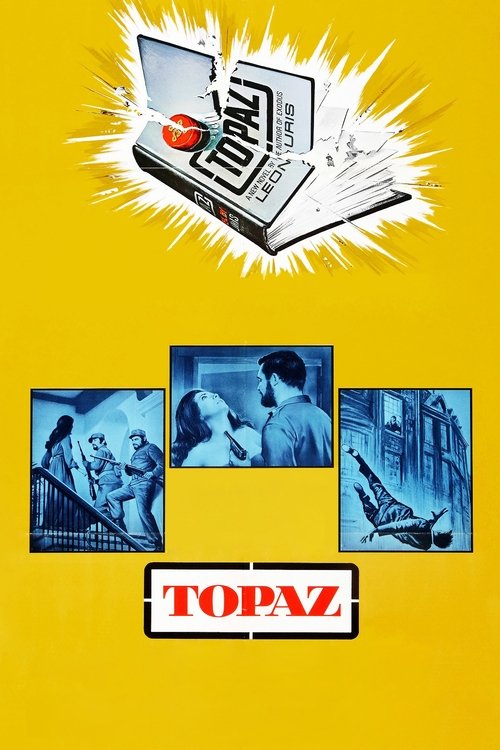
Topaz
Copenhagen, Denmark, 1962. When a high-ranking Soviet official decides to change sides, a French intelligence agent is caught up in a cold, silent and bloody spy war in which his own family will play a decisive role.
Working with a tight budget of $4.0M, the film achieved a modest success with $6.0M in global revenue (+50% profit margin).


Plot Structure
Story beats plotted across runtime


Narrative Arc
Emotional journey through the story's key moments
Story Circle
Blueprint 15-beat structure
Arcplot Score Breakdown
Weighted: Precision (70%) + Arc (15%) + Theme (15%)
Topaz (1969) showcases strategically placed story structure, characteristic of Alfred Hitchcock's storytelling approach. This structural analysis examines how the film's 15-point plot structure maps to proven narrative frameworks across 2 hours and 7 minutes. With an Arcplot score of 6.7, the film balances conventional beats with creative variation.
Characters
Cast & narrative archetypes

André Devereaux
Michael Nordstrom
Juanita de Cordoba
Nicole Devereaux
Jacques Granville
Boris Kusenov
Henri Jarre
Rico Parra
Main Cast & Characters
André Devereaux
Played by Frederick Stafford
French intelligence agent investigating Soviet espionage in Cuba and a mole within NATO
Michael Nordstrom
Played by John Forsythe
American CIA agent who recruits Devereaux to investigate Cuban missile crisis intelligence
Juanita de Cordoba
Played by Karin Dor
Cuban revolutionary and Devereaux's lover who provides intelligence from within Castro's government
Nicole Devereaux
Played by Dany Robin
André's wife who suspects her husband's infidelity and struggles with the spy life
Jacques Granville
Played by Michel Piccoli
High-ranking French official and Devereaux's friend, suspected of being the Soviet mole codenamed Topaz
Boris Kusenov
Played by Per-Axel Arosenius
Soviet defector whose information triggers the investigation into the NATO mole
Henri Jarre
Played by Philippe Noiret
French intelligence colleague and subordinate of Devereaux who assists in the investigation
Rico Parra
Played by John Vernon
Cuban security chief and Juanita's husband who discovers her espionage activities
Structural Analysis
The Status Quo at 1 minutes (1% through the runtime) establishes Copenhagen, 1962: Soviet intelligence officer Boris Kusenov and his family are under surveillance while sightseeing, establishing the tense Cold War atmosphere and the world of espionage where defection is a dangerous possibility.. Structural examination shows that this early placement immediately immerses viewers in the story world.
The inciting incident occurs at 15 minutes when Kusenov reveals to American intelligence that the Soviets are shipping offensive missiles to Cuba and that a high-level spy ring called "Topaz" exists within the French government - information that threatens Western security and forces André into a dangerous new mission.. At 12% through the film, this Disruption aligns precisely with traditional story structure. This beat shifts the emotional landscape, launching the protagonist into the central conflict.
The First Threshold at 32 minutes marks the transition into Act II, occurring at 25% of the runtime. This demonstrates the protagonist's commitment to André commits to the dangerous mission by traveling to Harlem to meet with Dubois and bribe Rico Parra's secretary Luis Uribe for photographs of the Soviet-Cuban treaty documents, crossing into covert operations that put him at personal risk., moving from reaction to action.
At 64 minutes, the Midpoint arrives at 50% of the runtime—precisely centered, creating perfect narrative symmetry. Significantly, this crucial beat Rico Parra discovers Juanita's betrayal and kills her in a devastating scene - her death is portrayed as an act of mercy to spare her from torture. The mission's true cost is revealed, and André loses both a key agent and the woman he loved., fundamentally raising what's at risk. The emotional intensity shifts, dividing the narrative into clear before-and-after phases.
The Collapse moment at 95 minutes (75% through) represents the emotional nadir. Here, André is ordered to cease his investigation by French intelligence leadership, and evidence points to his friend Henri Jarré being a member of Topaz. His career is in ruins, his marriage to Nicole has effectively ended, and the conspiracy seems to have protection at the highest levels of government., indicates the protagonist at their lowest point. This beat's placement in the final quarter sets up the climactic reversal.
The Second Threshold at 102 minutes initiates the final act resolution at 80% of the runtime. André obtains definitive proof that Jacques Granville is the leader of the Topaz spy ring. Armed with this evidence, he resolves to expose the traitors regardless of personal consequences, combining his intelligence skills with his moral conviction., demonstrating the transformation achieved throughout the journey.
Emotional Journey
Topaz's emotional architecture traces a deliberate progression across 15 carefully calibrated beats.
Narrative Framework
This structural analysis employs structural analysis methodology used to understand storytelling architecture. By mapping Topaz against these established plot points, we can identify how Alfred Hitchcock utilizes or subverts traditional narrative conventions. The plot point approach reveals not only adherence to structural principles but also creative choices that distinguish Topaz within the drama genre.
Alfred Hitchcock's Structural Approach
Among the 20 Alfred Hitchcock films analyzed on Arcplot, the average structural score is 6.6, demonstrating varied approaches to story architecture. Topaz represents one of the director's most structurally precise works. For comparative analysis, explore the complete Alfred Hitchcock filmography.
Comparative Analysis
Additional drama films include After Thomas, South Pacific and Dirty Dancing: Havana Nights. For more Alfred Hitchcock analyses, see Family Plot, The Birds and Vertigo.
Plot Points by Act
Act I
SetupStatus Quo
Copenhagen, 1962: Soviet intelligence officer Boris Kusenov and his family are under surveillance while sightseeing, establishing the tense Cold War atmosphere and the world of espionage where defection is a dangerous possibility.
Theme
American agent Nordstrom explains to André that in espionage, "the truth is the most dangerous weapon" - establishing the theme of deception, loyalty, and the personal costs of intelligence work that permeate all relationships in the film.
Worldbuilding
The Kusenov family's daring defection in Copenhagen unfolds as Western agents orchestrate their escape from Soviet handlers. André Devereaux is established as a respected French intelligence agent with connections to American intelligence, while his marriage to Nicole shows strain from his secretive profession.
Disruption
Kusenov reveals to American intelligence that the Soviets are shipping offensive missiles to Cuba and that a high-level spy ring called "Topaz" exists within the French government - information that threatens Western security and forces André into a dangerous new mission.
Resistance
American intelligence officer McKittrick persuades André to help obtain proof of the Cuban missile buildup. André wrestles with the request, knowing it could compromise his position with French intelligence. He recruits journalist Philippe Dubois and makes arrangements to travel to New York to approach Cuban official Rico Parra's aide.
Act II
ConfrontationFirst Threshold
André commits to the dangerous mission by traveling to Harlem to meet with Dubois and bribe Rico Parra's secretary Luis Uribe for photographs of the Soviet-Cuban treaty documents, crossing into covert operations that put him at personal risk.
Mirror World
André's relationship with Juanita de Cordoba is revealed - she is his former lover who now runs an anti-Castro resistance network in Havana. Their connection embodies the theme of divided loyalties, as love and duty intertwine dangerously in the world of espionage.
Premise
André's Cuban operation unfolds: he obtains the treaty photographs from Uribe, then his network in Havana gathers intelligence on missile installations. Juanita de Cordoba risks everything to photograph Soviet documents, while André navigates between American demands and protecting his agents. The espionage tradecraft of the Cold War is showcased.
Midpoint
Rico Parra discovers Juanita's betrayal and kills her in a devastating scene - her death is portrayed as an act of mercy to spare her from torture. The mission's true cost is revealed, and André loses both a key agent and the woman he loved.
Opposition
André returns to Paris haunted by Juanita's death and must now hunt for the Topaz traitors within French intelligence. His investigation causes tension with French authorities, strains his marriage further as Nicole suspects his Cuban affair, and puts him in conflict with colleagues who may be Soviet agents. Jacques Granville emerges as a suspect.
Collapse
André is ordered to cease his investigation by French intelligence leadership, and evidence points to his friend Henri Jarré being a member of Topaz. His career is in ruins, his marriage to Nicole has effectively ended, and the conspiracy seems to have protection at the highest levels of government.
Crisis
André faces professional isolation and personal devastation. Nicole leaves him, and he must decide whether to defy orders and continue pursuing the truth about Topaz or accept defeat. The personal toll of his espionage work - lost love, broken marriage, dead agents - weighs heavily.
Act III
ResolutionSecond Threshold
André obtains definitive proof that Jacques Granville is the leader of the Topaz spy ring. Armed with this evidence, he resolves to expose the traitors regardless of personal consequences, combining his intelligence skills with his moral conviction.
Synthesis
André confronts the Topaz conspirators and works to bring them to justice. Granville is exposed and faces the consequences of his treason. The spy ring is dismantled, though the resolution is bittersweet - the Cuban Missile Crisis backdrop resolves internationally, but André's personal losses remain.
Transformation
André stands alone, having served his duty but at tremendous personal cost. Unlike the opening surveillance of a family seeking freedom, André has sacrificed love and marriage for the cause. The Cold War continues, spies will be replaced, and the cycle of deception persists - a cynical meditation on the spy's solitary existence.