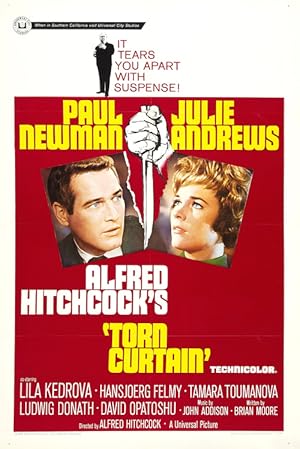
Torn Curtain
Professor Michael Armstrong (Paul Newman) is heading to Copenhagen, Denmark to attend a physics conference accompanied by his assistant and fiancée Sarah Sherman (Dame Julie Andrews). Once arrived however, Michael informs her that he may be staying for awhile and she should return home. She follows him and realizes he's actually heading to East Germany, behind the Iron Curtain. She follows him there and is shocked when he announces that he's defecting to the East after the U.S. government cancelled his research project. In fact, Michael is there to obtain information from a renowned East German scientist. Once the information is obtained, he and Sarah now have to make their way back to the West.
Despite its tight budget of $3.0M, Torn Curtain became a commercial success, earning $13.0M worldwide—a 333% return. The film's innovative storytelling resonated with audiences, showing that strong storytelling can transcend budget limitations.


Plot Structure
Story beats plotted across runtime


Narrative Arc
Emotional journey through the story's key moments
Story Circle
Blueprint 15-beat structure
Arcplot Score Breakdown
Weighted: Precision (70%) + Arc (15%) + Theme (15%)
Torn Curtain (1966) exemplifies meticulously timed narrative architecture, characteristic of Alfred Hitchcock's storytelling approach. This structural analysis examines how the film's 15-point plot structure maps to proven narrative frameworks across 2 hours and 7 minutes. With an Arcplot score of 7.5, the film showcases strong structural fundamentals.
Characters
Cast & narrative archetypes

Professor Michael Armstrong
Sarah Sherman
Professor Gustav Lindt
Hermann Gromek
Countess Kuchinska
Mr. Jacobi
Main Cast & Characters
Professor Michael Armstrong
Played by Paul Newman
American physicist who pretends to defect to East Germany to steal a secret formula, deceiving even his fiancée.
Sarah Sherman
Played by Julie Andrews
Michael's fiancée and assistant who follows him behind the Iron Curtain, initially believing he has genuinely defected.
Professor Gustav Lindt
Played by Ludwig Donath
East German scientist who possesses the formula Armstrong seeks; unwitting target of the espionage mission.
Hermann Gromek
Played by Wolfgang Kieling
East German security agent assigned to watch Armstrong; brutally killed when he discovers the deception.
Countess Kuchinska
Played by Lila Kedrova
Polish resistance member who helps Armstrong and Sarah escape through the underground network.
Mr. Jacobi
Played by David Opatoshu
Contact from the underground resistance who coordinates Armstrong's extraction from East Berlin.
Structural Analysis
The Status Quo at 2 minutes (2% through the runtime) establishes Michael Armstrong and Sarah Sherman share an intimate moment aboard a ship to Copenhagen. They appear as a happy couple, engaged scientists heading to a physics conference, representing their comfortable academic life together.. The analysis reveals that this early placement immediately immerses viewers in the story world.
The inciting incident occurs at 15 minutes when Michael abruptly cancels their return to the United States and announces he's going to East Berlin, stunning Sarah. She discovers a book of tickets and realizes he's planned to defect to Communist East Germany.. At 12% through the film, this Disruption aligns precisely with traditional story structure. This beat shifts the emotional landscape, launching the protagonist into the central conflict.
The First Threshold at 30 minutes marks the transition into Act II, occurring at 24% of the runtime. This indicates the protagonist's commitment to Sarah makes the active choice to board the plane to East Berlin, following Michael into the Communist bloc despite not understanding his motives. She crosses from the free world into the surveillance state, a point of no return., moving from reaction to action.
At 64 minutes, the Midpoint arrives at 50% of the runtime—precisely centered, creating perfect narrative symmetry. The analysis reveals that this crucial beat Michael successfully obtains the secret formula from Professor Lindt through an elaborate ruse. This false victory seems like mission accomplished, but raises the stakes: now they must escape with the information, and their cover is increasingly fragile., fundamentally raising what's at risk. The emotional intensity shifts, dividing the narrative into clear before-and-after phases.
The Collapse moment at 96 minutes (75% through) represents the emotional nadir. Here, Michael and Sarah are trapped at a ballet performance where they're surrounded by security forces. Their underground contact is compromised and killed. All escape routes appear cut off, and capture seems imminent—a death of hope and freedom., shows the protagonist at their lowest point. This beat's placement in the final quarter sets up the climactic reversal.
The Second Threshold at 102 minutes initiates the final act resolution at 80% of the runtime. The underground network provides one final desperate escape plan through a theatrical troupe. Michael synthesizes everything he's learned about deception and espionage with Sarah's unwavering loyalty. Together, they commit to the dangerous final gambit., demonstrating the transformation achieved throughout the journey.
Emotional Journey
Torn Curtain's emotional architecture traces a deliberate progression across 15 carefully calibrated beats.
Narrative Framework
This structural analysis employs a 15-point narrative structure framework that maps key story moments. By mapping Torn Curtain against these established plot points, we can identify how Alfred Hitchcock utilizes or subverts traditional narrative conventions. The plot point approach reveals not only adherence to structural principles but also creative choices that distinguish Torn Curtain within the drama genre.
Alfred Hitchcock's Structural Approach
Among the 20 Alfred Hitchcock films analyzed on Arcplot, the average structural score is 6.6, demonstrating varied approaches to story architecture. Torn Curtain represents one of the director's most structurally precise works. For comparative analysis, explore the complete Alfred Hitchcock filmography.
Comparative Analysis
Additional drama films include After Thomas, South Pacific and Dirty Dancing: Havana Nights. For more Alfred Hitchcock analyses, see Family Plot, The Birds and Vertigo.
Plot Points by Act
Act I
SetupStatus Quo
Michael Armstrong and Sarah Sherman share an intimate moment aboard a ship to Copenhagen. They appear as a happy couple, engaged scientists heading to a physics conference, representing their comfortable academic life together.
Theme
A colleague mentions the nature of loyalty and trust in relationships, foreshadowing the central question: what happens when love confronts secrets and deception in service of a greater cause?
Worldbuilding
Establishment of Michael's world as a respected nuclear physicist, his relationship with Sarah, the academic community, and the Cold War context. Michael receives mysterious messages and exhibits secretive behavior that troubles Sarah.
Disruption
Michael abruptly cancels their return to the United States and announces he's going to East Berlin, stunning Sarah. She discovers a book of tickets and realizes he's planned to defect to Communist East Germany.
Resistance
Sarah debates whether to follow Michael or return home. She struggles with betrayal and confusion but ultimately decides she must follow him to understand his decision. American intelligence operatives appear, adding complexity to the situation.
Act II
ConfrontationFirst Threshold
Sarah makes the active choice to board the plane to East Berlin, following Michael into the Communist bloc despite not understanding his motives. She crosses from the free world into the surveillance state, a point of no return.
Mirror World
In East Berlin, Sarah confronts Michael about his defection. Their relationship becomes the mirror that reflects the theme of trust versus deception. She represents the emotional truth he must protect while living a lie.
Premise
The "spy thriller" premise unfolds: Michael navigates East German surveillance, makes contact with underground networks, and works to extract the mathematical formula from Professor Lindt while maintaining his cover. The famous farm house murder scene occurs as Michael must kill a security agent.
Midpoint
Michael successfully obtains the secret formula from Professor Lindt through an elaborate ruse. This false victory seems like mission accomplished, but raises the stakes: now they must escape with the information, and their cover is increasingly fragile.
Opposition
East German security, led by agent Gromek and later others, closes in on Michael and Sarah. The couple faces increasing scrutiny, narrow escapes, and the machinery of the Communist surveillance state. Their every move is watched and their escape routes collapse.
Collapse
Michael and Sarah are trapped at a ballet performance where they're surrounded by security forces. Their underground contact is compromised and killed. All escape routes appear cut off, and capture seems imminent—a death of hope and freedom.
Crisis
In their darkest moment, Michael and Sarah process their seemingly hopeless situation. They face the reality that they may die in East Germany, never making it home. Their relationship is tested as they confront what they mean to each other.
Act III
ResolutionSecond Threshold
The underground network provides one final desperate escape plan through a theatrical troupe. Michael synthesizes everything he's learned about deception and espionage with Sarah's unwavering loyalty. Together, they commit to the dangerous final gambit.
Synthesis
Michael and Sarah execute the escape plan, hiding in costume baskets aboard a ship bound for Sweden. They use all their acquired knowledge of the surveillance state to evade detection, working together as a unified team through the tense border crossing.
Transformation
Safe aboard a ship to freedom, Michael and Sarah embrace. Unlike the opening scene's naive intimacy, they now share a bond forged through deception, survival, and ultimate trust. They have transformed from sheltered academics to tested partners who survived the Iron Curtain together.