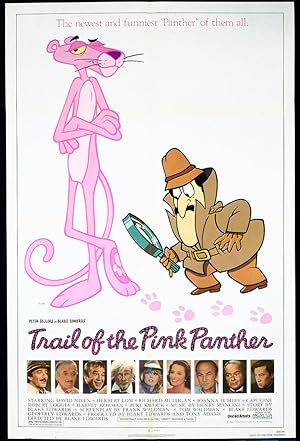
Trail of the Pink Panther
The Pink Panther diamond is stolen once again from Lugash and the authorities call in Chief Inspector Jacques Clouseau (Peter Sellers) from France. His plane disappears en-route. This time, famous French television reporter Marie Jouvet (Joanna Lumley) sets out to solve the mystery and starts to interview everybody connected to Clouseau. Each interviewee: Charles Dreyfus (Herbert Lom), Sir Charles Litton (David Niven) and Lady Simone Litton (Capucine) (an ex-wife of Clouseau), George Lytton (Robert Wagner), Hercule Lajoy (Graham Stark), and Cato Fong (Burt Kwouk) tell of their run-ins with Clouseau. She is also kidnapped by mobster Bruno Langlois (Robert Loggia), who doesn't want Clouseau found, but she continues and finds Clouseau, Sr. (Richard Mulligan), Clouseau's father. Is Clouseau alive or is he dead? Each interview has not-yet-seen or famous clips from the previous movies (since Peter Sellers died) as Marie continues to get a honest view or impression of the great French detective.
The film earned $9.1M at the global box office.


Plot Structure
Story beats plotted across runtime


Narrative Arc
Emotional journey through the story's key moments
Story Circle
Blueprint 15-beat structure
Arcplot Score Breakdown
Weighted: Precision (70%) + Arc (15%) + Theme (15%)
Trail of the Pink Panther (1982) showcases deliberately positioned story structure, characteristic of Blake Edwards's storytelling approach. This structural analysis examines how the film's 15-point plot structure maps to proven narrative frameworks across 1 hour and 36 minutes. With an Arcplot score of 7.7, the film showcases strong structural fundamentals.
Characters
Cast & narrative archetypes

Inspector Jacques Clouseau
Marie Jouvet
Chief Inspector Charles Dreyfus
Cato Fong
Sir Charles Litton
Lady Litton
Main Cast & Characters
Inspector Jacques Clouseau
Played by Peter Sellers
The bumbling yet beloved French detective who mysteriously disappears, prompting a worldwide search.
Marie Jouvet
Played by Joanna Lumley
A determined journalist investigating Clouseau's disappearance and uncovering his past.
Chief Inspector Charles Dreyfus
Played by Herbert Lom
Clouseau's long-suffering superior who has a love-hate relationship with the missing inspector.
Cato Fong
Played by Burt Kwouk
Clouseau's loyal manservant and martial arts partner who aids in the search.
Sir Charles Litton
Played by David Niven
The reformed jewel thief and Clouseau's occasional ally who assists in the investigation.
Lady Litton
Played by Capucine
Sir Charles' wife and former partner in crime who provides insights into Clouseau's past cases.
Structural Analysis
The Status Quo at 1 minutes (1% through the runtime) establishes The Pink Panther diamond is stolen from Lugash. Chief Inspector Dreyfus and the French police are in their typical bureaucratic chaos, establishing the familiar world of bumbling authorities who need Clouseau.. The analysis reveals that this early placement immediately immerses viewers in the story world.
The inciting incident occurs at 12 minutes when Clouseau's plane disappears over the ocean en route to Lugash. No trace of wreckage or survivors. The catalyst that launches the investigation and transforms the story from a typical Pink Panther caper into a mystery about Clouseau himself.. At 13% through the film, this Disruption is delayed, allowing extended setup of the story world. This beat shifts the emotional landscape, launching the protagonist into the central conflict.
The First Threshold at 24 minutes marks the transition into Act II, occurring at 25% of the runtime. This illustrates the protagonist's commitment to Marie Jouvray commits to the investigation and begins her journey, actively choosing to interview those who knew Clouseau. This launches Act 2's documentary-style exploration of Clouseau's character through others' eyes., moving from reaction to action.
At 49 minutes, the Midpoint arrives at 51% of the runtime—precisely centered, creating perfect narrative symmetry. The analysis reveals that this crucial beat Marie interviews Dreyfus at the sanitarium, who has a breakdown recounting his torment by Clouseau. False defeat: the investigation reveals that Clouseau drove everyone crazy, raising questions about whether he was truly valuable or just destructive. Stakes raise as the search becomes more desperate., fundamentally raising what's at risk. The emotional intensity shifts, dividing the narrative into clear before-and-after phases.
The Collapse moment at 72 minutes (75% through) represents the emotional nadir. Here, Official declaration that Clouseau is presumed dead. Memorial service planned. The "whiff of death" is literal - the protagonist of the entire Pink Panther series is gone. Marie faces the reality that her investigation is now an obituary, not a rescue mission., reveals the protagonist at their lowest point. This beat's placement in the final quarter sets up the climactic reversal.
The Second Threshold at 77 minutes initiates the final act resolution at 81% of the runtime. Marie synthesizes her understanding: Clouseau's value wasn't despite his chaos, but because of his unique perspective and unwavering dedication. She gains clarity on her documentary's true message - celebrating an unconventional hero. New resolve to honor his memory properly., demonstrating the transformation achieved throughout the journey.
Emotional Journey
Trail of the Pink Panther's emotional architecture traces a deliberate progression across 15 carefully calibrated beats.
Narrative Framework
This structural analysis employs structural analysis methodology used to understand storytelling architecture. By mapping Trail of the Pink Panther against these established plot points, we can identify how Blake Edwards utilizes or subverts traditional narrative conventions. The plot point approach reveals not only adherence to structural principles but also creative choices that distinguish Trail of the Pink Panther within the comedy genre.
Blake Edwards's Structural Approach
Among the 15 Blake Edwards films analyzed on Arcplot, the average structural score is 7.1, reflecting strong command of classical structure. Trail of the Pink Panther represents one of the director's most structurally precise works. For comparative analysis, explore the complete Blake Edwards filmography.
Comparative Analysis
Additional comedy films include The Bad Guys, Ella Enchanted and The Evening Star. For more Blake Edwards analyses, see Revenge of the Pink Panther, Curse of the Pink Panther and 10.
Plot Points by Act
Act I
SetupStatus Quo
The Pink Panther diamond is stolen from Lugash. Chief Inspector Dreyfus and the French police are in their typical bureaucratic chaos, establishing the familiar world of bumbling authorities who need Clouseau.
Theme
Dreyfus reluctantly admits they need Clouseau despite his destructive methods: "He may be an idiot, but he's our idiot." Theme: The value of unconventional approaches and how absence reveals true worth.
Worldbuilding
Setup of the diamond theft crisis and the decision to send Clouseau to Lugash. Establishes the supporting cast: Dreyfus, Cato, the police department. Shows the world's dependence on Clouseau despite everyone's exasperation with him.
Disruption
Clouseau's plane disappears over the ocean en route to Lugash. No trace of wreckage or survivors. The catalyst that launches the investigation and transforms the story from a typical Pink Panther caper into a mystery about Clouseau himself.
Resistance
Television reporter Marie Jouvray is assigned to investigate Clouseau's disappearance and create a documentary. Initial resistance and debate about how to approach the story. Introduction of the framing device that will structure the rest of the film.
Act II
ConfrontationFirst Threshold
Marie Jouvray commits to the investigation and begins her journey, actively choosing to interview those who knew Clouseau. This launches Act 2's documentary-style exploration of Clouseau's character through others' eyes.
Mirror World
Marie interviews Clouseau's father, who provides intimate family history and humanizes the missing inspector. This relationship subplot carries the theme of discovering someone's true value through those who loved them.
Premise
The "promise of the premise" - a series of flashback vignettes showing Clouseau's greatest (and most destructive) moments. Marie interviews Dreyfus, Cato, former colleagues, and witnesses. The audience gets the comedic Pink Panther content they came for, structured as memory sequences.
Midpoint
Marie interviews Dreyfus at the sanitarium, who has a breakdown recounting his torment by Clouseau. False defeat: the investigation reveals that Clouseau drove everyone crazy, raising questions about whether he was truly valuable or just destructive. Stakes raise as the search becomes more desperate.
Opposition
Marie continues investigating but finds more chaos and destruction in Clouseau's wake. Interviews with more witnesses reveal his bumbling nature. The opposition is the growing evidence that perhaps Clouseau was more liability than asset. The diamond remains unstolen, and hope of finding Clouseau fades.
Collapse
Official declaration that Clouseau is presumed dead. Memorial service planned. The "whiff of death" is literal - the protagonist of the entire Pink Panther series is gone. Marie faces the reality that her investigation is now an obituary, not a rescue mission.
Crisis
Marie processes the loss and reviews all she's learned. The emotional darkness of mourning Clouseau. Reflection on what he meant to those who knew him, despite his chaos. The world contemplates moving forward without him.
Act III
ResolutionSecond Threshold
Marie synthesizes her understanding: Clouseau's value wasn't despite his chaos, but because of his unique perspective and unwavering dedication. She gains clarity on her documentary's true message - celebrating an unconventional hero. New resolve to honor his memory properly.
Synthesis
Marie completes her documentary, presenting a tribute that captures both Clouseau's absurdity and his inadvertent genius. The memorial service brings together all who knew him. Resolution of the framing narrative as the documentary airs.
Transformation
Final image suggests Clouseau may still be alive, preserving hope and the character's immortal spirit. Marie's documentary has transformed public perception from "bungling idiot" to "beloved icon." The closing mirrors the opening's chaos, but now celebrated rather than lamented.