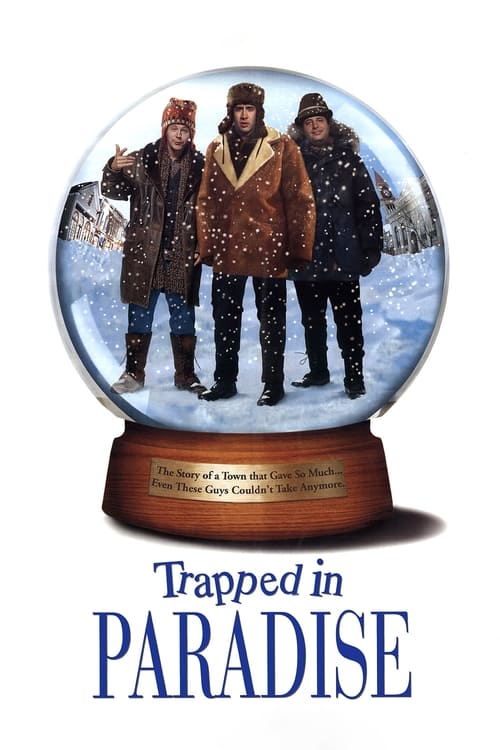
Trapped in Paradise
Residents of a friendly Pennsylvania town foil three brothers' plan to rob a bank on Christmas Eve.
The film earned $5.8M at the global box office.


Plot Structure
Story beats plotted across runtime


Narrative Arc
Emotional journey through the story's key moments
Story Circle
Blueprint 15-beat structure
Arcplot Score Breakdown
Weighted: Precision (70%) + Arc (15%) + Theme (15%)
Trapped in Paradise (1994) showcases precise narrative architecture, characteristic of George Gallo's storytelling approach. This structural analysis examines how the film's 15-point plot structure maps to proven narrative frameworks across 1 hour and 51 minutes. With an Arcplot score of 6.8, the film balances conventional beats with creative variation.
Characters
Cast & narrative archetypes

Bill Firpo
Dave Firpo
Alvin Firpo
Sarah Collins
Vic Mazzucci
Harding
Main Cast & Characters
Bill Firpo
Played by Nicolas Cage
The reluctant leader of the Firpo brothers, an ex-con trying to go straight but dragged into one last job by his criminal siblings.
Dave Firpo
Played by Jon Lovitz
The volatile, impulsive middle brother with anger management issues and a hair-trigger temper.
Alvin Firpo
Played by Dana Carvey
The dim-witted, childlike youngest brother who means well but constantly creates problems.
Sarah Collins
Played by Mädchen Amick
A kind-hearted small-town restaurant owner who shows compassion to the Firpo brothers and becomes Bill's love interest.
Vic Mazzucci
Played by Richard Jenkins
A relentless mob enforcer pursuing the Firpo brothers to collect a debt, representing the criminal world they can't escape.
Harding
Played by Donald Moffat
The suspicious FBI agent investigating the bank robbery in Paradise, Pennsylvania.
Structural Analysis
The Status Quo at 1 minutes (1% through the runtime) establishes Bill Firpo works as a restaurant manager in New York, trying to live an honest life and stay away from crime, having distanced himself from his troubled family.. Notably, this early placement immediately immerses viewers in the story world.
The inciting incident occurs at 13 minutes when Dave and Alvin reveal they've planned a bank robbery in the small town of Paradise, Pennsylvania, and coerce Bill into driving them there, threatening to implicate him regardless.. At 12% through the film, this Disruption aligns precisely with traditional story structure. This beat shifts the emotional landscape, launching the protagonist into the central conflict.
The First Threshold at 28 minutes marks the transition into Act II, occurring at 25% of the runtime. This reveals the protagonist's commitment to The Firpo brothers successfully rob the Paradise bank, crossing the point of no return. Bill actively participates, abandoning his reformed life and committing himself to the crime., moving from reaction to action.
At 56 minutes, the Midpoint arrives at 50% of the runtime—precisely centered, creating perfect narrative symmetry. Structural examination shows that this crucial beat The brothers are invited to Christmas dinner with multiple families who compete for their company. Bill begins genuinely enjoying the warmth of Paradise, experiencing a false victory as they seem to have gotten away with the crime., fundamentally raising what's at risk. The emotional intensity shifts, dividing the narrative into clear before-and-after phases.
The Collapse moment at 83 minutes (75% through) represents the emotional nadir. Here, The brothers learn the bank robbery has devastated the town—the stolen money included the community's Christmas fund and several families' life savings. Bill sees the human cost of their crime and his reformation feels dead., indicates the protagonist at their lowest point. This beat's placement in the final quarter sets up the climactic reversal.
The Second Threshold at 89 minutes initiates the final act resolution at 80% of the runtime. Bill decides they must return the money to Paradise, even if it means prison. The brothers unite in choosing redemption over escape, synthesizing their criminal skills with their newfound conscience., demonstrating the transformation achieved throughout the journey.
Emotional Journey
Trapped in Paradise's emotional architecture traces a deliberate progression across 15 carefully calibrated beats.
Narrative Framework
This structural analysis employs proven narrative structure principles that track dramatic progression. By mapping Trapped in Paradise against these established plot points, we can identify how George Gallo utilizes or subverts traditional narrative conventions. The plot point approach reveals not only adherence to structural principles but also creative choices that distinguish Trapped in Paradise within the comedy genre.
George Gallo's Structural Approach
Among the 3 George Gallo films analyzed on Arcplot, the average structural score is 7.0, reflecting strong command of classical structure. Trapped in Paradise takes a more unconventional approach compared to the director's typical style. For comparative analysis, explore the complete George Gallo filmography.
Comparative Analysis
Additional comedy films include The Bad Guys, Ella Enchanted and The Evening Star. For more George Gallo analyses, see Double Take, My Mom's New Boyfriend.
Plot Points by Act
Act I
SetupStatus Quo
Bill Firpo works as a restaurant manager in New York, trying to live an honest life and stay away from crime, having distanced himself from his troubled family.
Theme
Bill's parole officer warns him that family loyalty can be a man's greatest weakness or his salvation—foreshadowing the brothers' journey toward redemption through community.
Worldbuilding
Bill's reformed life is established, his brothers Dave and Alvin are released from prison, and we see the dysfunctional Firpo family dynamic. The brothers scheme and manipulate Bill into helping them with "one small errand."
Disruption
Dave and Alvin reveal they've planned a bank robbery in the small town of Paradise, Pennsylvania, and coerce Bill into driving them there, threatening to implicate him regardless.
Resistance
Bill reluctantly agrees to help but insists it will be clean and quick. The brothers travel to Paradise, scope out the small-town bank, and plan their Christmas Eve heist while Bill debates whether he can still back out.
Act II
ConfrontationFirst Threshold
The Firpo brothers successfully rob the Paradise bank, crossing the point of no return. Bill actively participates, abandoning his reformed life and committing himself to the crime.
Mirror World
The brothers encounter the warm, trusting townspeople of Paradise, including Sarah Collins and the Anderson family, whose genuine Christmas hospitality begins to contrast sharply with the brothers' criminal intentions.
Premise
The comic premise unfolds: every escape attempt fails. A blizzard traps them, their car breaks down, and the townspeople keep inviting them to stay. The brothers experience repeated hospitality while trying desperately to flee with the stolen money.
Midpoint
The brothers are invited to Christmas dinner with multiple families who compete for their company. Bill begins genuinely enjoying the warmth of Paradise, experiencing a false victory as they seem to have gotten away with the crime.
Opposition
FBI agents and the Gambini crime family both close in on the brothers. Their guilt intensifies as they spend more time with the kind townspeople whose money they stole. Each escape plan falls apart, and the net tightens.
Collapse
The brothers learn the bank robbery has devastated the town—the stolen money included the community's Christmas fund and several families' life savings. Bill sees the human cost of their crime and his reformation feels dead.
Crisis
The brothers hide in shame, unable to face the townspeople they've come to care about. Bill contemplates turning himself in while Dave and Alvin, for once, show genuine remorse for hurting innocent people.
Act III
ResolutionSecond Threshold
Bill decides they must return the money to Paradise, even if it means prison. The brothers unite in choosing redemption over escape, synthesizing their criminal skills with their newfound conscience.
Synthesis
The brothers execute a plan to return the money anonymously on Christmas morning while evading both the FBI and the mob. Through comedic chaos and narrow escapes, they succeed in making the town whole again.
Transformation
The Firpo brothers, having returned the money, experience true Christmas joy and acceptance. Bill is no longer trapped by his family's criminal legacy—Paradise has transformed them all, and they've found redemption through selflessness.