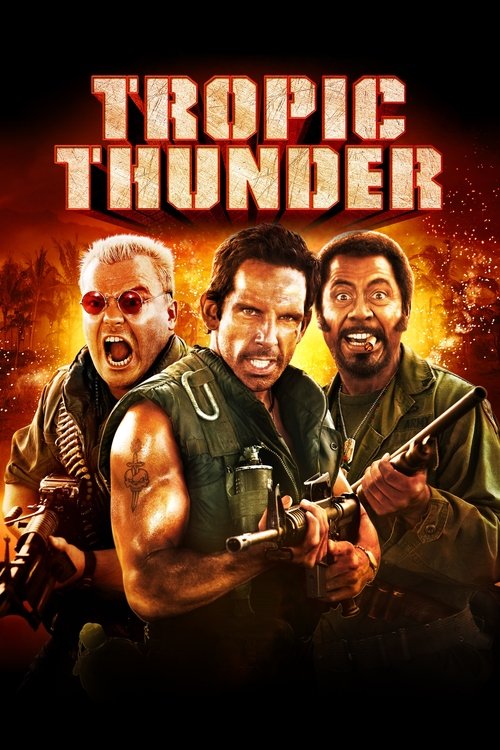
Tropic Thunder
Through a series of freak occurrences, a group of actors shooting a big-budget war movie are forced to become the soldiers they are portraying.
Despite a substantial budget of $92.0M, Tropic Thunder became a financial success, earning $195.7M worldwide—a 113% return.
Nominated for 1 Oscar. 10 wins & 47 nominations


Plot Structure
Story beats plotted across runtime


Narrative Arc
Emotional journey through the story's key moments
Story Circle
Blueprint 15-beat structure
Characters
Cast & narrative archetypes

Tugg Speedman
Kirk Lazarus
Jeff Portnoy
Les Grossman
Rick Peck
Alpa Chino
Kevin Sandusky
Damien Cockburn
Four Leaf Tayback
Main Cast & Characters
Tugg Speedman
Played by Ben Stiller
Fading action star desperate to be taken seriously as an actor, leading man of the film-within-a-film who struggles with ego and relevance.
Kirk Lazarus
Played by Robert Downey Jr.
Method actor of extreme dedication who undergoes pigmentation surgery to play a Black soldier and refuses to break character until the DVD commentary.
Jeff Portnoy
Played by Jack Black
Gross-out comedy star known for fart humor roles, struggling with drug addiction and desperate to prove his dramatic range.
Les Grossman
Played by Tom Cruise
Abrasive, foul-mouthed studio executive who runs the production with an iron fist and explosive temper.
Rick Peck
Played by Matthew McConaughey
Tugg Speedman's weak-willed agent who struggles to stand up to studio executive Les Grossman.
Alpa Chino
Played by Brandon T. Jackson
Rapper-turned-actor with a secret he's hiding about his sexuality, promoting his energy drink brand throughout.
Kevin Sandusky
Played by Jay Baruchel
Young, inexperienced actor playing the explosives expert, often overshadowed by the more famous stars.
Damien Cockburn
Played by Steve Coogan
British director of the Vietnam War film who quickly loses control of his production and cast.
Four Leaf Tayback
Played by Nick Nolte
Supposed Vietnam War veteran and author whose memoir inspired the film, revealed to be a fraud.
Structural Analysis
The Status Quo at 1 minutes (1% through the runtime) establishes The fake trailers and commercials establish each actor's persona: Tugg Speedman as a declining action star, Kirk Lazarus as an intense method actor, Jeff Portnoy as a lowbrow comedian, Alpa Chino as a rapper-turned-actor, and Kevin Sandusky as an unknown. These meta-theatrical openings reveal Hollywood's shallow spectacle.. Significantly, this early placement immediately immerses viewers in the story world.
The inciting incident occurs at 13 minutes when Les Grossman threatens to shut down production and destroy Damien's career. The studio's ultimatum forces desperate measures - the production cannot continue in its current form. This external pressure catalyzes the radical plan that follows.. At 12% through the film, this Disruption aligns precisely with traditional story structure. This beat shifts the emotional landscape, launching the protagonist into the central conflict.
The First Threshold at 27 minutes marks the transition into Act II, occurring at 25% of the runtime. This demonstrates the protagonist's commitment to Director Damien Cockburn steps on a landmine and is killed instantly. The actors are now stranded in the real jungle with no director, no crew, and no understanding that they've wandered into actual danger. Their choice to continue "filming" without realizing the stakes have become life-or-death marks their true entry into the unknown., moving from reaction to action.
At 54 minutes, the Midpoint arrives at 50% of the runtime—precisely centered, creating perfect narrative symmetry. Of particular interest, this crucial beat Tugg Speedman is captured by Flaming Dragon, a heroin-producing cartel. The group discovers this isn't a movie when they find real armed soldiers and Tugg's disappearance. The false victory of "great footage" inverts into the false defeat of realizing they're in genuine mortal danger with no rescue coming. Stakes shift from career to survival., fundamentally raising what's at risk. The emotional intensity shifts, dividing the narrative into clear before-and-after phases.
The Collapse moment at 80 minutes (75% through) represents the emotional nadir. Here, Kirk Lazarus finally breaks character, removing his makeup and admitting he doesn't know who he is anymore. This "death of identity" is the metaphorical whiff of death - the persona Kirk hid behind is gone. Meanwhile, Tugg has been so broken by captivity that he believes he actually is Simple Jack, representing the death of his ego and former self., indicates the protagonist at their lowest point. This beat's placement in the final quarter sets up the climactic reversal.
The Second Threshold at 86 minutes initiates the final act resolution at 80% of the runtime. The actors choose to mount a real rescue mission for Tugg, using their movie knowledge and Cody's remaining explosives. Kirk declares "I'm a dude playing a dude disguised as another dude" - finally understanding the layers of identity he's hidden behind. They're no longer acting; they're choosing authentic heroism., demonstrating the transformation achieved throughout the journey.
Emotional Journey
Tropic Thunder's emotional architecture traces a deliberate progression across 15 carefully calibrated beats.
Narrative Framework
This structural analysis employs a 15-point narrative structure framework that maps key story moments. By mapping Tropic Thunder against these established plot points, we can identify how Ben Stiller utilizes or subverts traditional narrative conventions. The plot point approach reveals not only adherence to structural principles but also creative choices that distinguish Tropic Thunder within the action genre.
Ben Stiller's Structural Approach
Among the 6 Ben Stiller films analyzed on Arcplot, the average structural score is 6.8, demonstrating varied approaches to story architecture. Tropic Thunder exemplifies the director's characteristic narrative technique. For comparative analysis, explore the complete Ben Stiller filmography.
Comparative Analysis
Additional action films include The Bad Guys, Puss in Boots and Venom: The Last Dance. For more Ben Stiller analyses, see The Cable Guy, Reality Bites and Zoolander 2.
Plot Points by Act
Act I
SetupStatus Quo
The fake trailers and commercials establish each actor's persona: Tugg Speedman as a declining action star, Kirk Lazarus as an intense method actor, Jeff Portnoy as a lowbrow comedian, Alpa Chino as a rapper-turned-actor, and Kevin Sandusky as an unknown. These meta-theatrical openings reveal Hollywood's shallow spectacle.
Theme
Kirk Lazarus tells Tugg, "I don't drop character till I done the DVD commentary." This encapsulates the film's central question about the difference between authentic identity and performance, and how far actors go to avoid confronting who they really are.
Worldbuilding
The Vietnam War film production is established as a disaster: five months behind schedule after five days of shooting. We meet the dysfunctional ensemble cast, overwhelmed director Damien Cockburn, frustrated studio executive Les Grossman, and Four Leaf Tayback, the veteran whose memoir they're adapting. The Hollywood machine is shown as bloated, ego-driven, and absurd.
Disruption
Les Grossman threatens to shut down production and destroy Damien's career. The studio's ultimatum forces desperate measures - the production cannot continue in its current form. This external pressure catalyzes the radical plan that follows.
Resistance
Four Leaf Tayback proposes dropping the actors into the real jungle with hidden cameras for "guerrilla filmmaking." Damien debates the risks but is desperate enough to try anything. The actors resist leaving their comfort zones - Tugg worries about his career, Kirk stays in character, Portnoy hides his drug addiction. Pyrotechnics expert Cody rigs the jungle with explosives and cameras.
Act II
ConfrontationFirst Threshold
Director Damien Cockburn steps on a landmine and is killed instantly. The actors are now stranded in the real jungle with no director, no crew, and no understanding that they've wandered into actual danger. Their choice to continue "filming" without realizing the stakes have become life-or-death marks their true entry into the unknown.
Mirror World
The group encounters the real jungle and begins their trek, with Tugg insisting on following the "script" while the others debate what's real. Kevin Sandusky emerges as the only one who read the actual book and understands the mission. This reveals the thematic contrast: those who study reality versus those who only perform it.
Premise
The "fun and games" of pampered actors stumbling through real jungle warfare. Kirk refuses to break character as an African-American sergeant, leading to conflicts with Alpa Chino about authentic Black identity. Portnoy goes through heroin withdrawal. Tugg's delusion that everything is scripted leads the group deeper into Flaming Dragon territory. The comedy mines the gap between Hollywood fantasy and brutal reality.
Midpoint
Tugg Speedman is captured by Flaming Dragon, a heroin-producing cartel. The group discovers this isn't a movie when they find real armed soldiers and Tugg's disappearance. The false victory of "great footage" inverts into the false defeat of realizing they're in genuine mortal danger with no rescue coming. Stakes shift from career to survival.
Opposition
The group fractures: Kirk wants to rescue Tugg while others want to escape. Tugg is held captive and forced to perform scenes from his failed film "Simple Jack" for the drug lords. Back in Hollywood, Les Grossman negotiates with Flaming Dragon and shockingly decides to let Tugg die for insurance money. The actors must become the heroes they only pretend to be, while Tugg's captivity strips away his ego.
Collapse
Kirk Lazarus finally breaks character, removing his makeup and admitting he doesn't know who he is anymore. This "death of identity" is the metaphorical whiff of death - the persona Kirk hid behind is gone. Meanwhile, Tugg has been so broken by captivity that he believes he actually is Simple Jack, representing the death of his ego and former self.
Crisis
The remaining actors confront their own inadequacies. Kirk, without his method acting shield, must find authentic courage. Portnoy admits his addiction. Alpa reveals he's been hiding his true self behind his brand. Kevin steps up as the unlikely tactical leader. Each actor faces who they really are beneath the performance.
Act III
ResolutionSecond Threshold
The actors choose to mount a real rescue mission for Tugg, using their movie knowledge and Cody's remaining explosives. Kirk declares "I'm a dude playing a dude disguised as another dude" - finally understanding the layers of identity he's hidden behind. They're no longer acting; they're choosing authentic heroism.
Synthesis
The rescue assault combines Hollywood spectacle with genuine courage. Each actor uses their unique skills authentically: Kirk's intensity, Portnoy's physical comedy, Alpa's bravado, Kevin's tactical knowledge. Tugg snaps out of his Simple Jack fugue when he sees his friends risking their lives for him. The climax features a helicopter escape, explosions, and Tugg throwing a real grenade. They escape as the footage Cody captured becomes an actual hit film.
Transformation
At the Oscars, Tugg Speedman wins Best Actor - not for the war film, but for playing himself in the documentary about their real experience. Kirk Lazarus is in the audience as himself, an Australian, no longer hiding behind characters. The final image shows actors who found authentic identity through genuine experience, inverting the opening's hollow performances.