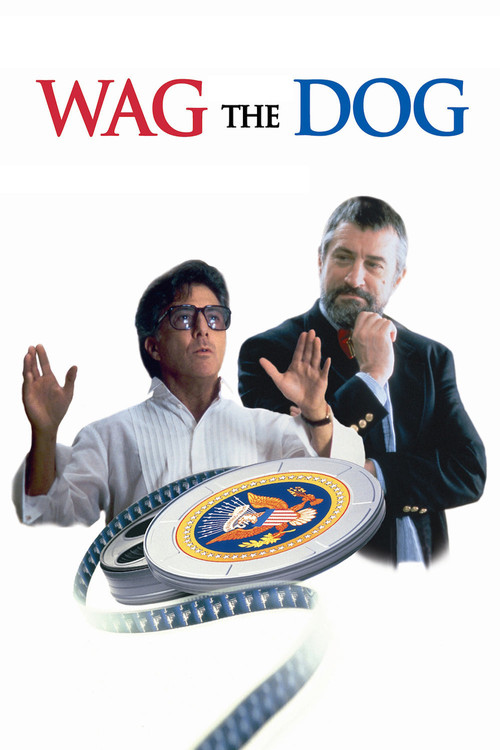
Wag the Dog
During the final weeks of a presidential race, the President is accused of sexual misconduct. To distract the public until the election, the President's adviser hires a Hollywood producer to help him stage a fake war.
Despite a respectable budget of $15.0M, Wag the Dog became a solid performer, earning $64.3M worldwide—a 328% return.
Nominated for 2 Oscars. 2 wins & 23 nominations


Plot Structure
Story beats plotted across runtime


Narrative Arc
Emotional journey through the story's key moments
Story Circle
Blueprint 15-beat structure
Arcplot Score Breakdown
Weighted: Precision (70%) + Arc (15%) + Theme (15%)
Wag the Dog (1997) showcases precise plot construction, characteristic of Barry Levinson's storytelling approach. This structural analysis examines how the film's 15-point plot structure maps to proven narrative frameworks across 1 hour and 37 minutes. With an Arcplot score of 6.7, the film balances conventional beats with creative variation.
Structural Analysis
The Status Quo at 1 minutes (1% through the runtime) establishes Opening title card with the proverb about the dog wagging its tail, establishing the film's satirical premise about who really controls whom in politics and media.. Notably, this early placement immediately immerses viewers in the story world.
The inciting incident occurs at 12 minutes when The scandal story is about to break. Brean realizes they need something bigger than spin—they need to create an entirely fabricated crisis to dominate the news cycle and bury the scandal.. At 12% through the film, this Disruption aligns precisely with traditional story structure. This beat shifts the emotional landscape, launching the protagonist into the central conflict.
The First Threshold at 24 minutes marks the transition into Act II, occurring at 25% of the runtime. This reveals the protagonist's commitment to Stanley Motss agrees to produce the fake war, asking "What's the difference between a war and a movie?" The team commits fully to manufacturing a conflict with Albania that exists only in media., moving from reaction to action.
At 49 minutes, the Midpoint arrives at 50% of the runtime—precisely centered, creating perfect narrative symmetry. Of particular interest, this crucial beat False defeat: The CIA announces the war is over and Albania has surrendered. Their entire production is being shut down by people who know it's fake. The scandal will resurface with nothing to bury it., fundamentally raising what's at risk. The emotional intensity shifts, dividing the narrative into clear before-and-after phases.
The Collapse moment at 73 minutes (75% through) represents the emotional nadir. Here, Schumann is revealed to be criminally insane, imprisoned for raping a nun. During their staged homecoming, he escapes and is killed by a farmer whose daughter he attacks. Their manufactured hero is dead, and the truth is catastrophic., demonstrates the protagonist at their lowest point. This beat's placement in the final quarter sets up the climactic reversal.
The Second Threshold at 78 minutes initiates the final act resolution at 80% of the runtime. Motss has a revelation: they can spin the death. Schumann dies a hero's death, killed tragically on American soil. They'll give him a state funeral with full military honors. The narrative is saved by reframing disaster as tragedy., demonstrating the transformation achieved throughout the journey.
Emotional Journey
Wag the Dog's emotional architecture traces a deliberate progression across 15 carefully calibrated beats.
Narrative Framework
This structural analysis employs systematic plot point analysis that identifies crucial turning points. By mapping Wag the Dog against these established plot points, we can identify how Barry Levinson utilizes or subverts traditional narrative conventions. The plot point approach reveals not only adherence to structural principles but also creative choices that distinguish Wag the Dog within the comedy genre.
Barry Levinson's Structural Approach
Among the 14 Barry Levinson films analyzed on Arcplot, the average structural score is 7.0, reflecting strong command of classical structure. Wag the Dog takes a more unconventional approach compared to the director's typical style. For comparative analysis, explore the complete Barry Levinson filmography.
Comparative Analysis
Additional comedy films include The Bad Guys, Ella Enchanted and The Evening Star. For more Barry Levinson analyses, see Envy, Diner and Rain Man.
Plot Points by Act
Act I
SetupStatus Quo
Opening title card with the proverb about the dog wagging its tail, establishing the film's satirical premise about who really controls whom in politics and media.
Theme
Conrad Brean arrives at the White House and states the theme: "What difference does it make if it's true? If it's a story and it breaks, they're gonna run with it." Truth is irrelevant; perception is everything.
Worldbuilding
The world of high-stakes political crisis management is established. The President is accused of sexual misconduct with a Firefly Girl eleven days before the election. Winifred Ames brings in fixer Conrad Brean to handle the disaster.
Disruption
The scandal story is about to break. Brean realizes they need something bigger than spin—they need to create an entirely fabricated crisis to dominate the news cycle and bury the scandal.
Resistance
Brean debates strategy with Ames and decides they need Hollywood expertise to manufacture their distraction. He proposes creating a fake war with Albania and recruits legendary producer Stanley Motss to produce it.
Act II
ConfrontationFirst Threshold
Stanley Motss agrees to produce the fake war, asking "What's the difference between a war and a movie?" The team commits fully to manufacturing a conflict with Albania that exists only in media.
Mirror World
Introduction of the creative production team—songwriter Johnny Dean and arranger/producer Liz Butsky—who will craft the emotional mythology of the war. Their artistic passion mirrors and enables the political deception.
Premise
The "fun and games" of fabricating war: creating fake footage of an Albanian girl fleeing bombers using green screen, writing patriotic songs like "Good Old Shoe," leaking stories to the press, and watching the media swallow every manufactured detail.
Midpoint
False defeat: The CIA announces the war is over and Albania has surrendered. Their entire production is being shut down by people who know it's fake. The scandal will resurface with nothing to bury it.
Opposition
Motss refuses to let his "production" be cancelled and pivots to Act Two: creating a heroic POW named "Old Shoe" Schumann left behind enemy lines. They cast a real military prisoner, Sergeant William Schumann, to play the hero.
Collapse
Schumann is revealed to be criminally insane, imprisoned for raping a nun. During their staged homecoming, he escapes and is killed by a farmer whose daughter he attacks. Their manufactured hero is dead, and the truth is catastrophic.
Crisis
The team faces their darkest moment. Their heroic narrative has collapsed violently. Motss must reconcile that his greatest production may fail—and worse, that no one will ever know he created it.
Act III
ResolutionSecond Threshold
Motss has a revelation: they can spin the death. Schumann dies a hero's death, killed tragically on American soil. They'll give him a state funeral with full military honors. The narrative is saved by reframing disaster as tragedy.
Synthesis
The grand finale: Schumann receives a hero's funeral, the President wins reelection, and the scandal is forgotten. But Motss cannot accept anonymity—he wants credit for his masterpiece and threatens to go public.
Transformation
Stanley Motss dies of a "heart attack by the pool." News reports his death as Brean watches impassively. The final irony: the producer who manufactured reality becomes its victim. A new Albanian crisis begins on TV—the machine continues.