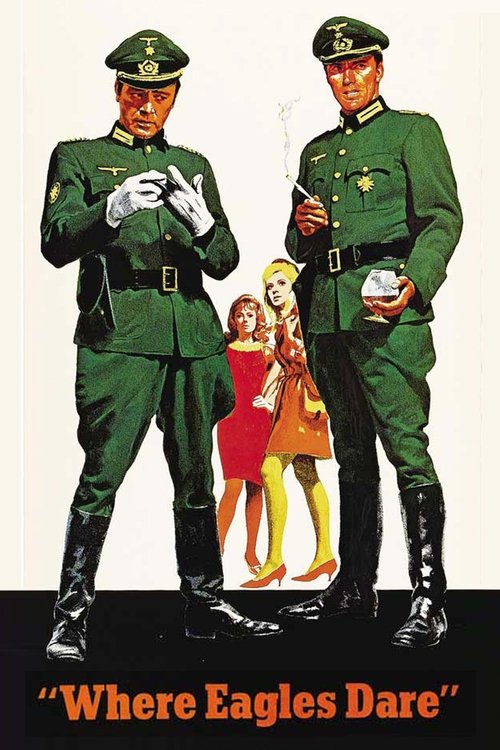
Where Eagles Dare
World War II is raging, and an American general has been captured and is being held hostage in the Schloss Adler, a Bavarian castle that's nearly impossible to breach. It's up to a group of skilled Allied soldiers to liberate the general before it's too late.
Despite its limited budget of $7.7M, Where Eagles Dare became a financial success, earning $21.0M worldwide—a 173% return.
1 win & 3 nominations


Plot Structure
Story beats plotted across runtime


Narrative Arc
Emotional journey through the story's key moments
Story Circle
Blueprint 15-beat structure
Arcplot Score Breakdown
Weighted: Precision (70%) + Arc (15%) + Theme (15%)
Where Eagles Dare (1968) demonstrates deliberately positioned story structure, characteristic of Brian G. Hutton's storytelling approach. This structural analysis examines how the film's 15-point plot structure maps to proven narrative frameworks across 2 hours and 35 minutes. With an Arcplot score of 6.8, the film balances conventional beats with creative variation.
Structural Analysis
The Status Quo at 2 minutes (1% through the runtime) establishes A British bomber flies through treacherous Alpine mountains at night. The crew prepares for a dangerous mission as the plane battles through snow and wind, establishing the perilous wartime world where survival is never guaranteed.. Significantly, this early placement immediately immerses viewers in the story world.
The inciting incident occurs at 18 minutes when The team parachutes into Nazi-occupied Bavaria, but radio operator Harrod is found dead with a broken neck—murdered before he hit the ground. Someone on the team is a traitor. The mission is compromised before it truly begins.. At 12% through the film, this Disruption aligns precisely with traditional story structure. This beat shifts the emotional landscape, launching the protagonist into the central conflict.
The First Threshold at 39 minutes marks the transition into Act II, occurring at 25% of the runtime. This shows the protagonist's commitment to Smith and Schaffer board the cable car ascending to Schloss Adler, crossing from the relative safety of the village into the heart of Nazi power. There is no turning back—they are entering the eagle's nest itself, surrounded by enemies on all sides., moving from reaction to action.
At 77 minutes, the Midpoint arrives at 50% of the runtime—precisely centered, creating perfect narrative symmetry. Of particular interest, this crucial beat Smith reveals to Schaffer the true nature of the mission: there are no invasion plans to protect. Carnaby is an actor. The real mission is to expose a network of double agents within British Intelligence. Everything the audience believed is upended—a false victory that reframes the entire story., fundamentally raising what's at risk. The emotional intensity shifts, dividing the narrative into clear before-and-after phases.
The Collapse moment at 114 minutes (74% through) represents the emotional nadir. Here, The three British traitors—Jones, Christiansen, and Thomas—are exposed in the great hall, but German soldiers surround Smith and Schaffer. Carnaby's cover is blown. The mission appears doomed, with Smith's intricate plan seemingly in ruins and death imminent., illustrates the protagonist at their lowest point. This beat's placement in the final quarter sets up the climactic reversal.
The Second Threshold at 124 minutes initiates the final act resolution at 80% of the runtime. With the names secured, Smith detonates the planted explosives throughout the castle, creating chaos. The team fights their way toward the cable car station. The threshold into Act 3 is crossed in fire and fury—now it's about escape and survival., demonstrating the transformation achieved throughout the journey.
Emotional Journey
Where Eagles Dare's emotional architecture traces a deliberate progression across 15 carefully calibrated beats.
Narrative Framework
This structural analysis employs systematic plot point analysis that identifies crucial turning points. By mapping Where Eagles Dare against these established plot points, we can identify how Brian G. Hutton utilizes or subverts traditional narrative conventions. The plot point approach reveals not only adherence to structural principles but also creative choices that distinguish Where Eagles Dare within the action genre.
Brian G. Hutton's Structural Approach
Among the 2 Brian G. Hutton films analyzed on Arcplot, the average structural score is 6.9, demonstrating varied approaches to story architecture. Where Eagles Dare takes a more unconventional approach compared to the director's typical style. For comparative analysis, explore the complete Brian G. Hutton filmography.
Comparative Analysis
Additional action films include The Bad Guys, Puss in Boots and Venom: The Last Dance. For more Brian G. Hutton analyses, see Kelly's Heroes.
Plot Points by Act
Act I
SetupStatus Quo
A British bomber flies through treacherous Alpine mountains at night. The crew prepares for a dangerous mission as the plane battles through snow and wind, establishing the perilous wartime world where survival is never guaranteed.
Theme
Colonel Turner briefs Major Smith: "Trust no one." The theme of deception, loyalty, and the impossibility of knowing who is friend or foe in wartime espionage is established. Nothing is as it seems, and survival depends on out-thinking everyone.
Worldbuilding
The mission is established: rescue American General Carnaby from the impregnable Schloss Adler fortress before the Nazis extract D-Day invasion plans. Smith assembles his team of commandos including the American Lieutenant Schaffer. The stakes are nothing less than the outcome of the war.
Disruption
The team parachutes into Nazi-occupied Bavaria, but radio operator Harrod is found dead with a broken neck—murdered before he hit the ground. Someone on the team is a traitor. The mission is compromised before it truly begins.
Resistance
Smith leads the team through the frozen Bavarian wilderness toward the village below the castle. They make contact with local resistance, and female agent Mary Ellison. Smith begins to suspect multiple team members, playing his cards close while preparing for the infiltration.
Act II
ConfrontationFirst Threshold
Smith and Schaffer board the cable car ascending to Schloss Adler, crossing from the relative safety of the village into the heart of Nazi power. There is no turning back—they are entering the eagle's nest itself, surrounded by enemies on all sides.
Mirror World
Mary Ellison proves her worth as Smith's true ally, infiltrating the castle through a separate route. Her competence and loyalty contrast sharply with the treacherous male commandos. She represents trust in a world of deception—the thematic heart of the story.
Premise
The promise of the premise delivers: elaborate disguises, tense infiltration, cat-and-mouse games within the fortress. Smith and Schaffer navigate Nazi officers, plant explosives, and gather intelligence while their supposed allies are picked off one by one under mysterious circumstances.
Midpoint
Smith reveals to Schaffer the true nature of the mission: there are no invasion plans to protect. Carnaby is an actor. The real mission is to expose a network of double agents within British Intelligence. Everything the audience believed is upended—a false victory that reframes the entire story.
Opposition
The Germans close in as Smith executes his elaborate trap. The traitors among the commando team are systematically exposed. Gunfights erupt throughout the castle. Colonel Kramer interrogates the prisoners while Smith manipulates everyone—German and British alike—toward his endgame.
Collapse
The three British traitors—Jones, Christiansen, and Thomas—are exposed in the great hall, but German soldiers surround Smith and Schaffer. Carnaby's cover is blown. The mission appears doomed, with Smith's intricate plan seemingly in ruins and death imminent.
Crisis
In the explosive standoff, Smith forces the traitors to write down the names of German agents in Britain—or die as traitors. The tension is unbearable as loyalties are tested and the true scope of the deception becomes clear. Schaffer guards against the inevitable German assault.
Act III
ResolutionSecond Threshold
With the names secured, Smith detonates the planted explosives throughout the castle, creating chaos. The team fights their way toward the cable car station. The threshold into Act 3 is crossed in fire and fury—now it's about escape and survival.
Synthesis
The legendary cable car sequence unfolds—fighting atop the gondolas, cutting cables, explosions against the Alpine backdrop. The team escapes to a bus, races through mountain roads while battling pursuing Germans, and finally reaches the airfield where a plane awaits.
Transformation
The plane lifts off with Smith, Schaffer, Mary, and the captured traitor Colonel Turner (revealed as the mastermind). Justice is served at altitude. The team who began as apparent rescue commandos end as triumphant counter-espionage heroes who have dismantled a network of treachery.