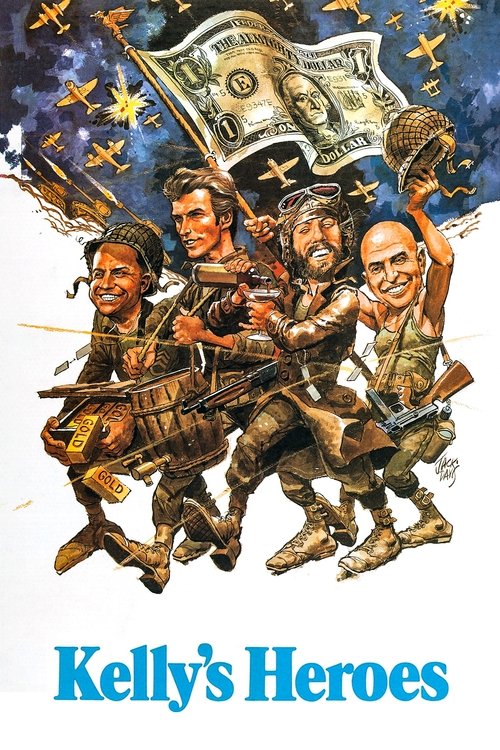
Kelly's Heroes
A misfit group of World War II American soldiers goes AWOL to rob a bank behind German lines.
Working with a limited budget of $4.0M, the film achieved a modest success with $5.2M in global revenue (+30% profit margin).


Plot Structure
Story beats plotted across runtime


Narrative Arc
Emotional journey through the story's key moments
Story Circle
Blueprint 15-beat structure
Arcplot Score Breakdown
Weighted: Precision (70%) + Arc (15%) + Theme (15%)
Kelly's Heroes (1970) exhibits deliberately positioned narrative design, characteristic of Brian G. Hutton's storytelling approach. This structural analysis examines how the film's 15-point plot structure maps to proven narrative frameworks across 2 hours and 24 minutes. With an Arcplot score of 7.0, the film balances conventional beats with creative variation.
Characters
Cast & narrative archetypes

Private Kelly
Oddball
Big Joe
Crapgame
General Colt
Moriarty
Main Cast & Characters
Private Kelly
Played by Clint Eastwood
A disillusioned former lieutenant who discovers a Nazi gold cache and organizes a rogue heist behind enemy lines. Pragmatic and calculating, he transforms from cynical soldier to determined leader.
Oddball
Played by Donald Sutherland
An eccentric tank commander who leads a unit of Sherman tanks with a laid-back, countercultural attitude. He provides the mechanical muscle and comic relief for the gold heist operation.
Big Joe
Played by Telly Savalas
A tough, pragmatic master sergeant who initially opposes Kelly's scheme but eventually becomes a key ally. He represents military professionalism balanced with practical self-interest.
Crapgame
Played by Don Rickles
A shrewd supply sergeant and deal-maker who manages logistics and negotiations for the heist. His merchant instincts and business acumen make him indispensable to the operation.
General Colt
Played by Carroll O'Connor
An ambitious and glory-seeking general who believes the rogue mission is a legitimate military advance. His misinterpretation of events provides cover for Kelly's team.
Moriarty
Played by Gavin MacLeod
A pessimistic soldier prone to dark humor and complaints, but loyal when it counts. He represents the everyman grunt swept up in Kelly's audacious plan.
Structural Analysis
The Status Quo at 1 minutes (1% through the runtime) establishes Opening image of American troops in France 1944, grinding through routine combat operations. Kelly is a cynical, demoted officer going through the motions of war.. Significantly, this early placement immediately immerses viewers in the story world.
The inciting incident occurs at 16 minutes when Kelly interrogates the drunk German colonel who reveals that 14,000 gold bars worth $16 million are sitting in a bank 30 miles behind enemy lines in the town of Clermont.. At 11% through the film, this Disruption aligns precisely with traditional story structure. This beat shifts the emotional landscape, launching the protagonist into the central conflict.
The First Threshold at 35 minutes marks the transition into Act II, occurring at 24% of the runtime. This demonstrates the protagonist's commitment to Kelly and his squad cross the river and leave their unit behind, fully committing to the gold heist behind enemy lines. No turning back—they're AWOL and on their own mission., moving from reaction to action.
At 72 minutes, the Midpoint arrives at 50% of the runtime—precisely centered, creating perfect narrative symmetry. Of particular interest, this crucial beat The group reaches Clermont but discovers three Tiger tanks guarding the bank. What seemed achievable now looks impossible. Stakes raise—false defeat. They're outgunned and exposed., fundamentally raising what's at risk. The emotional intensity shifts, dividing the narrative into clear before-and-after phases.
The Collapse moment at 103 minutes (71% through) represents the emotional nadir. Here, Oddball's tanks are destroyed in the battle with the German Tigers. The crew is pinned down, outgunned, with no way to reach the bank. The heist seems finished, the gold lost., demonstrates the protagonist at their lowest point. This beat's placement in the final quarter sets up the climactic reversal.
The Second Threshold at 113 minutes initiates the final act resolution at 79% of the runtime. Kelly has a breakthrough: make a deal with the German tank commander. Instead of fighting, they'll share the gold. A synthesis of American ingenuity and the absurdity of war., demonstrating the transformation achieved throughout the journey.
Emotional Journey
Kelly's Heroes's emotional architecture traces a deliberate progression across 15 carefully calibrated beats.
Narrative Framework
This structural analysis employs structural analysis methodology used to understand storytelling architecture. By mapping Kelly's Heroes against these established plot points, we can identify how Brian G. Hutton utilizes or subverts traditional narrative conventions. The plot point approach reveals not only adherence to structural principles but also creative choices that distinguish Kelly's Heroes within the adventure genre.
Brian G. Hutton's Structural Approach
Among the 2 Brian G. Hutton films analyzed on Arcplot, the average structural score is 6.9, demonstrating varied approaches to story architecture. Kelly's Heroes represents one of the director's most structurally precise works. For comparative analysis, explore the complete Brian G. Hutton filmography.
Comparative Analysis
Additional adventure films include The Black Stallion, The Bad Guys and Puss in Boots. For more Brian G. Hutton analyses, see Where Eagles Dare.
Plot Points by Act
Act I
SetupStatus Quo
Opening image of American troops in France 1944, grinding through routine combat operations. Kelly is a cynical, demoted officer going through the motions of war.
Theme
Big Joe tells Kelly: "Don't hit me with them negative waves so early in the morning." The film's theme about opportunism, greed versus duty, and finding your own war within the war.
Worldbuilding
Establishment of the weary American platoon, the characters (Big Joe, Oddball, Crapgame), the war-torn French setting, and Kelly's disillusionment. The squad captures a German colonel.
Disruption
Kelly interrogates the drunk German colonel who reveals that 14,000 gold bars worth $16 million are sitting in a bank 30 miles behind enemy lines in the town of Clermont.
Resistance
Kelly debates whether to pursue the gold. He recruits his squad one by one—Big Joe, Crapgame the supply sergeant, and eventually Oddball's tank crew. They plan the unauthorized mission.
Act II
ConfrontationFirst Threshold
Kelly and his squad cross the river and leave their unit behind, fully committing to the gold heist behind enemy lines. No turning back—they're AWOL and on their own mission.
Mirror World
Introduction of Oddball, the hippie tank commander who represents the counterculture anti-war sentiment. His laid-back philosophy mirrors the film's theme of rejecting traditional military values.
Premise
The fun and games of the heist—combat sequences, navigating enemy territory, outsmarting Germans, dealing with obstacles. Oddball's tanks join the mission. The promise: a WWII heist caper.
Midpoint
The group reaches Clermont but discovers three Tiger tanks guarding the bank. What seemed achievable now looks impossible. Stakes raise—false defeat. They're outgunned and exposed.
Opposition
General Colt mistakes their unauthorized advance for heroism and orders the entire division to follow. Pressure mounts from both sides—Germans defending, Americans closing in to take credit. Time runs out.
Collapse
Oddball's tanks are destroyed in the battle with the German Tigers. The crew is pinned down, outgunned, with no way to reach the bank. The heist seems finished, the gold lost.
Crisis
Dark night of the soul as Kelly and crew assess their impossible situation. They debate giving up versus finding another way. The greed versus survival tension peaks.
Act III
ResolutionSecond Threshold
Kelly has a breakthrough: make a deal with the German tank commander. Instead of fighting, they'll share the gold. A synthesis of American ingenuity and the absurdity of war.
Synthesis
Kelly negotiates with the German commander. They break into the bank together, divide the gold, and escape as General Colt arrives to claim victory. The heist succeeds through cooperation, not combat.
Transformation
Kelly and his crew drive off in a jeep loaded with gold, having beaten the system. Contrast to opening: no longer cynical soldiers following orders, but free men who made their own war profitable.