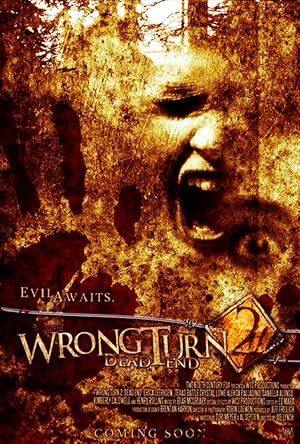
Wrong Turn 2: Dead End
Retired military commander Colonel Dale Murphy hosts the simulated post-apocalyptic reality show where participants are challenged to survive a remote West Virginia wasteland. But the show turns into a nightmarish showdown when each realizes they are being hunted by an inbred family of cannibals determined to make them all dinner!
Produced on a limited budget of $4.0M, the film represents a independent production.


Plot Structure
Story beats plotted across runtime


Narrative Arc
Emotional journey through the story's key moments
Story Circle
Blueprint 15-beat structure
Arcplot Score Breakdown
Weighted: Precision (70%) + Arc (15%) + Theme (15%)
Wrong Turn 2: Dead End (2007) reveals carefully calibrated dramatic framework, characteristic of Joe Lynch's storytelling approach. This structural analysis examines how the film's 15-point plot structure maps to proven narrative frameworks across 1 hour and 37 minutes. With an Arcplot score of 7.4, the film balances conventional beats with creative variation.
Structural Analysis
The Status Quo at 1 minutes (1% through the runtime) establishes Reality TV contestant Kimberly drives through the West Virginia backwoods while on her phone, representing the vapid, self-absorbed world of celebrity culture about to collide with primal horror.. Structural examination shows that this early placement immediately immerses viewers in the story world.
The inciting incident occurs at 12 minutes when The mutant cannibals make their presence violently known by killing Kimberly in the opening, and soon the production crew begins disappearing. The contestants' reality show adventure becomes a real fight for survival.. At 12% through the film, this Disruption aligns precisely with traditional story structure. This beat shifts the emotional landscape, launching the protagonist into the central conflict.
The First Threshold at 24 minutes marks the transition into Act II, occurring at 25% of the runtime. This reveals the protagonist's commitment to The contestants discover the first mutilated body and realize this is no longer a game. They must choose to venture deeper into the woods to find help, crossing from the artificial reality TV world into genuine survival horror., moving from reaction to action.
At 49 minutes, the Midpoint arrives at 50% of the runtime—precisely centered, creating perfect narrative symmetry. Significantly, this crucial beat The survivors discover the cannibals' compound and witness the full extent of the mutant family's operation, including their breeding program. What seemed like escaping random attackers becomes understanding they're trapped in the family's territory with no easy way out., fundamentally raising what's at risk. The emotional intensity shifts, dividing the narrative into clear before-and-after phases.
The Collapse moment at 73 minutes (75% through) represents the emotional nadir. Here, Most of the contestants have been killed. The survivors are captured and brought to the cannibals' home for the family dinner. All hope seems lost as they're prepared to become the next meal, with the full horror of the family's generational violence revealed., demonstrates the protagonist at their lowest point. This beat's placement in the final quarter sets up the climactic reversal.
The Second Threshold at 78 minutes initiates the final act resolution at 80% of the runtime. Nina and Dale break free and decide to stop running. Instead of trying to escape, they choose to systematically destroy the cannibal family, embracing their own capacity for violence to survive., demonstrating the transformation achieved throughout the journey.
Emotional Journey
Wrong Turn 2: Dead End's emotional architecture traces a deliberate progression across 15 carefully calibrated beats.
Narrative Framework
This structural analysis employs structural analysis methodology used to understand storytelling architecture. By mapping Wrong Turn 2: Dead End against these established plot points, we can identify how Joe Lynch utilizes or subverts traditional narrative conventions. The plot point approach reveals not only adherence to structural principles but also creative choices that distinguish Wrong Turn 2: Dead End within the adventure genre.
Comparative Analysis
Additional adventure films include The Black Stallion, The Bad Guys and Puss in Boots.
Plot Points by Act
Act I
SetupStatus Quo
Reality TV contestant Kimberly drives through the West Virginia backwoods while on her phone, representing the vapid, self-absorbed world of celebrity culture about to collide with primal horror.
Theme
Colonel Dale Murphy introduces the reality show concept: "Ultimate Survivalist" will test who has what it takes to survive in the wilderness, foreshadowing that true survival means shedding civilization's superficiality.
Worldbuilding
The contestants are introduced: Nina, Jake, Amber, Jonesy, Elena, Mara, and Michael. Each represents different archetypes of reality TV participants. The remote West Virginia forest location is established as the show's setting, with crew setting up cameras throughout the woods.
Disruption
The mutant cannibals make their presence violently known by killing Kimberly in the opening, and soon the production crew begins disappearing. The contestants' reality show adventure becomes a real fight for survival.
Resistance
Colonel Dale Murphy serves as the authoritative guide figure, organizing the contestants and establishing survival protocols. The group debates whether strange occurrences are part of the show or something genuinely wrong. Tensions rise between contestants as they're divided into teams.
Act II
ConfrontationFirst Threshold
The contestants discover the first mutilated body and realize this is no longer a game. They must choose to venture deeper into the woods to find help, crossing from the artificial reality TV world into genuine survival horror.
Mirror World
Nina and Jake's growing bond represents the authentic human connection that contrasts with the superficial relationships of the reality TV format. Their partnership demonstrates that genuine trust, not competitive backstabbing, is necessary for survival.
Premise
The horror premise delivers: contestants are hunted through the forest by the inbred cannibal family. Gore-filled chase sequences, creative kills, and the group's desperate attempts to escape or fight back. The reality show format is subverted as cameras capture real deaths.
Midpoint
The survivors discover the cannibals' compound and witness the full extent of the mutant family's operation, including their breeding program. What seemed like escaping random attackers becomes understanding they're trapped in the family's territory with no easy way out.
Opposition
The cannibal family systematically hunts the dwindling survivors. Characters are captured, tortured, and killed. Mara is revealed to be pregnant by one of the mutants. Colonel Dale Murphy transforms from reality TV host to genuine warrior, using his military training to fight back.
Collapse
Most of the contestants have been killed. The survivors are captured and brought to the cannibals' home for the family dinner. All hope seems lost as they're prepared to become the next meal, with the full horror of the family's generational violence revealed.
Crisis
The survivors face their darkest moment, bound and helpless in the cannibals' lair. They must confront the reality that civilization's rules mean nothing here. The choice becomes clear: fight with primal savagery or die.
Act III
ResolutionSecond Threshold
Nina and Dale break free and decide to stop running. Instead of trying to escape, they choose to systematically destroy the cannibal family, embracing their own capacity for violence to survive.
Synthesis
The final battle unfolds as Dale and Nina wage war against the mutant family. Dale uses explosives and military tactics while Nina proves her survivalist worth. The cannibal compound becomes a battleground as the hunters become the hunted.
Transformation
Nina emerges from the woods, bloodied but alive, having transformed from reality TV contestant to genuine survivor. The superficial world she came from is gone; she's been forged by primal violence into something harder and more authentic.