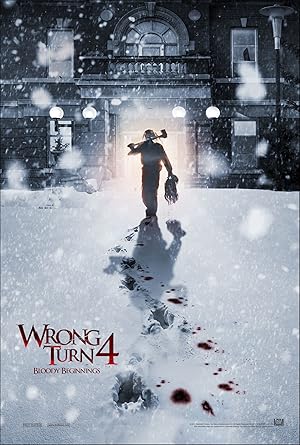
Wrong Turn 4: Bloody Beginnings
Follows a group of friends that decide to go snowmobiling during their winter break. They make a "wrong turn", getting lost in a storm, and seek shelter in an abandoned sanatorium. They are completely isolated by the storm and are thankful they can get out of the elements. But the sanatorium has a troubled past, and some of its former patients still reside there and are not happy about the intrusion. In a deadly game of cat and mouse, the college kids must fight to survive the night.
Produced on a modest budget of $3.0M, the film represents a independent production.


Plot Structure
Story beats plotted across runtime


Narrative Arc
Emotional journey through the story's key moments
Story Circle
Blueprint 15-beat structure
Arcplot Score Breakdown
Weighted: Precision (70%) + Arc (15%) + Theme (15%)
Wrong Turn 4: Bloody Beginnings (2011) showcases precise plot construction, characteristic of Declan O'Brien's storytelling approach. This structural analysis examines how the film's 15-point plot structure maps to proven narrative frameworks across 1 hour and 33 minutes. With an Arcplot score of 7.2, the film balances conventional beats with creative variation.
Structural Analysis
The Status Quo at 1 minutes (1% through the runtime) establishes 1974 - The inmates of Glensville Sanatorium have taken over the asylum during a violent riot, establishing a horrifying world of cannibalistic chaos within the institution's walls.. Of particular interest, this early placement immediately immerses viewers in the story world.
The inciting incident occurs at 11 minutes when A blizzard forces the group to seek shelter in what appears to be an abandoned sanatorium, disrupting their planned vacation and trapping them in the isolated building.. At 12% through the film, this Disruption aligns precisely with traditional story structure. This beat shifts the emotional landscape, launching the protagonist into the central conflict.
The First Threshold at 23 minutes marks the transition into Act II, occurring at 25% of the runtime. This illustrates the protagonist's commitment to The group discovers they are trapped inside the sanatorium and encounters the first clear evidence of the cannibalistic killers, committing them to a fight for survival rather than escape., moving from reaction to action.
At 46 minutes, the Midpoint arrives at 49% of the runtime—precisely centered, creating perfect narrative symmetry. Structural examination shows that this crucial beat The group's numbers are significantly reduced and they discover the true horrifying nature of the sanatorium's history, raising the stakes as they realize the killers have been doing this for decades., fundamentally raising what's at risk. The emotional intensity shifts, dividing the narrative into clear before-and-after phases.
The Collapse moment at 69 minutes (74% through) represents the emotional nadir. Here, The last apparent hope of escape is destroyed and the strongest member of the group is brutally killed, leaving only the most vulnerable survivors facing certain death., shows the protagonist at their lowest point. This beat's placement in the final quarter sets up the climactic reversal.
The Second Threshold at 74 minutes initiates the final act resolution at 80% of the runtime. The remaining survivor(s) find a desperate last chance for escape or confrontation, synthesizing their knowledge of the sanatorium's layout with newfound resolve to fight back., demonstrating the transformation achieved throughout the journey.
Emotional Journey
Wrong Turn 4: Bloody Beginnings's emotional architecture traces a deliberate progression across 15 carefully calibrated beats.
Narrative Framework
This structural analysis employs structural analysis methodology used to understand storytelling architecture. By mapping Wrong Turn 4: Bloody Beginnings against these established plot points, we can identify how Declan O'Brien utilizes or subverts traditional narrative conventions. The plot point approach reveals not only adherence to structural principles but also creative choices that distinguish Wrong Turn 4: Bloody Beginnings within the adventure genre.
Comparative Analysis
Additional adventure films include The Black Stallion, The Bad Guys and Puss in Boots.
Plot Points by Act
Act I
SetupStatus Quo
1974 - The inmates of Glensville Sanatorium have taken over the asylum during a violent riot, establishing a horrifying world of cannibalistic chaos within the institution's walls.
Theme
Present day - One of the young adults jokes about survival in extreme conditions, foreshadowing the film's exploration of whether civilization persists when stripped of social structures.
Worldbuilding
Introduction of the group of young friends heading to a remote cabin for a snowmobiling trip. Relationships, personalities, and interpersonal tensions are established as they travel through the winter wilderness.
Disruption
A blizzard forces the group to seek shelter in what appears to be an abandoned sanatorium, disrupting their planned vacation and trapping them in the isolated building.
Resistance
The group explores the sanatorium, debating whether to stay or risk the storm. They discover disturbing evidence of the facility's dark past and begin to realize they may not be alone.
Act II
ConfrontationFirst Threshold
The group discovers they are trapped inside the sanatorium and encounters the first clear evidence of the cannibalistic killers, committing them to a fight for survival rather than escape.
Mirror World
The revelation of who the killers truly are - the inbred cannibals Three Finger, Saw Tooth, and One Eye in their origin story - creates a thematic mirror showing civilization versus savagery.
Premise
Cat-and-mouse survival horror as the group is hunted through the sanatorium. The killers pick them off one by one using the asylum's gruesome infrastructure of torture and medical equipment.
Midpoint
The group's numbers are significantly reduced and they discover the true horrifying nature of the sanatorium's history, raising the stakes as they realize the killers have been doing this for decades.
Opposition
The remaining survivors attempt various escape plans, but the cannibals systematically destroy each opportunity. Interpersonal conflicts emerge under extreme pressure as hope dwindles.
Collapse
The last apparent hope of escape is destroyed and the strongest member of the group is brutally killed, leaving only the most vulnerable survivors facing certain death.
Crisis
The final survivors face their darkest moment, processing their losses and the seeming impossibility of survival as the cannibals close in for the final hunt.
Act III
ResolutionSecond Threshold
The remaining survivor(s) find a desperate last chance for escape or confrontation, synthesizing their knowledge of the sanatorium's layout with newfound resolve to fight back.
Synthesis
The final confrontation between survivors and cannibals, culminating in brutal violence as the remaining characters make their last stand in the frozen sanatorium.
Transformation
The bleak ending reveals whether any survivors escape, typically showing the cannibals' continued reign of terror, transforming the story from survival horror to inevitable tragedy.