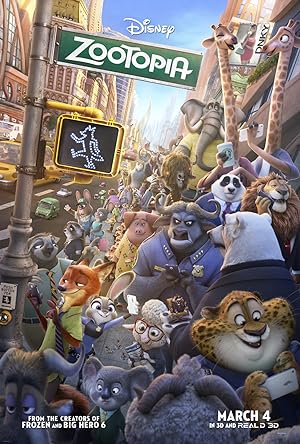
Zootopia
From the largest elephant to the smallest shrew, the city of Zootopia is a mammal metropolis where various animals live and thrive. When Judy Hopps becomes the first rabbit to join the police force, she quickly learns how tough it is to enforce the law. Determined to prove herself, Judy jumps at the opportunity to solve a mysterious case. Unfortunately, that means working with Nick Wilde, a wily fox who makes her job even harder.
Despite a blockbuster budget of $150.0M, Zootopia became a box office phenomenon, earning $1025.5M worldwide—a remarkable 584% return. This commercial performance validated the ambitious narrative scope, proving that audiences embrace distinctive approach even at blockbuster scale.
1 Oscar. 49 wins & 75 nominations


Plot Structure
Story beats plotted across runtime


Narrative Arc
Emotional journey through the story's key moments
Story Circle
Blueprint 15-beat structure
Arcplot Score Breakdown
Weighted: Precision (70%) + Arc (15%) + Theme (15%)
Zootopia (2016) exemplifies deliberately positioned story structure, characteristic of Byron Howard's storytelling approach. This structural analysis examines how the film's 15-point plot structure maps to proven narrative frameworks across 1 hour and 49 minutes. With an Arcplot score of 6.9, the film balances conventional beats with creative variation.
Structural Analysis
The Status Quo at 1 minutes (1% through the runtime) establishes Young Judy Hopps performs in a school play about predator-prey harmony, revealing her dream to become the first rabbit police officer despite everyone saying it's impossible.. Notably, this early placement immediately immerses viewers in the story world.
The inciting incident occurs at 13 minutes when Judy graduates top of her class at the police academy and becomes the first rabbit officer, assigned to Zootopia's Police Department. Her dream has come true.. At 12% through the film, this Disruption aligns precisely with traditional story structure. This beat shifts the emotional landscape, launching the protagonist into the central conflict.
The First Threshold at 27 minutes marks the transition into Act II, occurring at 25% of the runtime. This reveals the protagonist's commitment to Judy chooses to take on the missing otter case (Otterton) without authorization, giving herself 48 hours to solve it or resign. She blackmails Nick into helping her investigate., moving from reaction to action.
At 53 minutes, the Midpoint arrives at 49% of the runtime—precisely centered, creating perfect narrative symmetry. Structural examination shows that this crucial beat False victory: Judy and Nick discover the missing mammals in an asylum, all "gone savage." Judy calls for backup and becomes a hero. Chief Bogo praises her, and she's put in charge of the case., fundamentally raising what's at risk. The emotional intensity shifts, dividing the narrative into clear before-and-after phases.
The Collapse moment at 80 minutes (74% through) represents the emotional nadir. Here, Nick rejects Judy, telling her she's just like everyone else who judged him for being a fox. Judy realizes she has become what she fought against—someone who sees others through prejudice. She quits the police force in shame., reveals the protagonist at their lowest point. This beat's placement in the final quarter sets up the climactic reversal.
The Second Threshold at 85 minutes initiates the final act resolution at 78% of the runtime. Judy discovers that "night howlers" (toxic flowers) are the cause of the savage behavior, not biology. She realizes the truth and gains the knowledge needed to solve the case and undo the damage. She returns to Zootopia to find Nick and make things right., demonstrating the transformation achieved throughout the journey.
Emotional Journey
Zootopia's emotional architecture traces a deliberate progression across 15 carefully calibrated beats.
Narrative Framework
This structural analysis employs structural analysis methodology used to understand storytelling architecture. By mapping Zootopia against these established plot points, we can identify how Byron Howard utilizes or subverts traditional narrative conventions. The plot point approach reveals not only adherence to structural principles but also creative choices that distinguish Zootopia within the animation genre.
Byron Howard's Structural Approach
Among the 3 Byron Howard films analyzed on Arcplot, the average structural score is 7.2, reflecting strong command of classical structure. Zootopia takes a more unconventional approach compared to the director's typical style. For comparative analysis, explore the complete Byron Howard filmography.
Comparative Analysis
Additional animation films include The Bad Guys, Puss in Boots and Violet Evergarden: Eternity and the Auto Memory Doll. For more Byron Howard analyses, see Tangled, Encanto.
Plot Points by Act
Act I
SetupStatus Quo
Young Judy Hopps performs in a school play about predator-prey harmony, revealing her dream to become the first rabbit police officer despite everyone saying it's impossible.
Theme
Judy's parents warn her: "It's great to have dreams, just as long as you don't believe in them too much." The theme of prejudice vs. potential is stated.
Worldbuilding
Establishing Judy's small-town Bunnyburrow origins, her training at the police academy, and her determination to prove everyone wrong about what rabbits can accomplish.
Disruption
Judy graduates top of her class at the police academy and becomes the first rabbit officer, assigned to Zootopia's Police Department. Her dream has come true.
Resistance
Judy arrives in Zootopia full of hope but faces reality: Chief Bogo assigns her to parking duty instead of real cases. She meets Nick Wilde, a fox con artist, who humiliates her. She struggles with being taken seriously.
Act II
ConfrontationFirst Threshold
Judy chooses to take on the missing otter case (Otterton) without authorization, giving herself 48 hours to solve it or resign. She blackmails Nick into helping her investigate.
Mirror World
Nick and Judy begin their partnership. Nick, the cynical fox who has faced prejudice his whole life, becomes the character who will teach Judy about the real nature of bias in Zootopia.
Premise
The buddy-cop investigation: Judy and Nick navigate Zootopia's districts (Tundratown, Rainforest District), tracking clues about the missing mammals. Their odd-couple dynamic provides humor as they interview witnesses and dodge danger.
Midpoint
False victory: Judy and Nick discover the missing mammals in an asylum, all "gone savage." Judy calls for backup and becomes a hero. Chief Bogo praises her, and she's put in charge of the case.
Opposition
Judy becomes the face of the investigation at a press conference but inadvertently makes prejudiced statements about predators having biological tendencies to go savage. Nick is deeply hurt. Their partnership fractures. Predators face discrimination citywide. Judy's hero status comes at a terrible cost.
Collapse
Nick rejects Judy, telling her she's just like everyone else who judged him for being a fox. Judy realizes she has become what she fought against—someone who sees others through prejudice. She quits the police force in shame.
Crisis
Judy returns to Bunnyburrow defeated, working on her parents' carrot farm. She reflects on her failure and the harm she caused. This is her dark night of the soul.
Act III
ResolutionSecond Threshold
Judy discovers that "night howlers" (toxic flowers) are the cause of the savage behavior, not biology. She realizes the truth and gains the knowledge needed to solve the case and undo the damage. She returns to Zootopia to find Nick and make things right.
Synthesis
Judy apologizes to Nick, and they reunite to expose the conspiracy: Assistant Mayor Bellwether is weaponizing night howlers to turn predators savage and seize power. They obtain evidence, survive Bellwether's trap, and bring her to justice. Harmony is restored to Zootopia.
Transformation
Judy is reinstated as an officer, and Nick joins the ZPD as her partner—the first fox police officer. The closing image mirrors the opening: they patrol together, equals, having overcome prejudice through understanding and friendship.