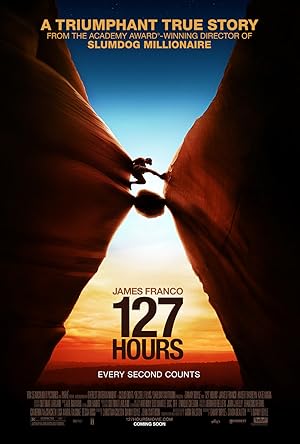
127 Hours
127 Hours is the true story of mountain climber Aron Ralston's remarkable adventure to save himself after a fallen boulder crashes on his arm and traps him in an isolated canyon in Utah. Over the next five days Ralston examines his life and survives the elements to finally discover he has the courage and the wherewithal to extricate himself by any means necessary, scale a 65 foot wall and hike over eight miles before he can be rescued. Throughout his journey, Ralston recalls friends, lovers, family, and the two hikers he met before his accident. Will they be the last two people he ever had the chance to meet?
Working with a moderate budget of $18.0M, the film achieved a steady performer with $35.7M in global revenue (+98% profit margin).
Nominated for 6 Oscars. 23 wins & 150 nominations


Plot Structure
Story beats plotted across runtime


Narrative Arc
Emotional journey through the story's key moments
Story Circle
Blueprint 15-beat structure
Arcplot Score Breakdown
Weighted: Precision (70%) + Arc (15%) + Theme (15%)
127 Hours (2010) exhibits precise story structure, characteristic of Danny Boyle's storytelling approach. This structural analysis examines how the film's 15-point plot structure maps to proven narrative frameworks across 1 hour and 34 minutes. With an Arcplot score of 6.0, the film takes an unconventional approach to traditional narrative frameworks.
Characters
Cast & narrative archetypes

Aron Ralston
Main Cast & Characters
Aron Ralston
Played by James Franco
An adventurous canyoneer who becomes trapped by a boulder in a remote Utah canyon and must survive alone for 127 hours.
Structural Analysis
The Status Quo at 1 minutes (1% through the runtime) establishes Aron Ralston prepares for his solo canyon adventure, moving quickly through his apartment, ignoring a phone call. Split-screen montage shows his isolated, self-sufficient lifestyle - a man who doesn't ask for help or tell anyone where he's going.. Significantly, this early placement immediately immerses viewers in the story world.
The inciting incident occurs at 11 minutes when Aron descends into Blue John Canyon. A boulder shifts under his weight and falls, trapping his right arm against the canyon wall. He realizes with dawning horror that he is completely stuck and utterly alone.. At 12% through the film, this Disruption aligns precisely with traditional story structure. This beat shifts the emotional landscape, launching the protagonist into the central conflict.
The First Threshold at 24 minutes marks the transition into Act II, occurring at 26% of the runtime. This indicates the protagonist's commitment to Aron accepts that no one is coming to save him. He didn't tell anyone where he was going, and no one will look for him here. He makes the choice to commit fully to survival, beginning his video diary for whoever finds his body., moving from reaction to action.
At 47 minutes, the Midpoint arrives at 50% of the runtime—precisely centered, creating perfect narrative symmetry. Significantly, this crucial beat Aron runs out of water. The stakes are raised from "trapped and waiting" to "dying of dehydration." He realizes he has perhaps 24 hours left. The false hope of rescue is completely gone; this becomes a fight for survival at any cost., fundamentally raising what's at risk. The emotional intensity shifts, dividing the narrative into clear before-and-after phases.
The Collapse moment at 64 minutes (68% through) represents the emotional nadir. Here, In a powerful hallucination/vision, Aron sees his future son and realizes he will die here without ever experiencing the love and connection he's been avoiding. This "whiff of death" is both literal (his impending death) and metaphorical (death of his old self-sufficient identity)., illustrates the protagonist at their lowest point. This beat's placement in the final quarter sets up the climactic reversal.
The Second Threshold at 67 minutes initiates the final act resolution at 71% of the runtime. Aron realizes he can break his arm bones using the boulder as leverage, then cut through the soft tissue. The vision of his future son combined with acceptance of help/dependence gives him clarity: he wants to live and connect with others. He synthesizes his survival skills with his newfound emotional openness., demonstrating the transformation achieved throughout the journey.
Emotional Journey
127 Hours's emotional architecture traces a deliberate progression across 15 carefully calibrated beats.
Narrative Framework
This structural analysis employs systematic plot point analysis that identifies crucial turning points. By mapping 127 Hours against these established plot points, we can identify how Danny Boyle utilizes or subverts traditional narrative conventions. The plot point approach reveals not only adherence to structural principles but also creative choices that distinguish 127 Hours within the biography genre.
Danny Boyle's Structural Approach
Among the 12 Danny Boyle films analyzed on Arcplot, the average structural score is 6.6, demonstrating varied approaches to story architecture. 127 Hours takes a more unconventional approach compared to the director's typical style. For comparative analysis, explore the complete Danny Boyle filmography.
Comparative Analysis
Additional biography films include After Thomas, Taking Woodstock and The Fire Inside. For more Danny Boyle analyses, see Yesterday, Millions and T2 Trainspotting.
Plot Points by Act
Act I
SetupStatus Quo
Aron Ralston prepares for his solo canyon adventure, moving quickly through his apartment, ignoring a phone call. Split-screen montage shows his isolated, self-sufficient lifestyle - a man who doesn't ask for help or tell anyone where he's going.
Theme
Aron meets two lost hikers (Megan and Kristi) and when asked if he's hiking alone, enthusiastically says "Just me!" Later they ask "Don't you ever get lonely?" foreshadowing the film's exploration of self-reliance versus connection.
Worldbuilding
Aron drives to Utah's Canyonlands, mountain bikes across the desert, and explores slot canyons. We see his expertise, confidence, and love of adventure. He guides the two hikers to an underground pool, showing his knowledge and charisma, but also his tendency to take risks.
Disruption
Aron descends into Blue John Canyon. A boulder shifts under his weight and falls, trapping his right arm against the canyon wall. He realizes with dawning horror that he is completely stuck and utterly alone.
Resistance
Aron tries every practical solution to free himself: pulling his arm out, chipping at the boulder with his multi-tool, rigging a pulley system with climbing rope. Each attempt fails. He debates his options, takes inventory of supplies (two burritos, 300ml water), and begins documenting on his video camera.
Act II
ConfrontationFirst Threshold
Aron accepts that no one is coming to save him. He didn't tell anyone where he was going, and no one will look for him here. He makes the choice to commit fully to survival, beginning his video diary for whoever finds his body.
Mirror World
Through hallucinations and memories, Aron begins reliving his relationships - his ex-girlfriend Rana, his family, the hikers he met. These "B Story" connections represent what he's been running from: emotional intimacy and dependence on others.
Premise
Aron battles the elements and his own mind. Days blur together as he rations water, fights dehydration, and experiences increasingly vivid hallucinations. His video confessions become more raw and honest, addressing regrets about relationships and his isolated lifestyle.
Midpoint
Aron runs out of water. The stakes are raised from "trapped and waiting" to "dying of dehydration." He realizes he has perhaps 24 hours left. The false hope of rescue is completely gone; this becomes a fight for survival at any cost.
Opposition
Delirium sets in. Aron drinks his own urine, endures freezing nights and scorching days. He hallucinates his family, revisits painful memories, and begins to emotionally break down. His body is shutting down as gangrene sets in on his trapped arm.
Collapse
In a powerful hallucination/vision, Aron sees his future son and realizes he will die here without ever experiencing the love and connection he's been avoiding. This "whiff of death" is both literal (his impending death) and metaphorical (death of his old self-sufficient identity).
Crisis
Aron records final goodbyes to his family, apologizing and expressing love. He carves his name and presumed death date into the canyon wall. He has accepted death and made peace with his life - the dark night before the dawn.
Act III
ResolutionSecond Threshold
Aron realizes he can break his arm bones using the boulder as leverage, then cut through the soft tissue. The vision of his future son combined with acceptance of help/dependence gives him clarity: he wants to live and connect with others. He synthesizes his survival skills with his newfound emotional openness.
Synthesis
In an excruciating sequence, Aron breaks his arm bones and amputates his forearm with a dull multi-tool knife. Free at last, he rappels down a cliff, hikes miles through the desert, and is finally rescued by a family. He allows himself to be helped and saved.
Transformation
Title cards reveal Aron married, had a son (the one he saw in his vision), and never goes climbing without telling someone where he's going. Final image shows Aron with his family - the isolated, self-reliant adventurer transformed into a connected, interdependent person who values relationships above independence.