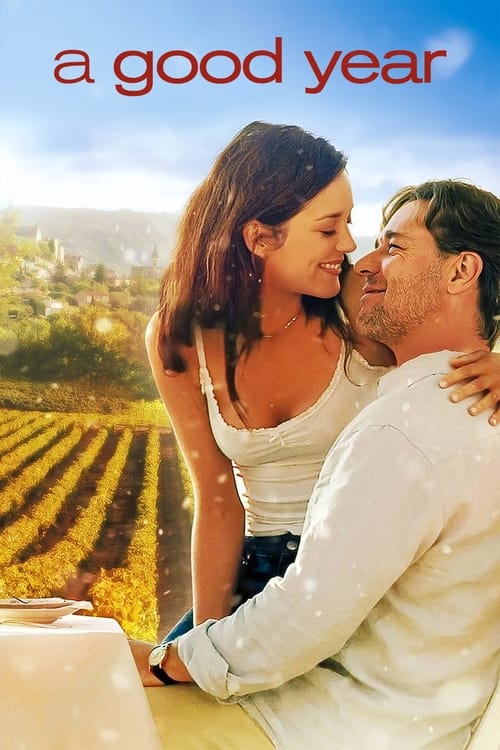
A Good Year
Failed London banker Max Skinner inherits his uncle's vineyard in Provence, where he spent many childhood holidays. Upon his arrival, he meets a woman from California who tells Max she is his long-lost cousin and that the property is hers.
Working with a mid-range budget of $35.0M, the film achieved a respectable showing with $42.1M in global revenue (+20% profit margin).
1 win & 2 nominations


Plot Structure
Story beats plotted across runtime


Narrative Arc
Emotional journey through the story's key moments
Story Circle
Blueprint 15-beat structure
Arcplot Score Breakdown
Weighted: Precision (70%) + Arc (15%) + Theme (15%)
A Good Year (2006) exhibits strategically placed narrative architecture, characteristic of Ridley Scott's storytelling approach. This structural analysis examines how the film's 15-point plot structure maps to proven narrative frameworks across 1 hour and 57 minutes. With an Arcplot score of 7.4, the film balances conventional beats with creative variation.
Characters
Cast & narrative archetypes

Max Skinner
Fanny Chenal
Uncle Henry
Christie Roberts
Francis Duflot
Main Cast & Characters
Max Skinner
Played by Russell Crowe
A ruthless London investment banker who inherits a French vineyard and rediscovers what matters in life
Fanny Chenal
Played by Marion Cotillard
A local French café owner and winemaker who becomes Max's love interest and moral guide
Uncle Henry
Played by Albert Finney
Max's beloved late uncle who owned the vineyard and taught him about life and wine as a child
Christie Roberts
Played by Abbie Cornish
A young American woman claiming to be Henry's illegitimate daughter and rightful heir to the estate
Francis Duflot
Played by Didier Bourdon
The estate's loyal and traditional French caretaker and winemaker
Structural Analysis
The Status Quo at 1 minutes (1% through the runtime) establishes Max Skinner as ruthless London trader executing aggressive financial deals, showing his cutthroat business mentality and materialistic lifestyle.. Structural examination shows that this early placement immediately immerses viewers in the story world.
The inciting incident occurs at 14 minutes when Max receives news that Uncle Henry has died, leaving him the Château la Siroque vineyard in Provence.. At 12% through the film, this Disruption aligns precisely with traditional story structure. This beat shifts the emotional landscape, launching the protagonist into the central conflict.
The First Threshold at 29 minutes marks the transition into Act II, occurring at 25% of the runtime. This illustrates the protagonist's commitment to Max arrives at Château la Siroque and decides to stay long enough to prepare the property for sale, actively choosing to engage with his past., moving from reaction to action.
At 58 minutes, the Midpoint arrives at 50% of the runtime—precisely centered, creating perfect narrative symmetry. Structural examination shows that this crucial beat Max and Fanny share romantic dinner and night together - false victory as Max believes he can have both romance and return to London wealth., fundamentally raising what's at risk. The emotional intensity shifts, dividing the narrative into clear before-and-after phases.
The Collapse moment at 87 minutes (75% through) represents the emotional nadir. Here, Fanny rejects Max after learning he views the vineyard only as money; Max loses both the woman and the connection to his authentic self. His old life is metaphorically "dead."., demonstrates the protagonist at their lowest point. This beat's placement in the final quarter sets up the climactic reversal.
The Second Threshold at 93 minutes initiates the final act resolution at 79% of the runtime. Max discovers Uncle Henry's letter revealing life wisdom and blessing to choose happiness over money; Max decides to return and fight for the vineyard and Fanny., demonstrating the transformation achieved throughout the journey.
Emotional Journey
A Good Year's emotional architecture traces a deliberate progression across 15 carefully calibrated beats.
Narrative Framework
This structural analysis employs a 15-point narrative structure framework that maps key story moments. By mapping A Good Year against these established plot points, we can identify how Ridley Scott utilizes or subverts traditional narrative conventions. The plot point approach reveals not only adherence to structural principles but also creative choices that distinguish A Good Year within the comedy genre.
Ridley Scott's Structural Approach
Among the 24 Ridley Scott films analyzed on Arcplot, the average structural score is 6.5, demonstrating varied approaches to story architecture. A Good Year represents one of the director's most structurally precise works. For comparative analysis, explore the complete Ridley Scott filmography.
Comparative Analysis
Additional comedy films include The Bad Guys, Ella Enchanted and The Evening Star. For more Ridley Scott analyses, see Alien, White Squall and American Gangster.
Plot Points by Act
Act I
SetupStatus Quo
Max Skinner as ruthless London trader executing aggressive financial deals, showing his cutthroat business mentality and materialistic lifestyle.
Theme
Flashback to young Max with Uncle Henry at the vineyard: "There are no rules here - we make our own." Theme of choosing authentic life over prescribed success.
Worldbuilding
Establish Max's high-pressure trading career, his competitive nature, empty romantic life, and childhood memories of summers in Provence with Uncle Henry.
Disruption
Max receives news that Uncle Henry has died, leaving him the Château la Siroque vineyard in Provence.
Resistance
Max debates whether to travel to France, views it purely as real estate to sell quickly, reluctantly leaves London expecting brief trip.
Act II
ConfrontationFirst Threshold
Max arrives at Château la Siroque and decides to stay long enough to prepare the property for sale, actively choosing to engage with his past.
Mirror World
Max meets Fanny Chenal at her bistro - she represents authentic Provençal life and becomes the romantic subplot that carries the theme of choosing love over money.
Premise
Max experiences the charm of Provence, reconnects with childhood memories, pursues Fanny, clashes with estate manager Francis over vineyard care, still intending to sell.
Midpoint
Max and Fanny share romantic dinner and night together - false victory as Max believes he can have both romance and return to London wealth.
Opposition
Christie claims to be Henry's illegitimate daughter with rights to estate; Max's London life intrudes; Fanny discovers Max's plan to sell; relationship crumbles as Max's true intentions revealed.
Collapse
Fanny rejects Max after learning he views the vineyard only as money; Max loses both the woman and the connection to his authentic self. His old life is metaphorically "dead."
Crisis
Max returns to London defeated, goes through motions of trading life, but realizes the emptiness of his existence without authentic connection.
Act III
ResolutionSecond Threshold
Max discovers Uncle Henry's letter revealing life wisdom and blessing to choose happiness over money; Max decides to return and fight for the vineyard and Fanny.
Synthesis
Max returns to Provence, quits his London job, resolves Christie's claim honorably, wins back Fanny by proving genuine transformation, chooses vineyard life over trading career.
Transformation
Max at the vineyard with Fanny, living the authentic life his uncle wanted for him - mirrors opening but shows transformation from ruthless trader to man who values love and authenticity.