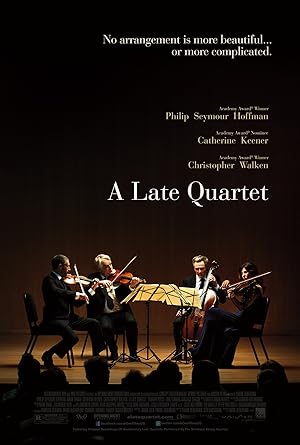
A Late Quartet
After a classical string quartet's 25 years of success, Peter, the cellist and oldest member, decides that he must retire when he learns he has Parkinson's disease. For the others, that announcement proves a catalyst for bringing their hidden resentments to the surface, while the married member's daughter has her own disruptive desires. All this threatens to tear the group apart even as they are famous for playing Beethoven's String Quartet No. 14, opus 131, a piece that is played non-stop no matter how life interferes.
The film earned $6.3M at the global box office.
1 win & 2 nominations


Plot Structure
Story beats plotted across runtime


Narrative Arc
Emotional journey through the story's key moments
Story Circle
Blueprint 15-beat structure
Arcplot Score Breakdown
Weighted: Precision (70%) + Arc (15%) + Theme (15%)
A Late Quartet (2012) demonstrates precise narrative design, characteristic of Yaron Zilberman's storytelling approach. This structural analysis examines how the film's 15-point plot structure maps to proven narrative frameworks across 1 hour and 46 minutes. With an Arcplot score of 7.7, the film showcases strong structural fundamentals.
Characters
Cast & narrative archetypes

Peter Mitchell
Robert Gelbart
Juliette Gelbart
Daniel Lerner
Alexandra Gelbart
Main Cast & Characters
Peter Mitchell
Played by Christopher Walken
Second violinist of the quartet facing a career crisis and marital tensions, struggling with his position and artistic ambitions.
Robert Gelbart
Played by Philip Seymour Hoffman
First violinist and perfectionist leader of the quartet, fiercely protective of the group's artistic integrity and hierarchy.
Juliette Gelbart
Played by Catherine Keener
Second violinist and Robert's wife, caught between her husband and her attraction to Daniel, seeking balance and harmony.
Daniel Lerner
Played by Mark Ivanir
Cellist of the quartet, charismatic and emotionally expressive, becomes romantically involved with Robert and Juliette's daughter.
Alexandra Gelbart
Played by Imogen Poots
Daughter of Robert and Juliette, a talented violinist who studies with Peter and becomes romantically involved with Daniel.
Structural Analysis
The Status Quo at 2 minutes (2% through the runtime) establishes The Fugue String Quartet performs Beethoven's Opus 131 in perfect harmony before an appreciative audience. Twenty-five years of collaboration, discipline, and artistic excellence on display.. Of particular interest, this early placement immediately immerses viewers in the story world.
The inciting incident occurs at 12 minutes when Peter is diagnosed with Parkinson's disease. His doctor tells him his fine motor control will deteriorate. The quartet's foundation—their anchor for 25 years—is crumbling.. At 12% through the film, this Disruption aligns precisely with traditional story structure. This beat shifts the emotional landscape, launching the protagonist into the central conflict.
The First Threshold at 26 minutes marks the transition into Act II, occurring at 25% of the runtime. This shows the protagonist's commitment to Peter announces his illness to the quartet and states this will be his final season. The quartet must choose: disband or continue. They commit to performing Opus 131 for the 25th anniversary, entering uncertain territory., moving from reaction to action.
At 52 minutes, the Midpoint arrives at 49% of the runtime—precisely centered, creating perfect narrative symmetry. Notably, this crucial beat Daniel discovers Robert's affair with Alexandra. The betrayal is complete—personal and professional boundaries shattered. What seemed like artistic disagreement reveals itself as deeper fractures in trust and respect., fundamentally raising what's at risk. The emotional intensity shifts, dividing the narrative into clear before-and-after phases.
The Collapse moment at 78 minutes (74% through) represents the emotional nadir. Here, The quartet falls apart during a catastrophic rehearsal. Daniel walks out. Robert and Juliette clash. Peter realizes the quartet may not survive to perform the final concert. The "death" of the ensemble—and Peter's legacy., illustrates the protagonist at their lowest point. This beat's placement in the final quarter sets up the climactic reversal.
The Second Threshold at 83 minutes initiates the final act resolution at 78% of the runtime. Peter visits each member individually, reminding them that Opus 131 has seven movements played without pause—"like life, it doesn't stop for our problems." They must choose between ego and ensemble. Reconciliation begins., demonstrating the transformation achieved throughout the journey.
Emotional Journey
A Late Quartet's emotional architecture traces a deliberate progression across 15 carefully calibrated beats.
Narrative Framework
This structural analysis employs structural analysis methodology used to understand storytelling architecture. By mapping A Late Quartet against these established plot points, we can identify how Yaron Zilberman utilizes or subverts traditional narrative conventions. The plot point approach reveals not only adherence to structural principles but also creative choices that distinguish A Late Quartet within the drama genre.
Comparative Analysis
Additional drama films include After Thomas, South Pacific and Dirty Dancing: Havana Nights.
Plot Points by Act
Act I
SetupStatus Quo
The Fugue String Quartet performs Beethoven's Opus 131 in perfect harmony before an appreciative audience. Twenty-five years of collaboration, discipline, and artistic excellence on display.
Theme
Peter tells his students about Beethoven's late quartets: "He was deaf, sick, alone... yet he wrote music of transcendent beauty. Art doesn't come from happiness, it comes from struggle." Theme of perfection versus humanity stated.
Worldbuilding
Establish the quartet's dynamics: Daniel and Juliette married, Robert frustrated in second chair, Peter the beloved mentor. Their upcoming 25th season and plans to perform Opus 131. The delicate balance of artistic egos and deep friendships.
Disruption
Peter is diagnosed with Parkinson's disease. His doctor tells him his fine motor control will deteriorate. The quartet's foundation—their anchor for 25 years—is crumbling.
Resistance
Peter struggles with whether to tell the quartet. Robert sees opportunity—suggests rotating first and second violin. Daniel resists change. Tensions emerge as each member contemplates life without Peter. The quartet debates their future.
Act II
ConfrontationFirst Threshold
Peter announces his illness to the quartet and states this will be his final season. The quartet must choose: disband or continue. They commit to performing Opus 131 for the 25th anniversary, entering uncertain territory.
Mirror World
Robert begins giving private lessons to Alexandra, Daniel and Juliette's daughter. The mentor relationship mirrors the quartet's dynamics and introduces the thematic question of artistic passion versus appropriate boundaries.
Premise
The quartet rehearses Opus 131 while personal conflicts intensify. Robert pursues Alexandra romantically. Daniel's perfectionism clashes with Robert's desire for equal standing. Juliette mediates. Peter watches his legacy unravel as his hands betray him.
Midpoint
Daniel discovers Robert's affair with Alexandra. The betrayal is complete—personal and professional boundaries shattered. What seemed like artistic disagreement reveals itself as deeper fractures in trust and respect.
Opposition
The quartet fractures. Daniel and Juliette's marriage strains. Robert defends his relationship with Alexandra. Rehearsals become battlegrounds. Peter's physical decline accelerates as he witnesses the destruction of what he built. The 25th season concert approaches.
Collapse
The quartet falls apart during a catastrophic rehearsal. Daniel walks out. Robert and Juliette clash. Peter realizes the quartet may not survive to perform the final concert. The "death" of the ensemble—and Peter's legacy.
Crisis
Each member faces isolation and loss. Robert ends things with Alexandra. Daniel and Juliette confront their marriage. Peter contemplates his mortality and legacy. Dark night of artistic and personal failure.
Act III
ResolutionSecond Threshold
Peter visits each member individually, reminding them that Opus 131 has seven movements played without pause—"like life, it doesn't stop for our problems." They must choose between ego and ensemble. Reconciliation begins.
Synthesis
The quartet reunites for the 25th season concert. They perform Beethoven's Opus 131, imperfect but together. Mid-performance, Peter's hands fail—he must stop. The remaining three continue, honoring both the music and their mentor.
Transformation
The quartet takes their bow—three members instead of four, but still whole. Peter watches from backstage, smiling through tears. Art requires both perfection and humanity, struggle and grace. The music continues.