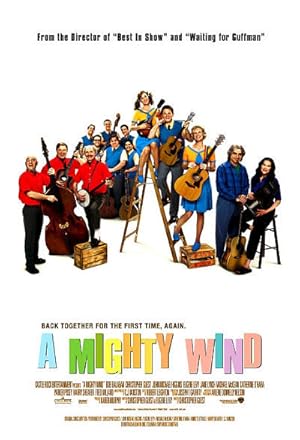
A Mighty Wind
When folk icon Irving Steinbloom passed away, he left behind a legacy of music and a family of performers he has shepherded to folk stardom. To celebrate a life spent submerged in folk, Irving's loving son Jonathan has decided to put together a memorial concert featuring some of Steinbloom's best-loved musicians. There's Mitch and Mickey, who were the epitome of young love until their partnership was torn apart by heartbreak; classic troubadours The Folksmen, whose records were endlessly entertaining for anyone able to punch a hole in the center to play them; and The New Main Street Singers, the most meticulously color-coordinated neuftet ever to hit an amusement park. Now for one night only in New York City's Town Hall, these three groups will reunite and gather together to celebrate the music that almost made them famous.
Despite its tight budget of $6.0M, A Mighty Wind became a financial success, earning $18.8M worldwide—a 213% return. The film's compelling narrative resonated with audiences, showing that strong storytelling can transcend budget limitations.
Nominated for 1 Oscar. 14 wins & 28 nominations


Plot Structure
Story beats plotted across runtime


Narrative Arc
Emotional journey through the story's key moments
Story Circle
Blueprint 15-beat structure
Arcplot Score Breakdown
Weighted: Precision (70%) + Arc (15%) + Theme (15%)
A Mighty Wind (2003) demonstrates strategically placed dramatic framework, characteristic of Christopher Guest's storytelling approach. This structural analysis examines how the film's 15-point plot structure maps to proven narrative frameworks across 1 hour and 32 minutes. With an Arcplot score of 6.7, the film balances conventional beats with creative variation.
Characters
Cast & narrative archetypes

Mitch Cohen
Mickey Crabbe
Alan Barrows
Jerry Palter
Terry Bohner
Laurie Bohner
Jonathan Steinbloom
Mark Shubb
Sissy Knox
Main Cast & Characters
Mitch Cohen
Played by Eugene Levy
Former folk singer struggling with mental health issues after losing his partner; attempts comeback for memorial concert.
Mickey Crabbe
Played by Christopher Guest
Lead singer of The Folksmen, laid-back model train enthusiast and folk music purist.
Alan Barrows
Played by Christopher Guest
The Folksmen member working as traveling sales manager, enthusiastic but slightly hapless.
Jerry Palter
Played by Harry Shearer
The Folksmen bassist, now a ship captain and inventor, eccentric and earnest.
Terry Bohner
Played by Catherine O'Hara
New age spiritualist married to Mitch, supportive but oblivious to his deeper struggles.
Laurie Bohner
Played by Jane Lynch
Witchy life coach and color therapist, Terry's partner in new age ventures.
Jonathan Steinbloom
Played by Bob Balaban
Former manager and son of Irving Steinbloom, organizing memorial concert to honor his father.
Mark Shubb
Played by John Michael Higgins
The New Main Street Singers leader, aggressively cheerful and controlling cult-like figure.
Sissy Knox
Played by Parker Posey
Mark's wife in The New Main Street Singers, equally enthusiastic and devoted follower.
Structural Analysis
The Status Quo at 1 minutes (1% through the runtime) establishes Mitch Cohen appears disoriented and diminished in his current life, a once-vibrant folk musician now disconnected from his past glory, living a quiet existence selling medical devices.. Notably, this early placement immediately immerses viewers in the story world.
The inciting incident occurs at 12 minutes when Irving Steinbloom's death prompts his son Jonathan to organize a memorial reunion concert at Town Hall, bringing together all the folk acts Irving managed in the 1960s for one final performance.. At 13% through the film, this Disruption is delayed, allowing extended setup of the story world. This beat shifts the emotional landscape, launching the protagonist into the central conflict.
The First Threshold at 22 minutes marks the transition into Act II, occurring at 24% of the runtime. This indicates the protagonist's commitment to All the groups commit to the reunion concert. Mitch & Mickey agree to perform together for the first time in decades, crossing back into their shared past and the world of folk music they left behind., moving from reaction to action.
At 47 minutes, the Midpoint arrives at 51% of the runtime—precisely centered, creating perfect narrative symmetry. Notably, this crucial beat During rehearsals, it becomes clear that Mitch's mental fragility may derail everything. He struggles to remember lyrics and can't emotionally handle the intimacy required to perform with Mickey. False defeat: the concert seems doomed to be an embarrassing disaster., fundamentally raising what's at risk. The emotional intensity shifts, dividing the narrative into clear before-and-after phases.
The Collapse moment at 69 minutes (75% through) represents the emotional nadir. Here, At the final rehearsal before the concert, Mitch has a breakdown and can't perform. Mickey confronts the death of their relationship and the possibility that the magic they once shared is gone forever. The dream of recapturing the past seems to die., reveals the protagonist at their lowest point. This beat's placement in the final quarter sets up the climactic reversal.
The Second Threshold at 72 minutes initiates the final act resolution at 78% of the runtime. Mitch finds clarity and strength, possibly through medication or simply through reconnecting with what the music meant to him. He decides to show up and try. The realization: it's not about being who they were, but honoring what they shared., demonstrating the transformation achieved throughout the journey.
Emotional Journey
A Mighty Wind's emotional architecture traces a deliberate progression across 15 carefully calibrated beats.
Narrative Framework
This structural analysis employs a 15-point narrative structure framework that maps key story moments. By mapping A Mighty Wind against these established plot points, we can identify how Christopher Guest utilizes or subverts traditional narrative conventions. The plot point approach reveals not only adherence to structural principles but also creative choices that distinguish A Mighty Wind within the comedy genre.
Christopher Guest's Structural Approach
Among the 3 Christopher Guest films analyzed on Arcplot, the average structural score is 6.9, demonstrating varied approaches to story architecture. A Mighty Wind takes a more unconventional approach compared to the director's typical style. For comparative analysis, explore the complete Christopher Guest filmography.
Comparative Analysis
Additional comedy films include The Bad Guys, Ella Enchanted and The Evening Star. For more Christopher Guest analyses, see For Your Consideration, Almost Heroes.
Plot Points by Act
Act I
SetupStatus Quo
Mitch Cohen appears disoriented and diminished in his current life, a once-vibrant folk musician now disconnected from his past glory, living a quiet existence selling medical devices.
Theme
During interviews about Irving Steinbloom's legacy, someone mentions "You can't recapture the past" - establishing the central question of whether these aging folk singers can reconnect with their former selves and each other.
Worldbuilding
Introduction of the three disbanded folk groups through documentary-style interviews: Mitch & Mickey (the separated romantic duo), The Folksmen (the bickering trio), and The New Main Street Singers (the aggressively wholesome group). Each group represents different faded dreams.
Disruption
Irving Steinbloom's death prompts his son Jonathan to organize a memorial reunion concert at Town Hall, bringing together all the folk acts Irving managed in the 1960s for one final performance.
Resistance
The various groups debate and reluctantly agree to participate. Mitch is particularly resistant, still fragile from his breakdown. The Folksmen bicker about creative control. Logistical challenges and old tensions resurface as they prepare.
Act II
ConfrontationFirst Threshold
All the groups commit to the reunion concert. Mitch & Mickey agree to perform together for the first time in decades, crossing back into their shared past and the world of folk music they left behind.
Mirror World
Mitch and Mickey reunite for their first rehearsal, awkwardly reconnecting. Their relationship embodies the theme - they were once so close they performed "A Kiss at the End of the Rainbow" with a real kiss, but life pulled them apart.
Premise
The promise of the premise: watching these absurd, earnest folk musicians rehearse and prepare. The Folksmen struggle with old instruments, The New Main Street Singers are cult-like and cheerful, Mitch & Mickey navigate their complicated history. Comic exploration of nostalgia and aging.
Midpoint
During rehearsals, it becomes clear that Mitch's mental fragility may derail everything. He struggles to remember lyrics and can't emotionally handle the intimacy required to perform with Mickey. False defeat: the concert seems doomed to be an embarrassing disaster.
Opposition
Pressure mounts as the concert approaches. Technical problems arise, The Folksmen fight over setlists, publicity is bungled, and Mitch becomes increasingly unstable. The question intensifies: can they actually pull this off, or will it expose how far they've fallen?
Collapse
At the final rehearsal before the concert, Mitch has a breakdown and can't perform. Mickey confronts the death of their relationship and the possibility that the magic they once shared is gone forever. The dream of recapturing the past seems to die.
Crisis
Mitch withdraws. Mickey must decide whether to go through with the performance alone or give up entirely. The other performers face their own dark nights, questioning what they're doing trying to relive their glory days.
Act III
ResolutionSecond Threshold
Mitch finds clarity and strength, possibly through medication or simply through reconnecting with what the music meant to him. He decides to show up and try. The realization: it's not about being who they were, but honoring what they shared.
Synthesis
The memorial concert unfolds at Town Hall. Each group performs with varying degrees of success and absurdity. The Folksmen are competent, The New Main Street Singers are bizarre, and finally Mitch & Mickey take the stage for their signature song, confronting their past together.
Transformation
During "A Kiss at the End of the Rainbow," Mitch and Mickey stand together at the song's end. The question hangs: will they kiss like they used to? Mitch leans in, they share a brief, gentle kiss - a moment of genuine connection that honors the past without trying to recreate it.