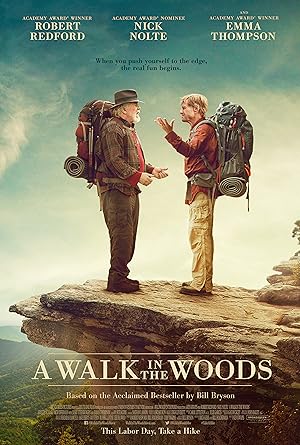
A Walk in the Woods
In this new comedy adventure, celebrated travel writer, Bill Bryson (Robert Redford), instead of retiring to enjoy his loving and beautiful wife, Catherine (Dame Emma Thompson), and large and happy family, challenges himself to hike the Appalachian Trail - two thousand two hundred miles of America's most unspoiled, spectacular and rugged countryside from Georgia to Maine. The peace and tranquility he hopes to find, though, is anything but, once he agrees to being accompanied by the only person he can find willing to join him on the trek - his long-lost and former friend Stephen Katz (Nick Nolte), a down-on-his-luck serial philanderer who, after a lifetime of relying on his charm and wits to keep one step ahead of the law - sees the trip as a way to sneak out of paying some debts and sneak into one last adventure before its too late. The trouble is, the two have a completely different definition of the word, "adventure". Now they're about to find out that when you push yourself to the edge, the real fun begins.
Despite its tight budget of $8.0M, A Walk in the Woods became a financial success, earning $37.5M worldwide—a 368% return. The film's innovative storytelling attracted moviegoers, proving that strong storytelling can transcend budget limitations.


Plot Structure
Story beats plotted across runtime


Narrative Arc
Emotional journey through the story's key moments
Story Circle
Blueprint 15-beat structure
Arcplot Score Breakdown
Weighted: Precision (70%) + Arc (15%) + Theme (15%)
A Walk in the Woods (2015) demonstrates meticulously timed story structure, characteristic of Ken Kwapis's storytelling approach. This structural analysis examines how the film's 15-point plot structure maps to proven narrative frameworks across 1 hour and 44 minutes. With an Arcplot score of 7.1, the film balances conventional beats with creative variation.
Characters
Cast & narrative archetypes

Bill Bryson
Stephen Katz
Catherine Bryson
Mary Ellen
Jeannie
Main Cast & Characters
Bill Bryson
Played by Robert Redford
A celebrated travel writer who decides to hike the Appalachian Trail after years of comfortable suburban life, seeking adventure and meaning in his later years.
Stephen Katz
Played by Nick Nolte
Bill's estranged, overweight, and irreverent old friend who volunteers to join the hike despite being completely unprepared, bringing chaos and humor to the journey.
Catherine Bryson
Played by Emma Thompson
Bill's loving but concerned wife who supports his adventure while worrying about his safety on the trail.
Mary Ellen
Played by Kristen Schaal
An annoying, know-it-all hiker who relentlessly attaches herself to Bill and Katz on the trail, driving them to desperate measures to escape her company.
Jeannie
Played by Mary Steenburgen
A friendly motel owner in a small trail town who develops a flirtatious connection with Katz.
Structural Analysis
The Status Quo at 1 minutes (1% through the runtime) establishes Bill Bryson at a funeral, feeling disconnected and restless in his comfortable but stagnant retirement life in New Hampshire.. Significantly, this early placement immediately immerses viewers in the story world.
The inciting incident occurs at 11 minutes when Bill impulsively announces on TV that he will hike the entire Appalachian Trail, publicly committing himself before thinking it through.. At 10% through the film, this Disruption aligns precisely with traditional story structure. This beat shifts the emotional landscape, launching the protagonist into the central conflict.
The First Threshold at 23 minutes marks the transition into Act II, occurring at 22% of the runtime. This demonstrates the protagonist's commitment to Bill chooses to accept Katz as his hiking partner despite their troubled history and takes his first steps onto the Appalachian Trail., moving from reaction to action.
At 52 minutes, the Midpoint arrives at 50% of the runtime—precisely centered, creating perfect narrative symmetry. Of particular interest, this crucial beat False victory: Bill and Katz reach a scenic overlook feeling triumphant and bonded, but the physical toll and remaining distance become apparent. Stakes raise as they realize the journey's true difficulty., fundamentally raising what's at risk. The emotional intensity shifts, dividing the narrative into clear before-and-after phases.
The Collapse moment at 73 minutes (70% through) represents the emotional nadir. Here, Katz disappears on a drinking binge; Bill finds him drunk in town. Their friendship seems broken, and the dream of completing the trail appears dead., shows the protagonist at their lowest point. This beat's placement in the final quarter sets up the climactic reversal.
The Second Threshold at 82 minutes initiates the final act resolution at 79% of the runtime. Bill realizes the journey was never about finishing the trail - it was about reconnecting with life and friendship. He chooses to continue with Katz on their own terms., demonstrating the transformation achieved throughout the journey.
Emotional Journey
A Walk in the Woods's emotional architecture traces a deliberate progression across 15 carefully calibrated beats.
Narrative Framework
This structural analysis employs proven narrative structure principles that track dramatic progression. By mapping A Walk in the Woods against these established plot points, we can identify how Ken Kwapis utilizes or subverts traditional narrative conventions. The plot point approach reveals not only adherence to structural principles but also creative choices that distinguish A Walk in the Woods within the adventure genre.
Ken Kwapis's Structural Approach
Among the 8 Ken Kwapis films analyzed on Arcplot, the average structural score is 7.3, reflecting strong command of classical structure. A Walk in the Woods takes a more unconventional approach compared to the director's typical style. For comparative analysis, explore the complete Ken Kwapis filmography.
Comparative Analysis
Additional adventure films include The Black Stallion, The Bad Guys and Puss in Boots. For more Ken Kwapis analyses, see The Sisterhood of the Traveling Pants, Follow That Bird and Big Miracle.
Plot Points by Act
Act I
SetupStatus Quo
Bill Bryson at a funeral, feeling disconnected and restless in his comfortable but stagnant retirement life in New Hampshire.
Theme
Bill's wife Catherine tells him "You can't just run away from life" - establishing the theme that true living requires engagement, not escape.
Worldbuilding
Bill's mundane routine, his failed book tour, awkward social interactions, and discovery of the Appalachian Trail as a way to feel alive again.
Disruption
Bill impulsively announces on TV that he will hike the entire Appalachian Trail, publicly committing himself before thinking it through.
Resistance
Catherine's concerns, Bill's naive preparations, rejections from potential hiking partners, and the unexpected call from his estranged friend Stephen Katz.
Act II
ConfrontationFirst Threshold
Bill chooses to accept Katz as his hiking partner despite their troubled history and takes his first steps onto the Appalachian Trail.
Mirror World
Bill and Katz begin hiking together, their contrasting personalities creating friction but also revealing what each needs - Bill needs spontaneity, Katz needs redemption.
Premise
The "fun and games" of the trail: encounters with Mary Ellen, struggles with equipment, bears, learning to work together, beautiful vistas, and rekindling their friendship.
Midpoint
False victory: Bill and Katz reach a scenic overlook feeling triumphant and bonded, but the physical toll and remaining distance become apparent. Stakes raise as they realize the journey's true difficulty.
Opposition
Physical exhaustion mounts, Katz's drinking resurfaces, they get lost, tensions escalate, Bill's age catches up with him, and they face the reality they may not finish.
Collapse
Katz disappears on a drinking binge; Bill finds him drunk in town. Their friendship seems broken, and the dream of completing the trail appears dead.
Crisis
Bill contemplates giving up and going home. He sits alone processing whether this was all a mistake and what the journey really meant.
Act III
ResolutionSecond Threshold
Bill realizes the journey was never about finishing the trail - it was about reconnecting with life and friendship. He chooses to continue with Katz on their own terms.
Synthesis
Bill and Katz hike together with new understanding, appreciating the journey rather than the destination. They reconcile, share honest conversation, and make peace with not completing the full trail.
Transformation
Bill returns home transformed - still in the same house, but now engaged with life, laughing with Catherine, planning the next adventure. The mirror of the opening funeral scene shows he's truly alive now.