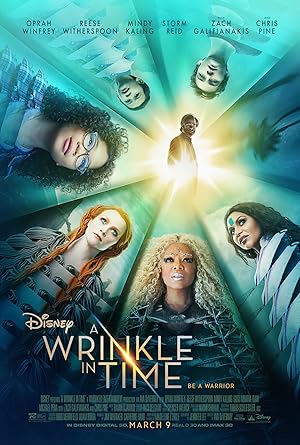
A Wrinkle in Time
Following the discovery of a new form of space travel as well as Meg's father's disappearance, she, her brother, and her friend must join three magical beings - Mrs. Whatsit, Mrs. Who, and Mrs. Which - to travel across the universe to rescue him from a terrible evil.
Working with a considerable budget of $103.0M, the film achieved a respectable showing with $132.7M in global revenue (+29% profit margin).
5 wins & 17 nominations


Plot Structure
Story beats plotted across runtime


Narrative Arc
Emotional journey through the story's key moments
Story Circle
Blueprint 15-beat structure
Arcplot Score Breakdown
Weighted: Precision (70%) + Arc (15%) + Theme (15%)
A Wrinkle in Time (2018) reveals meticulously timed narrative architecture, characteristic of Ava DuVernay's storytelling approach. This structural analysis examines how the film's 15-point plot structure maps to proven narrative frameworks across 1 hour and 49 minutes. With an Arcplot score of 6.8, the film balances conventional beats with creative variation.
Characters
Cast & narrative archetypes

Meg Murry
Mrs. Which
Mrs. Whatsit
Mrs. Who
Charles Wallace Murry
Calvin O'Keefe
Dr. Alex Murry
Dr. Kate Murry
The IT
Red
Main Cast & Characters
Meg Murry
Played by Storm Reid
A troubled teenage girl struggling with self-doubt and the disappearance of her scientist father, who embarks on a cosmic journey to find him.
Mrs. Which
Played by Oprah Winfrey
The wisest and most powerful of the three celestial guides, who appears in giant form and speaks in profound truths.
Mrs. Whatsit
Played by Reese Witherspoon
The youngest of the Mrs. W's, an impulsive and playful celestial being who transforms into a flying leaf creature.
Mrs. Who
Played by Mindy Kaling
A celestial guide who communicates primarily through famous quotations, serving as a wise intermediary among the three Mrs. W's.
Charles Wallace Murry
Played by Deric McCabe
Meg's extraordinarily gifted and intuitive younger brother who possesses an unusual connection to others' emotions.
Calvin O'Keefe
Played by Levi Miller
A popular but sensitive classmate who joins Meg on her journey, providing emotional support and friendship.
Dr. Alex Murry
Played by Chris Pine
Meg's father, a brilliant scientist who discovered the tesseract but became trapped on a dark planet while exploring the universe.
Dr. Kate Murry
Played by Gugu Mbatha-Raw
Meg's mother, a microbiologist who remains hopeful about her husband's return while raising their children alone.
The IT
Played by David Oyelowo
The disembodied evil entity that controls Camazotz, representing conformity, fear, and the darkness spreading across the universe.
Red
Played by Michael Pena
A mysterious man on Camazotz who appears helpful but serves as an agent of the IT, luring the children into danger.
Structural Analysis
The Status Quo at 2 minutes (2% through the runtime) establishes Meg struggles at school, bullied and isolated, unable to cope with her father's four-year disappearance. She's brilliant but broken, her grief manifesting as anger and withdrawal.. Structural examination shows that this early placement immediately immerses viewers in the story world.
The inciting incident occurs at 12 minutes when Mrs. Whatsit appears in the Murry home, confirming that the tesseract is real and that Dr. Murry's theories were correct. The impossible becomes possible, validating years of grief and hope.. At 11% through the film, this Disruption aligns precisely with traditional story structure. This beat shifts the emotional landscape, launching the protagonist into the central conflict.
The First Threshold at 27 minutes marks the transition into Act II, occurring at 25% of the runtime. This shows the protagonist's commitment to Meg chooses to tesser for the first time, actively deciding to journey across the universe to find her father despite her fears and self-doubt. She steps into the fantastic., moving from reaction to action.
At 54 minutes, the Midpoint arrives at 50% of the runtime—precisely centered, creating perfect narrative symmetry. Notably, this crucial beat Meg, Charles Wallace, and Calvin arrive on Camazotz and locate Dr. Murry. False victory: they've found him, the quest seems near completion, but they don't yet understand the true cost., fundamentally raising what's at risk. The emotional intensity shifts, dividing the narrative into clear before-and-after phases.
The Collapse moment at 81 minutes (74% through) represents the emotional nadir. Here, Dr. Murry tessers away with Meg and Calvin, leaving Charles Wallace behind in the IT's control. Meg nearly dies from the tesser. Her father has failed her, her brother is lost, and she's powerless., indicates the protagonist at their lowest point. This beat's placement in the final quarter sets up the climactic reversal.
The Second Threshold at 86 minutes initiates the final act resolution at 79% of the runtime. Meg realizes her "faults" - her anger, stubbornness, and fierce love - are actually her strengths. She chooses to return to Camazotz alone, accepting herself fully for the first time., demonstrating the transformation achieved throughout the journey.
Emotional Journey
A Wrinkle in Time's emotional architecture traces a deliberate progression across 15 carefully calibrated beats.
Narrative Framework
This structural analysis employs proven narrative structure principles that track dramatic progression. By mapping A Wrinkle in Time against these established plot points, we can identify how Ava DuVernay utilizes or subverts traditional narrative conventions. The plot point approach reveals not only adherence to structural principles but also creative choices that distinguish A Wrinkle in Time within the adventure genre.
Ava DuVernay's Structural Approach
Among the 2 Ava DuVernay films analyzed on Arcplot, the average structural score is 6.7, demonstrating varied approaches to story architecture. A Wrinkle in Time represents one of the director's most structurally precise works. For comparative analysis, explore the complete Ava DuVernay filmography.
Comparative Analysis
Additional adventure films include The Black Stallion, The Bad Guys and Puss in Boots. For more Ava DuVernay analyses, see Selma.
Plot Points by Act
Act I
SetupStatus Quo
Meg struggles at school, bullied and isolated, unable to cope with her father's four-year disappearance. She's brilliant but broken, her grief manifesting as anger and withdrawal.
Theme
Charles Wallace tells Meg about being a "warrior" and trusting in love. Mrs. Whatsit later reinforces: "The only thing faster than light is the darkness" - establishing the thematic conflict between love/light and fear/darkness.
Worldbuilding
Introduction to the Murry family dynamics, Meg's intelligence and pain, Charles Wallace's extraordinary abilities, their mother's loneliness, and the mystery of Dr. Murry's disappearance while researching tessering.
Disruption
Mrs. Whatsit appears in the Murry home, confirming that the tesseract is real and that Dr. Murry's theories were correct. The impossible becomes possible, validating years of grief and hope.
Resistance
Meeting Mrs. Who and Mrs. Which, learning about the universe's warriors of light, understanding the IT/darkness threat, and Meg's resistance to believing she could be special or capable of this quest.
Act II
ConfrontationFirst Threshold
Meg chooses to tesser for the first time, actively deciding to journey across the universe to find her father despite her fears and self-doubt. She steps into the fantastic.
Mirror World
On the planet Uriel, Meg experiences pure joy and freedom, flying through crystalline landscapes. Calvin tells her she's beautiful - the relationship that will teach her self-acceptance begins.
Premise
The adventure promised: traveling through stunning alien worlds, meeting the Happy Medium, learning to see with different eyes, discovering the IT's nature, and approaching Camazotz where Dr. Murry is trapped.
Midpoint
Meg, Charles Wallace, and Calvin arrive on Camazotz and locate Dr. Murry. False victory: they've found him, the quest seems near completion, but they don't yet understand the true cost.
Opposition
The IT takes control of Charles Wallace, using Meg's insecurities against her. Dr. Murry is broken and weak. Calvin can't reach Charles Wallace. The darkness exploits every flaw and fear, gaining strength.
Collapse
Dr. Murry tessers away with Meg and Calvin, leaving Charles Wallace behind in the IT's control. Meg nearly dies from the tesser. Her father has failed her, her brother is lost, and she's powerless.
Crisis
On Ixchel, Meg heals physically but rages emotionally. She blames her father, faces her deepest pain, and must confront that she alone can save Charles Wallace - no one else can do it for her.
Act III
ResolutionSecond Threshold
Meg realizes her "faults" - her anger, stubbornness, and fierce love - are actually her strengths. She chooses to return to Camazotz alone, accepting herself fully for the first time.
Synthesis
Meg confronts the IT with love instead of fear, using her imperfections as weapons. She reaches Charles Wallace by expressing unconditional love, breaking the IT's hold. The family reunites and returns home together.
Transformation
Meg stands confident at school, no longer hiding or ashamed. She smiles genuinely, transformed from a broken girl into a warrior who knows her worth. She has become the light.