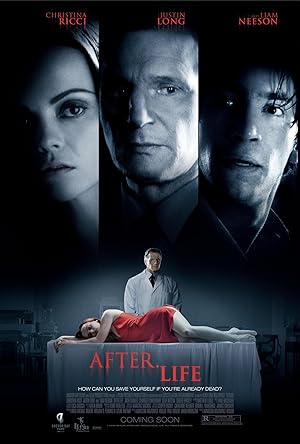
After.Life
After a horrific car accident, Anna (Ricci) wakes up to find the local funeral director Eliot Deacon (Neeson) preparing her for her funeral. Confused, terrified and feeling still very much alive, Anna doesn't believe she's dead, despite the funeral director's reassurances she's merely in transition to the afterlife. Eliot convinces her he has the ability to communicate with the dead and is the only one who can help her. Trapped inside the funeral home, with nobody to turn to except Eliot, Anna's forced to accept her own death. But Anna's grief-stricken boyfriend Paul (Long) can't shake the suspicion that Eliot isn't what he appears to be.
The film disappointed at the box office against its modest budget of $4.5M, earning $3.6M globally (-20% loss).


Plot Structure
Story beats plotted across runtime


Narrative Arc
Emotional journey through the story's key moments
Story Circle
Blueprint 15-beat structure
Arcplot Score Breakdown
Weighted: Precision (70%) + Arc (15%) + Theme (15%)
After.Life (2009) reveals meticulously timed story structure, characteristic of Agnieszka Wojtowicz-Vosloo's storytelling approach. This structural analysis examines how the film's 15-point plot structure maps to proven narrative frameworks across 1 hour and 44 minutes. With an Arcplot score of 7.0, the film balances conventional beats with creative variation.
Structural Analysis
The Status Quo at 1 minutes (1% through the runtime) establishes Anna lies in bed disconnected from her life and boyfriend Paul, emotionally numb and going through the motions of existence without truly living.. Significantly, this early placement immediately immerses viewers in the story world.
The inciting incident occurs at 13 minutes when After a devastating argument with Paul where he proposes and she rejects him, Anna drives away in emotional turmoil and crashes her car in a violent accident.. At 12% through the film, this Disruption aligns precisely with traditional story structure. This beat shifts the emotional landscape, launching the protagonist into the central conflict.
The First Threshold at 26 minutes marks the transition into Act II, occurring at 25% of the runtime. This reveals the protagonist's commitment to Anna reluctantly accepts her confinement in the funeral home and begins engaging with Eliot about her death, crossing into the liminal world between life and death where the story's central mystery unfolds., moving from reaction to action.
At 53 minutes, the Midpoint arrives at 51% of the runtime—precisely centered, creating perfect narrative symmetry. Notably, this crucial beat Anna discovers she can briefly move and seemingly breathe, suggesting she might be alive—a false hope that raises stakes but also deepens uncertainty about whether Eliot is helping her transition or murdering her., fundamentally raising what's at risk. The emotional intensity shifts, dividing the narrative into clear before-and-after phases.
The Collapse moment at 78 minutes (75% through) represents the emotional nadir. Here, Anna is dressed in her funeral clothes and placed in her coffin for the wake. She screams for help as mourners pass by unable to hear her—the death of hope and her final chance at rescue., demonstrates the protagonist at their lowest point. This beat's placement in the final quarter sets up the climactic reversal.
The Second Threshold at 84 minutes initiates the final act resolution at 80% of the runtime. Paul breaks into the funeral home seeking truth. Anna makes one final attempt to signal she's alive, and the question of reality versus death reaches its crisis point as burial becomes imminent., demonstrating the transformation achieved throughout the journey.
Emotional Journey
After.Life's emotional architecture traces a deliberate progression across 15 carefully calibrated beats.
Narrative Framework
This structural analysis employs proven narrative structure principles that track dramatic progression. By mapping After.Life against these established plot points, we can identify how Agnieszka Wojtowicz-Vosloo utilizes or subverts traditional narrative conventions. The plot point approach reveals not only adherence to structural principles but also creative choices that distinguish After.Life within the drama genre.
Comparative Analysis
Additional drama films include After Thomas, South Pacific and Dirty Dancing: Havana Nights.
Plot Points by Act
Act I
SetupStatus Quo
Anna lies in bed disconnected from her life and boyfriend Paul, emotionally numb and going through the motions of existence without truly living.
Theme
Eliot the funeral director tells Anna at their chance encounter: "Most people are dead already, they just don't know it." This states the film's central theme about truly living versus merely existing.
Worldbuilding
Anna's disconnected world is established: her troubled relationship with Paul, her work as a teacher, her distant interactions with student Jack who notices death around him, and her emotional isolation from life.
Disruption
After a devastating argument with Paul where he proposes and she rejects him, Anna drives away in emotional turmoil and crashes her car in a violent accident.
Resistance
Anna awakens on Eliot's mortuary table where he insists she is dead and he has the gift to communicate with the deceased. Anna resists, debates, and struggles to understand her reality while Eliot prepares her body.
Act II
ConfrontationFirst Threshold
Anna reluctantly accepts her confinement in the funeral home and begins engaging with Eliot about her death, crossing into the liminal world between life and death where the story's central mystery unfolds.
Mirror World
Paul, devastated and unable to accept Anna's death, becomes the external manifestation of the life Anna rejected. His desperate investigation mirrors Anna's internal struggle with whether she truly lived.
Premise
The psychological cat-and-mouse game between Anna and Eliot intensifies. Anna searches for evidence she's alive while Eliot philosophically guides her toward accepting death, all while Paul investigates and young Jack senses the truth.
Midpoint
Anna discovers she can briefly move and seemingly breathe, suggesting she might be alive—a false hope that raises stakes but also deepens uncertainty about whether Eliot is helping her transition or murdering her.
Opposition
Eliot intensifies his psychological control using drugs to keep Anna weak. Paul's investigation grows desperate, and Anna's hope of rescue diminishes as Eliot reveals his complete power over her fate and her funeral approaches.
Collapse
Anna is dressed in her funeral clothes and placed in her coffin for the wake. She screams for help as mourners pass by unable to hear her—the death of hope and her final chance at rescue.
Crisis
In her darkest moment sealed in the coffin, Anna reflects on her wasted life of emotional death. She finally understands Eliot's message—she was never truly alive, and now faces literal burial.
Act III
ResolutionSecond Threshold
Paul breaks into the funeral home seeking truth. Anna makes one final attempt to signal she's alive, and the question of reality versus death reaches its crisis point as burial becomes imminent.
Synthesis
The final confrontation unfolds: Paul faces Eliot, Anna's fate is sealed as she's buried, and the truth remains ambiguous. Young Jack inherits Anna's awareness of death, suggesting the cycle continues.
Transformation
Anna lies in her grave, eyes open in the darkness—whether dead all along or murdered by Eliot remains unresolved. Jack now sees the dead, and Paul dies in a car crash, meeting the same fate, trapped in the cycle.