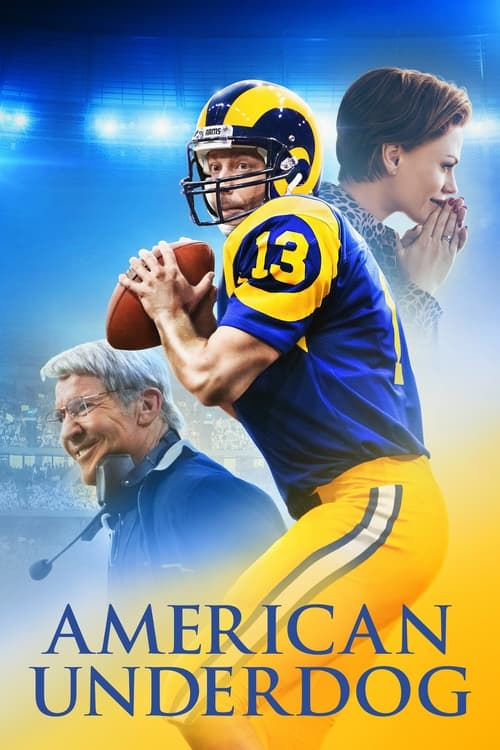
American Underdog
The true story of Kurt Warner, who went from a stockboy at a grocery store to a two-time NFL MVP, Super Bowl champion, and Hall of Fame quarterback.
Working with a respectable budget of $25.0M, the film achieved a respectable showing with $26.5M in global revenue (+6% profit margin).


Plot Structure
Story beats plotted across runtime


Narrative Arc
Emotional journey through the story's key moments
Story Circle
Blueprint 15-beat structure
Arcplot Score Breakdown
Weighted: Precision (70%) + Arc (15%) + Theme (15%)
American Underdog (2021) exemplifies carefully calibrated story structure, characteristic of Jon Erwin's storytelling approach. This structural analysis examines how the film's 15-point plot structure maps to proven narrative frameworks across 1 hour and 52 minutes. With an Arcplot score of 7.3, the film balances conventional beats with creative variation.
Characters
Cast & narrative archetypes

Kurt Warner
Brenda Warner
Dick Vermeil
Mike Martz
Jim Foster
Main Cast & Characters
Kurt Warner
Played by Zachary Levi
Undrafted quarterback who works at a grocery store while pursuing his NFL dream, eventually becoming Super Bowl MVP.
Brenda Warner
Played by Anna Paquin
Kurt's wife, a former Marine and divorced mother of two who supports Kurt through his struggles while dealing with her own past trauma.
Dick Vermeil
Played by Dennis Quaid
St. Louis Rams head coach who gives Kurt his opportunity in the NFL and believes in his potential.
Mike Martz
Played by Chance Kelly
Rams offensive coordinator who initially doubts Kurt but eventually becomes instrumental in his success.
Jim Foster
Played by Bruce McGill
Arena Football League coach who gives Kurt his first professional coaching and opportunity after college.
Structural Analysis
The Status Quo at 1 minutes (1% through the runtime) establishes Kurt Warner stocking shelves at a Hy-Vee grocery store in Iowa, wearing his employee vest. He's 27 years old, undrafted, seemingly forgotten - a far cry from his NFL dreams. This opening image establishes the "before" state: humble, overlooked, but still hopeful.. The analysis reveals that this early placement immediately immerses viewers in the story world.
The inciting incident occurs at 13 minutes when Kurt receives a phone call offering him a tryout with the Iowa Barnstormers of the Arena Football League. While it's not the NFL, it's a chance to play football again. This disrupts his resigned acceptance of the grocery store life and reignites possibility.. At 12% through the film, this Disruption aligns precisely with traditional story structure. This beat shifts the emotional landscape, launching the protagonist into the central conflict.
The First Threshold at 27 minutes marks the transition into Act II, occurring at 24% of the runtime. This indicates the protagonist's commitment to Kurt and Brenda get married. This is his active choice to fully commit - not just to football, but to Brenda, her kids, and the faith-driven path forward. He chooses to embrace this unconventional journey into Act 2, combining family and football dreams., moving from reaction to action.
At 56 minutes, the Midpoint arrives at 50% of the runtime—precisely centered, creating perfect narrative symmetry. Structural examination shows that this crucial beat Kurt signs with the St. Louis Rams as a backup quarterback. False victory: he's made it to the NFL! But reality quickly sets in - he's third string, coaches doubt him, he's considered too old and inexperienced. The stakes raise: being IN the NFL isn't enough; he needs to PLAY. The fun and games are over., fundamentally raising what's at risk. The emotional intensity shifts, dividing the narrative into clear before-and-after phases.
The Collapse moment at 83 minutes (74% through) represents the emotional nadir. Here, After a brutal loss and harsh criticism, Kurt sits alone in the locker room, questioning everything. He calls Brenda, broken: "Maybe everyone was right. Maybe I'm not good enough." This is his darkest moment - the death of his confidence and belief in his calling. He's ready to quit., illustrates the protagonist at their lowest point. This beat's placement in the final quarter sets up the climactic reversal.
The Second Threshold at 89 minutes initiates the final act resolution at 80% of the runtime. Kurt has a breakthrough realization: "I'm not playing for them. I'm playing for my family, for my faith." He synthesizes his Arena League grit with NFL opportunity, combining his unconventional path with elite skill. He stops trying to prove doubters wrong and starts playing from purpose. New clarity, new resolve., demonstrating the transformation achieved throughout the journey.
Emotional Journey
American Underdog's emotional architecture traces a deliberate progression across 15 carefully calibrated beats.
Narrative Framework
This structural analysis employs systematic plot point analysis that identifies crucial turning points. By mapping American Underdog against these established plot points, we can identify how Jon Erwin utilizes or subverts traditional narrative conventions. The plot point approach reveals not only adherence to structural principles but also creative choices that distinguish American Underdog within the drama genre.
Jon Erwin's Structural Approach
Among the 2 Jon Erwin films analyzed on Arcplot, the average structural score is 6.7, demonstrating varied approaches to story architecture. American Underdog represents one of the director's most structurally precise works. For comparative analysis, explore the complete Jon Erwin filmography.
Comparative Analysis
Additional drama films include After Thomas, South Pacific and Dirty Dancing: Havana Nights. For more Jon Erwin analyses, see Woodlawn.
Plot Points by Act
Act I
SetupStatus Quo
Kurt Warner stocking shelves at a Hy-Vee grocery store in Iowa, wearing his employee vest. He's 27 years old, undrafted, seemingly forgotten - a far cry from his NFL dreams. This opening image establishes the "before" state: humble, overlooked, but still hopeful.
Theme
Brenda tells Kurt at the country bar: "You can't be afraid of what people think. You have to trust where you're being led." This early statement encapsulates the film's theme about faith, perseverance, and trusting the journey despite external doubt.
Worldbuilding
Establishes Kurt's world: working at Hy-Vee, his relationship with Brenda and her two kids (including blind daughter Zack), flashbacks to his Northern Iowa college success, going undrafted, getting cut from Packers training camp. Shows his struggles, his faith, Brenda's past trauma, and their unconventional family dynamic.
Disruption
Kurt receives a phone call offering him a tryout with the Iowa Barnstormers of the Arena Football League. While it's not the NFL, it's a chance to play football again. This disrupts his resigned acceptance of the grocery store life and reignites possibility.
Resistance
Kurt debates whether to take the Arena League opportunity - it pays almost nothing, Brenda is skeptical about him chasing the dream again, he has family responsibilities. Brenda serves as both challenger and supporter. He practices, struggles with the indoor game's different rules, but gradually commits. Their relationship deepens.
Act II
ConfrontationFirst Threshold
Kurt and Brenda get married. This is his active choice to fully commit - not just to football, but to Brenda, her kids, and the faith-driven path forward. He chooses to embrace this unconventional journey into Act 2, combining family and football dreams.
Mirror World
Kurt connects deeply with Brenda's blind daughter Zack, reading to her and becoming a true father figure. This relationship embodies the theme - seeing what others overlook, finding value where others see limitation, faith in the unseen. The family subplot becomes the heart that balances the football plot.
Premise
The "fun and games" of Arena League success. Kurt excels with the Barnstormers, throws for huge numbers, wins Arena Bowl MVP. NFL scouts take notice. The promise of the premise: watching an underdog prove everyone wrong. Includes family moments, Kurt's growing confidence, and mounting NFL interest, particularly from Rams coach Dick Vermeil.
Midpoint
Kurt signs with the St. Louis Rams as a backup quarterback. False victory: he's made it to the NFL! But reality quickly sets in - he's third string, coaches doubt him, he's considered too old and inexperienced. The stakes raise: being IN the NFL isn't enough; he needs to PLAY. The fun and games are over.
Opposition
Kurt struggles on the Rams. Offensive coordinator Mike Martz openly disdains him, calling him a "grocery bagger." He barely gets practice reps. Brenda faces isolation and struggle in St. Louis. Kurt's faith is tested. When starting QB Trent Green tears his ACL in preseason, Kurt gets the starting job but faces enormous pressure, media doubt, and Martz's continued skepticism. Early season games are shaky.
Collapse
After a brutal loss and harsh criticism, Kurt sits alone in the locker room, questioning everything. He calls Brenda, broken: "Maybe everyone was right. Maybe I'm not good enough." This is his darkest moment - the death of his confidence and belief in his calling. He's ready to quit.
Crisis
Kurt processes his despair. Brenda reminds him of their journey and faith: "This isn't about football. It's about who you are." He reflects on Zack, his family, and his calling. Coach Vermeil offers quiet encouragement. Kurt finds resolve not from external validation, but internal faith. The dark night passes.
Act III
ResolutionSecond Threshold
Kurt has a breakthrough realization: "I'm not playing for them. I'm playing for my family, for my faith." He synthesizes his Arena League grit with NFL opportunity, combining his unconventional path with elite skill. He stops trying to prove doubters wrong and starts playing from purpose. New clarity, new resolve.
Synthesis
The finale: Kurt leads the Rams on their improbable run. The "Greatest Show on Turf" offense clicks. Victory after victory. He wins over Martz, the team, the media. The Super Bowl against Tennessee Titans - the iconic 73-yard touchdown pass to Isaac Bruce with under two minutes left. Rams win 23-16. Kurt named Super Bowl MVP. Dreams realized.
Transformation
Kurt Warner hoists the Lombardi Trophy, surrounded by Brenda and their children on the confetti-covered field. Final image mirrors the opening: same humble man, but transformed context. He didn't change WHO he was - he stayed true to faith and family - but the world finally recognized his worth. The underdog vindicated.