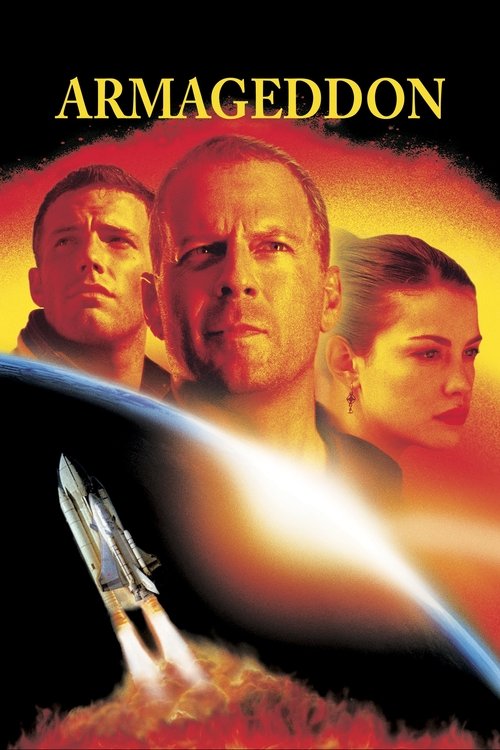
Armageddon
After discovering that an asteroid the size of Texas will impact Earth in less than a month, NASA recruits a misfit team of deep-core drillers to save the planet.
Despite a significant budget of $140.0M, Armageddon became a solid performer, earning $553.8M worldwide—a 296% return.
Nominated for 4 Oscars. 15 wins & 41 nominations


Plot Structure
Story beats plotted across runtime


Narrative Arc
Emotional journey through the story's key moments
Story Circle
Blueprint 15-beat structure
Characters
Cast & narrative archetypes

Harry Stamper
A.J. Frost
Grace Stamper
Dan Truman
Rockhound
Chick Chapple
Oscar Choice
Colonel William Sharp
Main Cast & Characters
Harry Stamper
Played by Bruce Willis
Gruff oil driller leading the mission to save Earth from an asteroid. A natural leader who sacrifices himself for humanity.
A.J. Frost
Played by Ben Affleck
Harry's best driller and surrogate son figure, in love with Harry's daughter Grace. Impulsive but skilled.
Grace Stamper
Played by Liv Tyler
Harry's daughter and A.J.'s girlfriend. Struggles with her father's dangerous lifestyle and her relationship.
Dan Truman
Played by Billy Bob Thornton
NASA executive who recruits the oil drillers for the mission. Pragmatic leader who advocates for the unconventional approach.
Rockhound
Played by Steve Buscemi
Eccentric geologist on the drilling crew. Brilliant but unstable under pressure, provides comic relief.
Chick Chapple
Played by Will Patton
Experienced driller with a gambling problem and estranged family. Seeks redemption through the mission.
Oscar Choice
Played by Owen Wilson
Member of the drilling crew, calm and religious. Provides steady presence among the chaos.
Colonel William Sharp
Played by William Fichtner
Military pilot leading the space mission. Initially clashes with the drillers but earns mutual respect.
Structural Analysis
The Status Quo at 2 minutes (1% through the runtime) establishes Harry Stamper runs his offshore oil rig with rough authority, chasing off A.J. Frost for dating his daughter Grace. He's a skilled, stubborn blue-collar worker living a dangerous but familiar life.. Of particular interest, this early placement immediately immerses viewers in the story world.
The inciting incident occurs at 19 minutes when NASA discovers a Texas-sized asteroid will impact Earth in 18 days, causing an extinction-level event. The military and scientific establishment realize humanity faces annihilation.. At 12% through the film, this Disruption aligns precisely with traditional story structure. This beat shifts the emotional landscape, launching the protagonist into the central conflict.
The First Threshold at 39 minutes marks the transition into Act II, occurring at 26% of the runtime. This indicates the protagonist's commitment to Harry and his crew actively choose to accept the mission, boarding the shuttles. They commit to leaving Earth and everything they know to attempt the impossible. The training and preparation give way to actual departure., moving from reaction to action.
At 76 minutes, the Midpoint arrives at 50% of the runtime—precisely centered, creating perfect narrative symmetry. Significantly, this crucial beat Both shuttles crash-land on the asteroid. Independence is destroyed, killing crew members, and Freedom is badly damaged. The drill hits a gas pocket and is destroyed. They're behind schedule, equipment is failing, and the mission appears doomed. False defeat—everything that can go wrong does., fundamentally raising what's at risk. The emotional intensity shifts, dividing the narrative into clear before-and-after phases.
The Collapse moment at 114 minutes (75% through) represents the emotional nadir. Here, The remote detonation is triggered, forcing the crew to disconnect the bomb before it explodes on the surface. They succeed, but now they're below minimum depth, and someone must manually detonate the bomb, meaning certain death. The "whiff of death" becomes literal—one of them must die., illustrates the protagonist at their lowest point. This beat's placement in the final quarter sets up the climactic reversal.
The Second Threshold at 121 minutes initiates the final act resolution at 80% of the runtime. Harry tricks A.J., damaging his air hose and sending him back up on the elevator, taking his place as the one who will stay behind. Harry makes the ultimate sacrifice, synthesizing his role as father-protector with acceptance of A.J. As his daughter's future. "I'm proud of you."., demonstrating the transformation achieved throughout the journey.
Emotional Journey
Armageddon's emotional architecture traces a deliberate progression across 15 carefully calibrated beats.
Narrative Framework
This structural analysis employs structural analysis methodology used to understand storytelling architecture. By mapping Armageddon against these established plot points, we can identify how Michael Bay utilizes or subverts traditional narrative conventions. The plot point approach reveals not only adherence to structural principles but also creative choices that distinguish Armageddon within the action genre.
Michael Bay's Structural Approach
Among the 14 Michael Bay films analyzed on Arcplot, the average structural score is 6.8, demonstrating varied approaches to story architecture. Armageddon exemplifies the director's characteristic narrative technique. For comparative analysis, explore the complete Michael Bay filmography.
Comparative Analysis
Additional action films include The Bad Guys, Puss in Boots and Venom: The Last Dance. For more Michael Bay analyses, see The Rock, Transformers: Dark of the Moon and Bad Boys.
Plot Points by Act
Act I
SetupStatus Quo
Harry Stamper runs his offshore oil rig with rough authority, chasing off A.J. Frost for dating his daughter Grace. He's a skilled, stubborn blue-collar worker living a dangerous but familiar life.
Theme
Dan Truman tells his team that sometimes we have to trust the imperfect people we have, not the perfect people we wish we had. This establishes the theme of trusting unlikely heroes and valuing practical wisdom over credentials.
Worldbuilding
We meet Harry's rough-edged drilling crew, his complicated relationship with Grace, and A.J.'s reckless charm. Meanwhile, NASA tracks asteroid fragments hitting Earth, establishing both the human relationships and the cosmic threat.
Disruption
NASA discovers a Texas-sized asteroid will impact Earth in 18 days, causing an extinction-level event. The military and scientific establishment realize humanity faces annihilation.
Resistance
NASA debates solutions and lands on a plan to drill into the asteroid and detonate a nuclear bomb. Dan Truman recruits Harry Stamper, explaining why the world's best driller is needed. Harry resists, negotiates, and assembles his crew. The team debates whether this suicide mission is possible.
Act II
ConfrontationFirst Threshold
Harry and his crew actively choose to accept the mission, boarding the shuttles. They commit to leaving Earth and everything they know to attempt the impossible. The training and preparation give way to actual departure.
Mirror World
A.J. and Grace's relationship deepens as they face his possible death. Their love story represents what's worth saving on Earth and provides the emotional heart that mirrors the theme—sometimes the roughnecks, the imperfect people, are exactly who we need.
Premise
The "promise of the premise"—blue-collar oil drillers become astronauts. Training montages, comic relief with the crew, space shuttle launches, and the dangerous journey through the asteroid field. The fun of watching roughnecks in space, navigating the Russian space station disaster, and landing on the asteroid.
Midpoint
Both shuttles crash-land on the asteroid. Independence is destroyed, killing crew members, and Freedom is badly damaged. The drill hits a gas pocket and is destroyed. They're behind schedule, equipment is failing, and the mission appears doomed. False defeat—everything that can go wrong does.
Opposition
The crew struggles to drill with failing equipment as time runs out. Mission Control debates taking remote control. Tensions explode between Harry and A.J. The military pressure mounts to detonate early on the surface, which won't work. Every obstacle intensifies—ground tremors, equipment malfunctions, and the President authorizing remote detonation.
Collapse
The remote detonation is triggered, forcing the crew to disconnect the bomb before it explodes on the surface. They succeed, but now they're below minimum depth, and someone must manually detonate the bomb, meaning certain death. The "whiff of death" becomes literal—one of them must die.
Crisis
The crew draws straws to see who will stay behind and die. A.J. draws the short straw. Harry grapples with the dark reality that he brought these men here to die. The emotional weight of sacrifice settles over everyone as they prepare for final goodbyes.
Act III
ResolutionSecond Threshold
Harry tricks A.J., damaging his air hose and sending him back up on the elevator, taking his place as the one who will stay behind. Harry makes the ultimate sacrifice, synthesizing his role as father-protector with acceptance of A.J. as his daughter's future. "I'm proud of you."
Synthesis
Harry says goodbye to Grace via video link in a devastating final conversation. He detonates the bomb manually, sacrificing himself to split the asteroid. The crew escapes as the asteroid breaks apart. Earth is saved through the sacrifice of an imperfect, blue-collar hero.
Transformation
A.J. and Grace's wedding, with the surviving crew attending. Where the opening showed Harry chasing A.J. off the rig with a shotgun, now A.J. is embraced as family. The roughnecks are celebrated as heroes. The imperfect people saved the world.