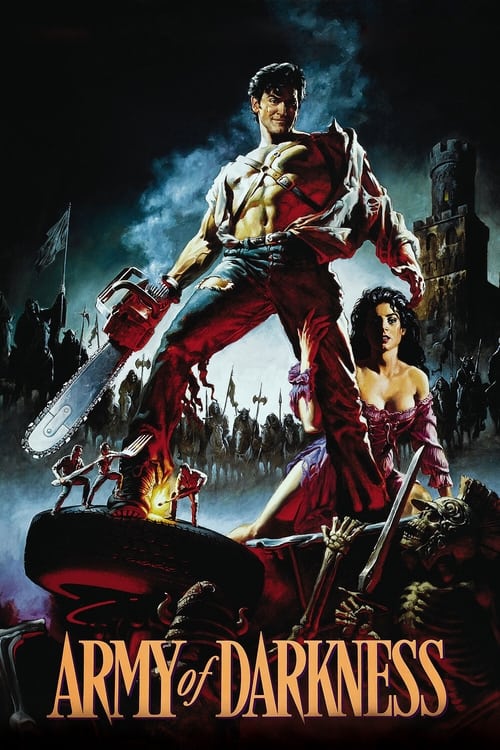
Army of Darkness
Ash, a handsome, shotgun-toting, chainsaw-armed department store clerk, is time warped backwards into England's Dark Ages, where he romances a beauty and faces legions of the undead.
Working with a small-scale budget of $11.0M, the film achieved a steady performer with $21.5M in global revenue (+95% profit margin).
12 wins & 6 nominations


Plot Structure
Story beats plotted across runtime


Narrative Arc
Emotional journey through the story's key moments
Story Circle
Blueprint 15-beat structure
Arcplot Score Breakdown
Weighted: Precision (70%) + Arc (15%) + Theme (15%)
Army of Darkness (1992) exhibits strategically placed narrative architecture, characteristic of Sam Raimi's storytelling approach. This structural analysis examines how the film's 15-point plot structure maps to proven narrative frameworks across 1 hour and 21 minutes. With an Arcplot score of 7.1, the film balances conventional beats with creative variation.
Characters
Cast & narrative archetypes

Ash Williams
Sheila
Lord Arthur
Evil Ash
Wiseman
Main Cast & Characters
Ash Williams
Played by Bruce Campbell
A sarcastic S-Mart employee trapped in medieval times who must battle the Army of Darkness to return home.
Sheila
Played by Embeth Davidtz
A beautiful noblewoman who becomes romantically involved with Ash but is later possessed by evil forces.
Lord Arthur
Played by Marcus Gilbert
The noble leader of the castle forces who initially distrusts Ash but eventually allies with him against the Deadites.
Evil Ash
Played by Bruce Campbell
Ash's dark doppelganger created from his own body who leads the Army of Darkness against the living.
Wiseman
Played by Ian Abercrombie
An elderly scholar who guides Ash on his quest to retrieve the Necronomicon and return to his own time.
Structural Analysis
The Status Quo at 1 minutes (1% through the runtime) establishes Ash, chained and dragged as a prisoner in medieval England, is thrown into a pit amid jeering crowds. He's stripped of his identity as a modern man, reduced to a slave—the ultimate "before" state of powerlessness and humiliation.. Structural examination shows that this early placement immediately immerses viewers in the story world.
The inciting incident occurs at 10 minutes when Ash is thrown into the Deadite pit but retrieves his chainsaw. He defeats the pit creature and rises triumphant, chainsaw roaring. His survival disrupts the status quo—he's no longer a prisoner but a warrior the people now look to with awe.. At 12% through the film, this Disruption aligns precisely with traditional story structure. This beat shifts the emotional landscape, launching the protagonist into the central conflict.
The First Threshold at 20 minutes marks the transition into Act II, occurring at 25% of the runtime. This reveals the protagonist's commitment to Ash actively chooses to embark on the quest for the Necronomicon, departing the castle on horseback. Despite his reluctance, he commits to retrieving the book—not for heroism, but because it's his only ticket home. The journey into Act 2 begins., moving from reaction to action.
At 41 minutes, the Midpoint arrives at 50% of the runtime—precisely centered, creating perfect narrative symmetry. The analysis reveals that this crucial beat Ash reaches the Necronomicon but botches the magic words ("Klaatu Barada Nikto"). His arrogance and shortcut-taking awakens the Army of the Dead. False victory turns to catastrophe—he has the book but has unleashed an unstoppable evil upon the land., fundamentally raising what's at risk. The emotional intensity shifts, dividing the narrative into clear before-and-after phases.
The Collapse moment at 60 minutes (74% through) represents the emotional nadir. Here, The Army of Darkness breaches the castle walls. Defenders fall. Sheila, now a Deadite, serves Evil Ash. Ash sees the consequence of his selfishness—people are dying because he couldn't be bothered to say three simple words correctly. All seems lost., demonstrates the protagonist at their lowest point. This beat's placement in the final quarter sets up the climactic reversal.
The Second Threshold at 64 minutes initiates the final act resolution at 79% of the runtime. Ash fully embraces his role as the Chosen One—not to go home, but to save these people. He rallies the troops with his chemistry knowledge, deploying gunpowder and his "boomstick." He synthesizes modern know-how with medieval warfare: "Good. Bad. I'm the guy with the gun."., demonstrating the transformation achieved throughout the journey.
Emotional Journey
Army of Darkness's emotional architecture traces a deliberate progression across 15 carefully calibrated beats.
Narrative Framework
This structural analysis employs systematic plot point analysis that identifies crucial turning points. By mapping Army of Darkness against these established plot points, we can identify how Sam Raimi utilizes or subverts traditional narrative conventions. The plot point approach reveals not only adherence to structural principles but also creative choices that distinguish Army of Darkness within the fantasy genre.
Sam Raimi's Structural Approach
Among the 13 Sam Raimi films analyzed on Arcplot, the average structural score is 7.1, reflecting strong command of classical structure. Army of Darkness takes a more unconventional approach compared to the director's typical style. For comparative analysis, explore the complete Sam Raimi filmography.
Comparative Analysis
Additional fantasy films include Thinner, Ella Enchanted and Conan the Barbarian. For more Sam Raimi analyses, see Spider-Man 2, The Quick and the Dead and Oz the Great and Powerful.
Plot Points by Act
Act I
SetupStatus Quo
Ash, chained and dragged as a prisoner in medieval England, is thrown into a pit amid jeering crowds. He's stripped of his identity as a modern man, reduced to a slave—the ultimate "before" state of powerlessness and humiliation.
Theme
The Wise Man tells Ash that he is "the Promised One" prophesied to fall from the sky and deliver them from the Deadites. The theme is stated: ordinary people can become heroes when they accept responsibility for others, not just themselves.
Worldbuilding
The medieval world of 1300 AD England is established: Lord Arthur's castle, the superstitious populace, the threat of the Deadites, and the ongoing war with Duke Henry. Ash is introduced as an unwilling captive who just wants to go home.
Disruption
Ash is thrown into the Deadite pit but retrieves his chainsaw. He defeats the pit creature and rises triumphant, chainsaw roaring. His survival disrupts the status quo—he's no longer a prisoner but a warrior the people now look to with awe.
Resistance
The Wise Man serves as Ash's guide, explaining the Necronomicon and the quest required to retrieve it. Ash resists—he just wants to go home. He trains, builds new weapons, and prepares while debating whether to accept his role as the Promised One.
Act II
ConfrontationFirst Threshold
Ash actively chooses to embark on the quest for the Necronomicon, departing the castle on horseback. Despite his reluctance, he commits to retrieving the book—not for heroism, but because it's his only ticket home. The journey into Act 2 begins.
Mirror World
Ash meets Sheila, Arthur's sister, who initially despises him but begins to see his worth. She represents the thematic mirror—connection, responsibility, having something worth fighting for beyond self-interest. Their growing bond humanizes Ash's quest.
Premise
The "promise of the premise" delivers Ash's solo adventure: the haunted windmill, fighting mini-Ashes, the creation of Evil Ash, and the journey to the graveyard. Classic horror-comedy beats showcase Bruce Campbell's physical comedy and the film's gonzo tone.
Midpoint
Ash reaches the Necronomicon but botches the magic words ("Klaatu Barada Nikto"). His arrogance and shortcut-taking awakens the Army of the Dead. False victory turns to catastrophe—he has the book but has unleashed an unstoppable evil upon the land.
Opposition
Evil Ash rises to lead the Deadite army. The skeleton warriors mass for attack. Ash's selfishness catches up with him—he caused this. Sheila is kidnapped and transformed into a Deadite. The castle prepares desperately for siege as doom approaches.
Collapse
The Army of Darkness breaches the castle walls. Defenders fall. Sheila, now a Deadite, serves Evil Ash. Ash sees the consequence of his selfishness—people are dying because he couldn't be bothered to say three simple words correctly. All seems lost.
Crisis
In the darkest moment, Ash must decide: flee with the book and abandon these people, or stay and fight. He processes the destruction around him and what his cowardice has wrought. The battle rages as he confronts who he really wants to be.
Act III
ResolutionSecond Threshold
Ash fully embraces his role as the Chosen One—not to go home, but to save these people. He rallies the troops with his chemistry knowledge, deploying gunpowder and his "boomstick." He synthesizes modern know-how with medieval warfare: "Good. Bad. I'm the guy with the gun."
Synthesis
The climactic battle unfolds. Ash's Oldsmobile becomes a war machine. He confronts Evil Ash in single combat, rescues Sheila, and destroys the Deadite army. The Necronomicon is secured. Arthur and Henry unite against the common foe. Victory is achieved through Ash finally caring about others.
Transformation
Ash returns to the present, back at S-Mart, telling his tale. When a Deadite attacks, he defeats it effortlessly—"Hail to the king, baby." The man who just wanted to escape is now a confident hero who embraces the fight. Same Ash, but transformed by accepting responsibility.