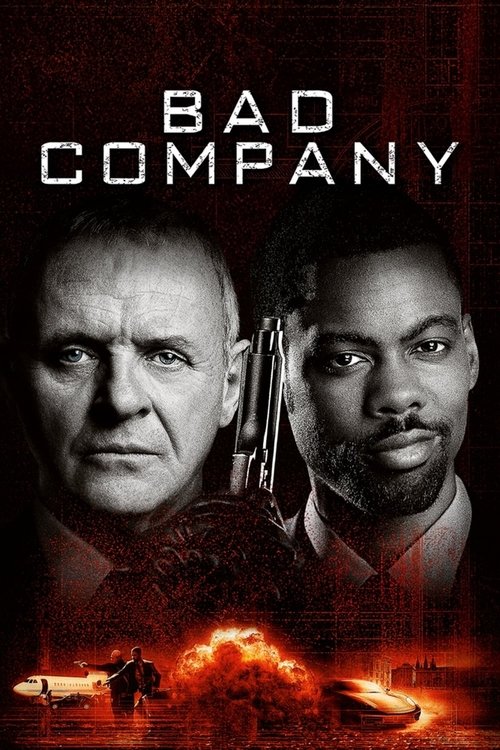
Bad Company
When a Harvard-educated CIA agent is killed during an operation, the secret agency recruits his twin brother.
The film struggled financially against its moderate budget of $70.0M, earning $66.0M globally (-6% loss).


Plot Structure
Story beats plotted across runtime


Narrative Arc
Emotional journey through the story's key moments
Story Circle
Blueprint 15-beat structure
Arcplot Score Breakdown
Weighted: Precision (70%) + Arc (15%) + Theme (15%)
Bad Company (2002) reveals deliberately positioned narrative architecture, characteristic of Joel Schumacher's storytelling approach. This structural analysis examines how the film's 15-point plot structure maps to proven narrative frameworks across 1 hour and 56 minutes. With an Arcplot score of 7.3, the film balances conventional beats with creative variation.
Characters
Cast & narrative archetypes

Jake Hayes
Kevin Pope / Michael Turner
Gaylord Oakes
Julie
Adrik Vas
Main Cast & Characters
Jake Hayes
Played by Chris Rock
A streetwise chess hustler from Harlem who must impersonate his twin brother, a CIA operative, to complete a critical mission.
Kevin Pope / Michael Turner
Played by Chris Rock
Jake's identical twin brother, a highly trained CIA operative killed during a mission, whose identity Jake must assume.
Gaylord Oakes
Played by Anthony Hopkins
A veteran CIA officer and handler who recruits Jake to replace his brother and complete the nuclear weapons deal.
Julie
Played by Kerry Washington
Kevin Pope's fiancée who becomes suspicious when Jake struggles to convincingly impersonate her late partner.
Adrik Vas
Played by Peter Stormare
A Czech terrorist and arms dealer attempting to acquire nuclear weapons through the deal with Michael Turner.
Structural Analysis
The Status Quo at 1 minutes (1% through the runtime) establishes Jake Hayes hustling chess games in New York City, living a street-smart but aimless life as a small-time con artist.. Significantly, this early placement immediately immerses viewers in the story world.
The inciting incident occurs at 13 minutes when CIA agents led by Gaylord Oakes track down Jake, revealing he's the twin brother of deceased agent Kevin Pope and the only person who can complete the mission.. At 12% through the film, this Disruption aligns precisely with traditional story structure. This beat shifts the emotional landscape, launching the protagonist into the central conflict.
The First Threshold at 29 minutes marks the transition into Act II, occurring at 25% of the runtime. This indicates the protagonist's commitment to Jake officially accepts the mission and enters the world of espionage, meeting Kevin's fiancée Julie and attempting to pass as his sophisticated twin brother., moving from reaction to action.
At 57 minutes, the Midpoint arrives at 50% of the runtime—precisely centered, creating perfect narrative symmetry. Structural examination shows that this crucial beat False defeat: The mission goes sideways when Jake's cover is threatened and terrorists discover inconsistencies in his identity, raising stakes and turning the fun and games deadly., fundamentally raising what's at risk. The emotional intensity shifts, dividing the narrative into clear before-and-after phases.
The Collapse moment at 86 minutes (74% through) represents the emotional nadir. Here, Jake is betrayed by Oakes, who is revealed as the true villain working with the terrorists. Jake is captured, beaten, and faces execution - literal whiff of death as everything falls apart., indicates the protagonist at their lowest point. This beat's placement in the final quarter sets up the climactic reversal.
The Second Threshold at 93 minutes initiates the final act resolution at 80% of the runtime. Jake synthesizes his street smarts with Kevin's training, realizing he doesn't have to be his brother - his own skills and authenticity are his greatest weapons. Escapes and commits to stopping Oakes., demonstrating the transformation achieved throughout the journey.
Emotional Journey
Bad Company's emotional architecture traces a deliberate progression across 15 carefully calibrated beats.
Narrative Framework
This structural analysis employs systematic plot point analysis that identifies crucial turning points. By mapping Bad Company against these established plot points, we can identify how Joel Schumacher utilizes or subverts traditional narrative conventions. The plot point approach reveals not only adherence to structural principles but also creative choices that distinguish Bad Company within the action genre.
Joel Schumacher's Structural Approach
Among the 17 Joel Schumacher films analyzed on Arcplot, the average structural score is 7.0, reflecting strong command of classical structure. Bad Company represents one of the director's most structurally precise works. For comparative analysis, explore the complete Joel Schumacher filmography.
Comparative Analysis
Additional action films include The Bad Guys, Puss in Boots and Venom: The Last Dance. For more Joel Schumacher analyses, see Batman Forever, The Phantom of the Opera and Trespass.
Plot Points by Act
Act I
SetupStatus Quo
Jake Hayes hustling chess games in New York City, living a street-smart but aimless life as a small-time con artist.
Theme
CIA officer discusses how intelligence work requires trust and identity - foreshadowing Jake's journey of becoming someone else while finding himself.
Worldbuilding
Establishing Jake's street life, his estranged relationship with his mother, and the parallel world of CIA agent Kevin Pope on a dangerous mission in Prague that goes fatally wrong.
Disruption
CIA agents led by Gaylord Oakes track down Jake, revealing he's the twin brother of deceased agent Kevin Pope and the only person who can complete the mission.
Resistance
Jake resists the CIA's recruitment, debates whether to leave his life, but is eventually persuaded by money and Oakes' manipulation. Begins crash training to impersonate his dead brother.
Act II
ConfrontationFirst Threshold
Jake officially accepts the mission and enters the world of espionage, meeting Kevin's fiancée Julie and attempting to pass as his sophisticated twin brother.
Mirror World
Jake connects with Julie, Kevin's fiancée, who represents the life of meaning, sophistication, and genuine connection that Jake never had. She becomes his emotional anchor.
Premise
Fish-out-of-water comedy as street-smart Jake fumbles through high-stakes espionage, meeting arms dealer Adrik Vas while trying to maintain his cover and complete the nuclear trigger exchange.
Midpoint
False defeat: The mission goes sideways when Jake's cover is threatened and terrorists discover inconsistencies in his identity, raising stakes and turning the fun and games deadly.
Opposition
Enemies close in on Jake, Oakes reveals darker manipulations, Julie discovers the deception about Kevin's death, and Jake realizes he's a pawn in a larger conspiracy involving Oakes himself.
Collapse
Jake is betrayed by Oakes, who is revealed as the true villain working with the terrorists. Jake is captured, beaten, and faces execution - literal whiff of death as everything falls apart.
Crisis
Jake's darkest moment of doubt, processing the betrayal and seemingly impossible odds, mourning the brother he never knew and the life he might have had with Julie.
Act III
ResolutionSecond Threshold
Jake synthesizes his street smarts with Kevin's training, realizing he doesn't have to be his brother - his own skills and authenticity are his greatest weapons. Escapes and commits to stopping Oakes.
Synthesis
Final confrontation where Jake uses his unique combination of street cunning and spy training to outsmart Oakes, prevent nuclear disaster, and save Julie, proving he's his own man.
Transformation
Jake, now a CIA agent in his own right, reconciles with his mother and commits to Julie - transformed from aimless hustler to purposeful hero who found family and identity.