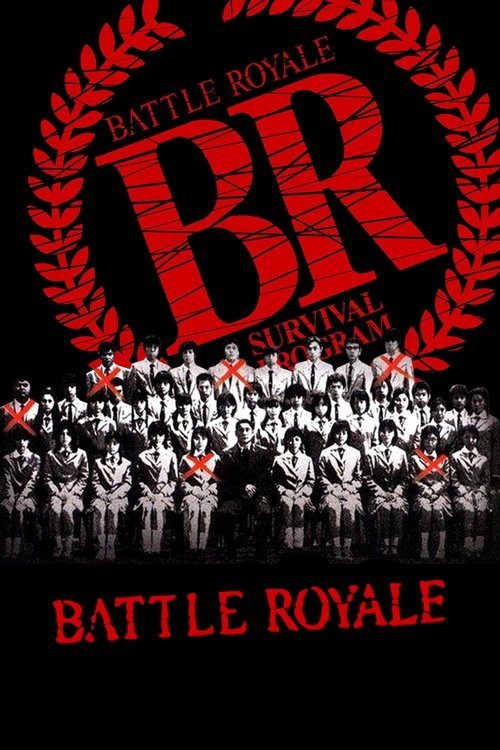
Battle Royale
In the future, the Japanese government captures a class of ninth-grade students and forces them to kill each other under the revolutionary "Battle Royale" act.
Despite its small-scale budget of $4.5M, Battle Royale became a commercial juggernaut, earning $30.6M worldwide—a remarkable 580% return. The film's compelling narrative connected with viewers, demonstrating that strong storytelling can transcend budget limitations.
7 wins & 8 nominations











Plot Structure
Story beats plotted across runtime


Narrative Arc
Emotional journey through the story's key moments
Story Circle
Blueprint 15-beat structure
Arcplot Score Breakdown
Weighted: Precision (70%) + Arc (15%) + Theme (15%)
Battle Royale (2000) reveals deliberately positioned dramatic framework, characteristic of Kinji Fukasaku's storytelling approach. This structural analysis examines how the film's 15-point plot structure maps to proven narrative frameworks across 1 hour and 53 minutes. With an Arcplot score of 7.3, the film balances conventional beats with creative variation.
Characters
Cast & narrative archetypes

Shuya Nanahara
Noriko Nakagawa
Kitano
Shogo Kawada
Kazuo Kiriyama
Mitsuko Souma
Takako Chigusa
Hiroki Sugimura
Shinji Mimura
Main Cast & Characters
Shuya Nanahara
Played by Tatsuya Fujiwara
A compassionate student who refuses to kill and tries to protect his classmates while surviving the deadly game.
Noriko Nakagawa
Played by Aki Maeda
A gentle, kind-hearted girl who becomes Shuya's companion and moral anchor throughout the game.
Kitano
Played by Takeshi Kitano
The class's former teacher who now oversees the Battle Royale program with cold detachment and dark motivations.
Shogo Kawada
Played by Taro Yamamoto
A transfer student and previous Battle Royale survivor who knows the game's secrets and helps Shuya and Noriko.
Kazuo Kiriyama
Played by Masanobu Ando
A cold, emotionless transfer student who kills efficiently and methodically without hesitation or remorse.
Mitsuko Souma
Played by Ko Shibasaki
A manipulative and ruthless student who uses her sexuality and cunning to survive by eliminating others.
Takako Chigusa
Played by Chiaki Kuriyama
A strong-willed athlete who fiercely protects her best friend and fights to survive with determination.
Hiroki Sugimura
Played by Sosuke Takaoka
A skilled martial artist searching for his crush Kotohiki throughout the game, refusing to kill.
Shinji Mimura
Played by Takashi Tsukamoto
A basketball star and tech-savvy student who attempts to hack the system and fight back against the game.
Structural Analysis
The Status Quo at 1 minutes (1% through the runtime) establishes News footage shows bloody middle school girl emerging as sole survivor of previous Battle Royale, establishing a society where youth violence has spiraled out of control and the government has instituted deadly "games" as punishment.. The analysis reveals that this early placement immediately immerses viewers in the story world.
The inciting incident occurs at 13 minutes when The students wake up in a classroom wearing electronic collars. Their former teacher Kitano reveals they've been selected for the Battle Royale - a government program where one class must fight to the death until only one survives. The ordinary world is completely shattered.. At 12% through the film, this Disruption aligns precisely with traditional story structure. This beat shifts the emotional landscape, launching the protagonist into the central conflict.
The First Threshold at 29 minutes marks the transition into Act II, occurring at 25% of the runtime. This indicates the protagonist's commitment to The students are released onto the island with their weapons. They scatter in different directions, each making their choice - some to hide, some to fight, some to find allies. Shuya chooses to protect Noriko and find a way to survive without killing. The game begins., moving from reaction to action.
At 56 minutes, the Midpoint arrives at 50% of the runtime—precisely centered, creating perfect narrative symmetry. Significantly, this crucial beat The lighthouse massacre: Mitsuko, a student who has fully embraced murder, slaughters a group of girls who were trying to survive together peacefully. This false defeat shows that trust and cooperation seem impossible - the game appears unbeatable, and innocence is being destroyed., fundamentally raising what's at risk. The emotional intensity shifts, dividing the narrative into clear before-and-after phases.
The Collapse moment at 84 minutes (75% through) represents the emotional nadir. Here, Kawada appears to betray Shuya and Noriko, shooting them both. Their ally and only hope for escape seemingly kills them. The whiff of death is literal - Shuya and Noriko appear to die, and their plan to escape without becoming murderers seems to have failed completely., reveals the protagonist at their lowest point. This beat's placement in the final quarter sets up the climactic reversal.
The Second Threshold at 92 minutes initiates the final act resolution at 81% of the runtime. Kawada successfully hacks the Battle Royale computer system, disabling all remaining collars. The three "dead" students prepare to confront Kitano. They synthesize what they've learned: trust, cooperation, and intelligence can beat the system. They choose defiance over submission., demonstrating the transformation achieved throughout the journey.
Emotional Journey
Battle Royale's emotional architecture traces a deliberate progression across 15 carefully calibrated beats.
Narrative Framework
This structural analysis employs a 15-point narrative structure framework that maps key story moments. By mapping Battle Royale against these established plot points, we can identify how Kinji Fukasaku utilizes or subverts traditional narrative conventions. The plot point approach reveals not only adherence to structural principles but also creative choices that distinguish Battle Royale within the drama genre.
Comparative Analysis
Additional drama films include After Thomas, South Pacific and Dirty Dancing: Havana Nights.
Plot Points by Act
Act I
SetupStatus Quo
News footage shows bloody middle school girl emerging as sole survivor of previous Battle Royale, establishing a society where youth violence has spiraled out of control and the government has instituted deadly "games" as punishment.
Theme
On the bus ride, students discuss their futures and dreams before the abduction. One student mentions "trust" - the central theme that will be tested as former friends must decide whether to kill each other or find another way.
Worldbuilding
Introduction of Shuya Nanahara and his classmates on their school trip. We see the social dynamics: Shuya's crush on Noriko, the various cliques and friendships, their teacher Kitano's resignation after being attacked by a student. Normal teenage concerns before everything changes.
Disruption
The students wake up in a classroom wearing electronic collars. Their former teacher Kitano reveals they've been selected for the Battle Royale - a government program where one class must fight to the death until only one survives. The ordinary world is completely shattered.
Resistance
Kitano explains the rules: explosive collars, three-day time limit, danger zones, weapons in bags. Students react with disbelief, panic, defiance. Two students are killed as examples. The class debates whether this is real, whether to fight or resist, whether to trust each other.
Act II
ConfrontationFirst Threshold
The students are released onto the island with their weapons. They scatter in different directions, each making their choice - some to hide, some to fight, some to find allies. Shuya chooses to protect Noriko and find a way to survive without killing. The game begins.
Mirror World
Shuya and Noriko encounter Kawada, a transfer student who survived a previous Battle Royale. He represents the thematic alternative - someone who knows the game but retained his humanity. He offers to help them survive and escape together.
Premise
The "game" unfolds as promised: students hunt, hide, form alliances, and betray each other. Some embrace violence, some kill in self-defense, some refuse to play. Friendships are tested. We see both the horror and the human moments - the promise of this premise delivered in full.
Midpoint
The lighthouse massacre: Mitsuko, a student who has fully embraced murder, slaughters a group of girls who were trying to survive together peacefully. This false defeat shows that trust and cooperation seem impossible - the game appears unbeatable, and innocence is being destroyed.
Opposition
The student count drops rapidly. Paranoia spreads. The few remaining students become more desperate and dangerous. Kiriyama, a volunteer killer, systematically hunts others. Shuya's group faces mounting threats. The government monitors and announces deaths. The collars create new danger zones, forcing confrontations.
Collapse
Kawada appears to betray Shuya and Noriko, shooting them both. Their ally and only hope for escape seemingly kills them. The whiff of death is literal - Shuya and Noriko appear to die, and their plan to escape without becoming murderers seems to have failed completely.
Crisis
The revelation: Kawada's "betrayal" was staged with fake blood to fool the organizers. Shuya and Noriko process this near-death experience. Kawada reveals his plan to hack the system using knowledge from his previous game. They must trust each other completely for the final gambit.
Act III
ResolutionSecond Threshold
Kawada successfully hacks the Battle Royale computer system, disabling all remaining collars. The three "dead" students prepare to confront Kitano. They synthesize what they've learned: trust, cooperation, and intelligence can beat the system. They choose defiance over submission.
Synthesis
Confrontation with Kitano at the headquarters. He reveals his motivation - loneliness, rejection by students and family. Shuya refuses to kill him; Kitano forces a confrontation and is shot. The collars are destroyed. Kawada, mortally wounded, ensures Shuya and Noriko escape. They become fugitives together.
Transformation
Shuya and Noriko, now wanted fugitives, run together into an uncertain future. Unlike the opening's image of bloody violence and state control, we see two young people who refused to let the system destroy their humanity, choosing freedom and trust over survival through murder.