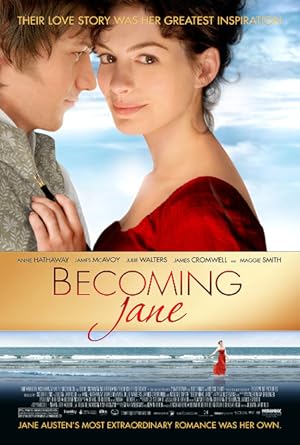
Becoming Jane
The year is 1795 and young Jane Austen (Anne Hathaway) is a feisty twenty-year-old and emerging writer who already sees a world beyond class and commerce, beyond pride and prejudice, and dreams of doing what was then nearly unthinkable, marrying for love. Naturally, her parents are searching for a wealthy, well-appointed husband to assure their daughter's future social standing. They are eyeing Mr. Wisley (Laurence Fox), nephew to the very formidable, not to mention very rich, local aristocrat Lady Gresham (Dame Maggie Smith), as a prospective match. But when Jane meets the roguish and decidedly non-aristocratic Tom Lefroy (James McAvoy), sparks soon fly along with the sharp repartee. His intellect and arrogance raise her ire, then knock her head over heels. Now, the couple, whose flirtation flies in the face of the sense and sensibility of the age, is faced with a terrible dilemma. If they attempt to marry, they will risk everything that matters - family, friends, and fortune.
Despite a moderate budget of $16.5M, Becoming Jane became a solid performer, earning $39.4M worldwide—a 139% return.
3 wins & 6 nominations


Plot Structure
Story beats plotted across runtime


Narrative Arc
Emotional journey through the story's key moments
Story Circle
Blueprint 15-beat structure
Arcplot Score Breakdown
Weighted: Precision (70%) + Arc (15%) + Theme (15%)
Becoming Jane (2007) reveals deliberately positioned dramatic framework, characteristic of Julian Jarrold's storytelling approach. This structural analysis examines how the film's 15-point plot structure maps to proven narrative frameworks across 2 hours. With an Arcplot score of 6.0, the film takes an unconventional approach to traditional narrative frameworks.
Characters
Cast & narrative archetypes

Jane Austen
Tom Lefroy
Mr. Austen
Mrs. Austen
Mr. Wisley
Lady Gresham
Henry Austen
Cassandra Austen
Main Cast & Characters
Jane Austen
Played by Anne Hathaway
A young aspiring writer who falls in love with Tom Lefroy, experiencing a romance that influences her future literary work.
Tom Lefroy
Played by James McAvoy
An impoverished Irish law student and charming rogue who becomes Jane's passionate love interest.
Mr. Austen
Played by James Cromwell
Jane's loving father, a modest clergyman who supports her writing ambitions but must consider family financial security.
Mrs. Austen
Played by Julie Walters
Jane's pragmatic mother who pressures her to marry well for financial stability rather than for love.
Mr. Wisley
Played by Laurence Fox
A wealthy but socially awkward gentleman and nephew of Lady Gresham who proposes marriage to Jane.
Lady Gresham
Played by Maggie Smith
A wealthy and imperious benefactor of the Austen family who expects Jane to marry her nephew.
Henry Austen
Played by Joe Anderson
Jane's charming and supportive brother who encourages her romantic and literary pursuits.
Cassandra Austen
Played by Anna Maxwell Martin
Jane's beloved older sister and confidante, engaged to be married.
Structural Analysis
The Status Quo at 2 minutes (1% through the runtime) establishes Jane Austen writes in the countryside, a young woman constrained by her family's expectations and the limited options available to women, showing her world before disruption.. Notably, this early placement immediately immerses viewers in the story world.
The inciting incident occurs at 15 minutes when Tom Lefroy arrives and disrupts Jane's world with his arrogant criticism of her writing and his contradictory, magnetic presence.. At 12% through the film, this Disruption aligns precisely with traditional story structure. This beat shifts the emotional landscape, launching the protagonist into the central conflict.
The First Threshold at 30 minutes marks the transition into Act II, occurring at 25% of the runtime. This shows the protagonist's commitment to Jane chooses to pursue her feelings for Tom, actively engaging in their intellectual and romantic connection, crossing the threshold from duty-bound daughter to woman following her heart., moving from reaction to action.
At 61 minutes, the Midpoint arrives at 50% of the runtime—precisely centered, creating perfect narrative symmetry. Significantly, this crucial beat False victory: Jane and Tom decide to elope, believing love will conquer all obstacles. They commit to running away together, raising the stakes to their highest point., fundamentally raising what's at risk. The emotional intensity shifts, dividing the narrative into clear before-and-after phases.
The Collapse moment at 91 minutes (76% through) represents the emotional nadir. Here, Jane discovers that Tom's family depends entirely on his uncle's support and their elopement would destroy them. Her dream of love and independence dies as she faces the impossible choice., indicates the protagonist at their lowest point. This beat's placement in the final quarter sets up the climactic reversal.
The Second Threshold at 96 minutes initiates the final act resolution at 80% of the runtime. Jane achieves synthesis: she chooses to sacrifice her love for Tom's family, understanding that true love sometimes means letting go, embracing her independence as a writer instead., demonstrating the transformation achieved throughout the journey.
Emotional Journey
Becoming Jane's emotional architecture traces a deliberate progression across 15 carefully calibrated beats.
Narrative Framework
This structural analysis employs proven narrative structure principles that track dramatic progression. By mapping Becoming Jane against these established plot points, we can identify how Julian Jarrold utilizes or subverts traditional narrative conventions. The plot point approach reveals not only adherence to structural principles but also creative choices that distinguish Becoming Jane within the biography genre.
Julian Jarrold's Structural Approach
Among the 4 Julian Jarrold films analyzed on Arcplot, the average structural score is 6.7, demonstrating varied approaches to story architecture. Becoming Jane takes a more unconventional approach compared to the director's typical style. For comparative analysis, explore the complete Julian Jarrold filmography.
Comparative Analysis
Additional biography films include After Thomas, Taking Woodstock and The Fire Inside. For more Julian Jarrold analyses, see A Royal Night Out, Brideshead Revisited and Kinky Boots.
Plot Points by Act
Act I
SetupStatus Quo
Jane Austen writes in the countryside, a young woman constrained by her family's expectations and the limited options available to women, showing her world before disruption.
Theme
Mrs. Austen or another character discusses the necessity of marrying for security versus affection, stating the central conflict between practical duty and passionate love.
Worldbuilding
Introduction to Jane's world: her family's financial struggles, her writing ambitions, the social strictures of Georgian England, and the arrival of Mr. Wisley as a wealthy suitor.
Disruption
Tom Lefroy arrives and disrupts Jane's world with his arrogant criticism of her writing and his contradictory, magnetic presence.
Resistance
Jane resists Tom initially, debates her feelings and society's expectations, and experiences growing attraction despite their verbal sparring and her engagement prospects with Wisley.
Act II
ConfrontationFirst Threshold
Jane chooses to pursue her feelings for Tom, actively engaging in their intellectual and romantic connection, crossing the threshold from duty-bound daughter to woman following her heart.
Mirror World
Tom becomes the mirror world character representing Jane's thematic journey - he embodies the passionate, independent life she craves but cannot easily attain.
Premise
The romance flourishes: Jane and Tom explore their connection through wit, literature, and stolen moments, experiencing the promise of love and intellectual partnership.
Midpoint
False victory: Jane and Tom decide to elope, believing love will conquer all obstacles. They commit to running away together, raising the stakes to their highest point.
Opposition
The elopement proceeds but reality closes in: Tom's family obligations surface, Jane learns of his dependent family, and the consequences of their choice become increasingly dire.
Collapse
Jane discovers that Tom's family depends entirely on his uncle's support and their elopement would destroy them. Her dream of love and independence dies as she faces the impossible choice.
Crisis
Jane processes the devastating reality that she must choose between her love and Tom's family's survival, sitting in darkness with the weight of her decision.
Act III
ResolutionSecond Threshold
Jane achieves synthesis: she chooses to sacrifice her love for Tom's family, understanding that true love sometimes means letting go, embracing her independence as a writer instead.
Synthesis
Jane returns home, rejects Wisley definitively, commits to her writing career, and lives as an independent woman. Years pass, she becomes a successful author.
Transformation
Jane and Tom meet again years later. She is now the accomplished author Jane Austen; he has a daughter named after her. Both have transformed - she found her voice, he honors what they shared.