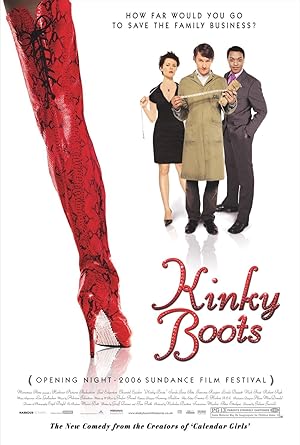
Kinky Boots
Charlie Price grew up with his father in the family shoe business, but he never thought he'd take his father's place. But his father's untimely death places him exactly there, where he learns that Price and Sons Shoes is failing. While in despair at his failed attempts to save the business, Charlie has a chance encounter with flamboyant drag queen cabaret singer Lola. Her complaints about the inadequate footwear for her work, combined with the suggestion of one of Charlie's ex-employees, Lauren, lead to a bid to save the business by making men's fetish footwear. Charlie convinces Lola to be their footwear designer and the transition begins. Now this disparate lot must struggle with this unorthodox idea while dealing with the prejudice of the staff, Lola's discomfort in the small town, and the selfish manipulation of Charles' greedy fiancee, who cannot see the greater good in Charlie's dream.
The film disappointed at the box office against its tight budget of $10.0M, earning $10.0M globally (0% loss).
2 wins & 7 nominations


Plot Structure
Story beats plotted across runtime


Narrative Arc
Emotional journey through the story's key moments
Story Circle
Blueprint 15-beat structure
Arcplot Score Breakdown
Weighted: Precision (70%) + Arc (15%) + Theme (15%)
Kinky Boots (2005) showcases deliberately positioned plot construction, characteristic of Julian Jarrold's storytelling approach. This structural analysis examines how the film's 15-point plot structure maps to proven narrative frameworks across 1 hour and 47 minutes. With an Arcplot score of 6.6, the film balances conventional beats with creative variation.
Characters
Cast & narrative archetypes

Charlie Price
Lola
Lauren
Nicola
Don
George
Main Cast & Characters
Charlie Price
Played by Joel Edgerton
A young man who inherits his father's failing shoe factory and must find a way to save it and the workers who depend on it.
Lola
Played by Chiwetel Ejiofor
A drag queen performer who becomes Charlie's unlikely business partner and friend, inspiring the factory to produce boots for drag performers.
Lauren
Played by Jemima Rooper
Charlie's materialistic fiancée from London who struggles to accept his commitment to the failing factory in Northampton.
Nicola
Played by Sarah-Jane Potts
A loyal factory worker who develops feelings for Charlie and supports his efforts to save the business.
Don
Played by Nick Frost
A close-minded factory worker who initially bullies Lola but eventually learns acceptance and respect.
George
Played by Robert Pugh
A veteran factory worker who serves as a voice of experience and support for Charlie.
Structural Analysis
The Status Quo at 1 minutes (1% through the runtime) establishes Young Charlie Price learns the family shoe business from his father in Northampton, while young Simon (later Lola) performs in his father's boxing gym. Two boys, two fathers, two different expectations.. Notably, this early placement immediately immerses viewers in the story world.
The inciting incident occurs at 13 minutes when Charlie's father dies suddenly. Charlie must return to Northampton to handle the factory, disrupting his London life and forcing him to confront the legacy he tried to escape.. At 13% through the film, this Disruption is delayed, allowing extended setup of the story world. This beat shifts the emotional landscape, launching the protagonist into the central conflict.
The First Threshold at 27 minutes marks the transition into Act II, occurring at 25% of the runtime. This demonstrates the protagonist's commitment to After witnessing Lola defend herself in heels that break, Charlie has an epiphany: make shoes for a niche market that doesn't exist - high-fashion boots for men. He actively chooses to pursue this radical idea to save the factory., moving from reaction to action.
At 54 minutes, the Midpoint arrives at 50% of the runtime—precisely centered, creating perfect narrative symmetry. The analysis reveals that this crucial beat False victory: They secure a spot at the Milan fashion show. The factory has a deadline and purpose. Charlie and Lola bond over their fathers' expectations. Everything seems to be working - but underlying tensions remain unresolved., fundamentally raising what's at risk. The emotional intensity shifts, dividing the narrative into clear before-and-after phases.
The Collapse moment at 80 minutes (75% through) represents the emotional nadir. Here, All is lost: After Charlie fails to defend Lola against Don's cruelty, Lola quits and disappears. The Milan show is impossible without him. Charlie has lost his partner, his workforce is divided, and his relationship with Nicola crumbles. The dream dies., demonstrates the protagonist at their lowest point. This beat's placement in the final quarter sets up the climactic reversal.
The Second Threshold at 86 minutes initiates the final act resolution at 80% of the runtime. Charlie finds Lola and genuinely apologizes, not to save the business, but because it's right. He chooses friendship and integrity over profit. Lola shares his own pain about his father. They reconcile as true friends, combining their strengths for Milan., demonstrating the transformation achieved throughout the journey.
Emotional Journey
Kinky Boots's emotional architecture traces a deliberate progression across 15 carefully calibrated beats.
Narrative Framework
This structural analysis employs a 15-point narrative structure framework that maps key story moments. By mapping Kinky Boots against these established plot points, we can identify how Julian Jarrold utilizes or subverts traditional narrative conventions. The plot point approach reveals not only adherence to structural principles but also creative choices that distinguish Kinky Boots within the comedy genre.
Julian Jarrold's Structural Approach
Among the 4 Julian Jarrold films analyzed on Arcplot, the average structural score is 6.7, demonstrating varied approaches to story architecture. Kinky Boots takes a more unconventional approach compared to the director's typical style. For comparative analysis, explore the complete Julian Jarrold filmography.
Comparative Analysis
Additional comedy films include The Bad Guys, Ella Enchanted and The Evening Star. For more Julian Jarrold analyses, see A Royal Night Out, Brideshead Revisited and Becoming Jane.
Plot Points by Act
Act I
SetupStatus Quo
Young Charlie Price learns the family shoe business from his father in Northampton, while young Simon (later Lola) performs in his father's boxing gym. Two boys, two fathers, two different expectations.
Theme
Charlie's father tells him: "A man is measured by how well he fulfills his role and responsibilities." The theme of identity versus duty, being true to yourself while honoring legacy.
Worldbuilding
Adult Charlie lives in London, engaged to Nicola, working in marketing. The Price & Sons factory struggles. Charlie's father runs the traditional family business, employing the whole community. Lola performs as a drag queen in Soho.
Disruption
Charlie's father dies suddenly. Charlie must return to Northampton to handle the factory, disrupting his London life and forcing him to confront the legacy he tried to escape.
Resistance
Charlie discovers the factory is failing and must lay off workers. He debates closing it versus saving it. Nicola pressures him to sell. Lauren (factory worker) challenges him to fight for the business. Charlie resists taking full responsibility.
Act II
ConfrontationFirst Threshold
After witnessing Lola defend herself in heels that break, Charlie has an epiphany: make shoes for a niche market that doesn't exist - high-fashion boots for men. He actively chooses to pursue this radical idea to save the factory.
Mirror World
Charlie convinces Lola to be his designer and partner. Lola represents everything Charlie was taught to reject, but embodies authenticity and self-acceptance - the thematic opposite of Charlie's people-pleasing and fear of judgment.
Premise
The "fun and games" of designing kinky boots: Lola sketches outrageous designs, the factory workers struggle with prejudice, Charlie and Lola clash over vision versus practicality, workers gradually warm to Lola, early prototypes are tested and fail hilariously.
Midpoint
False victory: They secure a spot at the Milan fashion show. The factory has a deadline and purpose. Charlie and Lola bond over their fathers' expectations. Everything seems to be working - but underlying tensions remain unresolved.
Opposition
Pressure mounts as the Milan deadline approaches. Worker Don's homophobia intensifies. Nicola's demands increase. Charlie's attempts to please everyone create conflict. He fails to defend Lola when Don attacks him. The workers struggle with overtime and tension.
Collapse
All is lost: After Charlie fails to defend Lola against Don's cruelty, Lola quits and disappears. The Milan show is impossible without him. Charlie has lost his partner, his workforce is divided, and his relationship with Nicola crumbles. The dream dies.
Crisis
Charlie confronts his own cowardice and people-pleasing. He realizes he's been living for others' approval just like he accused his father of doing. Lauren helps him see what matters. He must choose authenticity over acceptance.
Act III
ResolutionSecond Threshold
Charlie finds Lola and genuinely apologizes, not to save the business, but because it's right. He chooses friendship and integrity over profit. Lola shares his own pain about his father. They reconcile as true friends, combining their strengths for Milan.
Synthesis
The factory unites to finish the boots. They race to Milan. The fashion show is a triumph - Lola and the drag queens strut down the runway in Price & Sons kinky boots. Orders pour in. Charlie stands up to Nicola and ends their relationship. The factory is saved.
Transformation
Charlie and Lola, now true friends and partners, stand together in the factory with the workers. Charlie has become his own man - honoring his father's legacy by transforming it, not conforming to it. He's accepted himself and others.