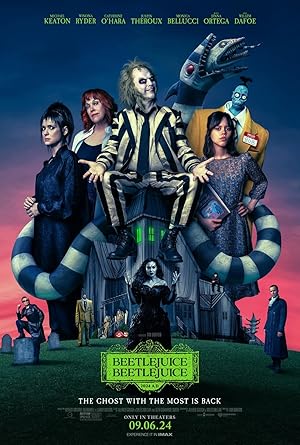
Beetlejuice Beetlejuice
From critically acclaimed filmmaker and screenwriter, Tim Burton presents the long-awaited sequel to the Halloween classic. Keaton's action-packed comedic demon returns to the silver screen for more mischief than ever before. When the Maitland house EXPLODES, so does the fun, so buckle up. The original cast and crew plus new additions return when Beetlejuice is found homeless in the netherworld. He takes it upon himself to travel back to the mortal world seeking comfort, only to find the Maitland house has blown up due to a gas leak. Leaving our beloved characters without a humble home to share the love. In search of guidance, the crew travels down to the Netherworld only to find there's a new sheriff in these parts, The Jersey Devil (Will Arnett). Through a surprising turn of events, the self-known ladies man, Beetlejuice learns that the Jersey Devil is his long-lost son through one of his numerous love affairs. Lydia Deetz (Winona Ryder) is wood by the enchanting Jersey Devil, despite being married to a struggling real estate agent (David Harbour). Through kooky scenarios and ecstatic characters, the fun near stops. Though entertaining it is also a heart-wrenching tale that shows Beetlejuice is just another man trying to find his way in the world. The story also progresses the idea that a family is never truly ideal. The story continues when you say the release date three times unbroken. Release date TBD.
Despite a substantial budget of $99.0M, Beetlejuice Beetlejuice became a commercial success, earning $452.0M worldwide—a 357% return.
9 wins & 48 nominations


Plot Structure
Story beats plotted across runtime


Narrative Arc
Emotional journey through the story's key moments
Story Circle
Blueprint 15-beat structure
Arcplot Score Breakdown
Weighted: Precision (70%) + Arc (15%) + Theme (15%)
Beetlejuice Beetlejuice (2024) exhibits strategically placed narrative design, characteristic of Tim Burton's storytelling approach. This structural analysis examines how the film's 15-point plot structure maps to proven narrative frameworks across 1 hour and 45 minutes. With an Arcplot score of 7.0, the film balances conventional beats with creative variation.
Characters
Cast & narrative archetypes

Lydia Deetz
Beetlejuice
Astrid Deetz
Delia Deetz
Rory
Delores
Wolf Jackson
Main Cast & Characters
Lydia Deetz
Played by Winona Ryder
Now a mature woman and paranormal TV host, still haunted by her past encounters with the supernatural and struggling to connect with her teenage daughter.
Beetlejuice
Played by Michael Keaton
The mischievous bio-exorcist ghost returns with his chaotic energy, crude humor, and desperate schemes to escape the afterlife.
Astrid Deetz
Played by Jenna Ortega
Lydia's rebellious teenage daughter who is skeptical of her mother's supernatural experiences and feels disconnected from her family.
Delia Deetz
Played by Catherine O'Hara
Lydia's eccentric stepmother, still pursuing her avant-garde artistic endeavors and maintaining her dramatic flair into her later years.
Rory
Played by Justin Theroux
Lydia's manipulative boyfriend and producer of her paranormal show, who has his own agenda regarding their relationship.
Delores
Played by Monica Bellucci
Beetlejuice's vengeful ex-wife from the afterlife, a soul-sucking witch who is hunting him down for past betrayals.
Wolf Jackson
Played by Willem Dafoe
An afterlife detective and action hero actor who patrols the realm between the living and the dead.
Structural Analysis
The Status Quo at 1 minutes (1% through the runtime) establishes Lydia Deetz hosts her successful paranormal talk show, now famous but emotionally disconnected from her daughter Astrid, living a carefully controlled public life that masks deeper family wounds.. The analysis reveals that this early placement immediately immerses viewers in the story world.
The inciting incident occurs at 13 minutes when Lydia receives news that her father Charles has died in a bizarre shark attack, forcing the family to return to Winter River and the haunted house where everything began.. At 13% through the film, this Disruption is delayed, allowing extended setup of the story world. This beat shifts the emotional landscape, launching the protagonist into the central conflict.
The First Threshold at 26 minutes marks the transition into Act II, occurring at 25% of the runtime. This shows the protagonist's commitment to Astrid encounters a mysterious boy who claims to need her help, drawing her into the supernatural world. Simultaneously, Beetlejuice becomes active again, setting both mother and daughter on collision courses with the afterlife., moving from reaction to action.
At 53 minutes, the Midpoint arrives at 50% of the runtime—precisely centered, creating perfect narrative symmetry. The analysis reveals that this crucial beat Astrid discovers the boy has betrayed her and she's trapped in the afterlife, revealing the true stakes. Lydia realizes her daughter is in mortal danger and must accept that only Beetlejuice can help her now., fundamentally raising what's at risk. The emotional intensity shifts, dividing the narrative into clear before-and-after phases.
The Collapse moment at 79 minutes (75% through) represents the emotional nadir. Here, Lydia agrees to marry Beetlejuice to save Astrid's soul, sacrificing her own freedom and future. The wedding ceremony begins as all hope seems lost and Lydia must surrender everything she's fought to protect., shows the protagonist at their lowest point. This beat's placement in the final quarter sets up the climactic reversal.
The Second Threshold at 84 minutes initiates the final act resolution at 80% of the runtime. Astrid and the Deetz family unite, using their combined knowledge of the supernatural to fight back. They realize that together they can outmaneuver Beetlejuice by exploiting the very rules he's been manipulating., demonstrating the transformation achieved throughout the journey.
Emotional Journey
Beetlejuice Beetlejuice's emotional architecture traces a deliberate progression across 15 carefully calibrated beats.
Narrative Framework
This structural analysis employs structural analysis methodology used to understand storytelling architecture. By mapping Beetlejuice Beetlejuice against these established plot points, we can identify how Tim Burton utilizes or subverts traditional narrative conventions. The plot point approach reveals not only adherence to structural principles but also creative choices that distinguish Beetlejuice Beetlejuice within the comedy genre.
Tim Burton's Structural Approach
Among the 19 Tim Burton films analyzed on Arcplot, the average structural score is 6.9, demonstrating varied approaches to story architecture. Beetlejuice Beetlejuice represents one of the director's most structurally precise works. For comparative analysis, explore the complete Tim Burton filmography.
Comparative Analysis
Additional comedy films include The Bad Guys, Ella Enchanted and The Evening Star. For more Tim Burton analyses, see Beetlejuice, Dark Shadows and Pee-wee's Big Adventure.
Plot Points by Act
Act I
SetupStatus Quo
Lydia Deetz hosts her successful paranormal talk show, now famous but emotionally disconnected from her daughter Astrid, living a carefully controlled public life that masks deeper family wounds.
Theme
Astrid challenges Lydia about exploiting the dead for fame, stating "You built your whole career on lies about seeing ghosts," introducing the theme of authenticity versus performance and unresolved family trauma.
Worldbuilding
Establishment of Lydia's celebrity status, her strained relationship with Astrid, her manipulative boyfriend Rory, and the fractured Deetz family dynamics. We see Lydia's gift is real but commodified, while Astrid is skeptical and resentful.
Disruption
Lydia receives news that her father Charles has died in a bizarre shark attack, forcing the family to return to Winter River and the haunted house where everything began.
Resistance
The family reluctantly returns to Winter River for the funeral. Lydia resists confronting her past, Astrid rebels against being back, and Delia plans an avant-garde funeral. Tension builds as Lydia senses Beetlejuice's presence stirring.
Act II
ConfrontationFirst Threshold
Astrid encounters a mysterious boy who claims to need her help, drawing her into the supernatural world. Simultaneously, Beetlejuice becomes active again, setting both mother and daughter on collision courses with the afterlife.
Mirror World
Astrid's connection with the mysterious boy deepens, mirroring Lydia's own teenage encounter with the supernatural. This relationship will force Astrid to confront whether her mother's abilities are real.
Premise
The fun of exploring the afterlife bureaucracy, Beetlejuice's schemes, Astrid's supernatural romance, and the family navigating Winter River. Comic supernatural chaos as multiple underworld plots converge and Astrid gets pulled deeper into danger.
Midpoint
Astrid discovers the boy has betrayed her and she's trapped in the afterlife, revealing the true stakes. Lydia realizes her daughter is in mortal danger and must accept that only Beetlejuice can help her now.
Opposition
Lydia is forced to bargain with Beetlejuice to save Astrid. Beetlejuice's soul-sucking ex-wife Delores closes in. The situation becomes increasingly desperate as multiple threats converge and Lydia must confront her deepest fears.
Collapse
Lydia agrees to marry Beetlejuice to save Astrid's soul, sacrificing her own freedom and future. The wedding ceremony begins as all hope seems lost and Lydia must surrender everything she's fought to protect.
Crisis
The dark wedding proceeds with Lydia trapped and Astrid still in danger. The family faces their darkest moment as supernatural forces collide and it appears Beetlejuice has finally won.
Act III
ResolutionSecond Threshold
Astrid and the Deetz family unite, using their combined knowledge of the supernatural to fight back. They realize that together they can outmaneuver Beetlejuice by exploiting the very rules he's been manipulating.
Synthesis
The family works together to banish Beetlejuice and save Astrid. Lydia embraces her authentic gift rather than hiding from it. Mother and daughter reconcile, finding genuine connection through shared supernatural understanding. The afterlife threats are neutralized.
Transformation
Lydia and Astrid share a genuine moment of understanding and connection, both accepting the reality of their gifts. The family is reunited in authenticity rather than performance, having faced death and emerged stronger together.