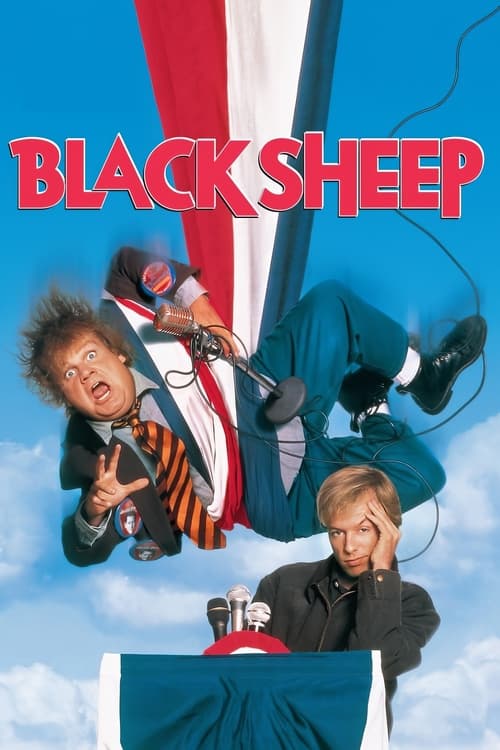
Black Sheep
When dignified Albert Donnelly runs for Governor, his team moves to keep his slow-witted and klutzy younger brother, Mike, out of the eye of the media. To baby-sit Mike, the campaign assigns sarcastic Steve, who gets the experience of a lifetime when he tries to take Mike out of town during the election.
The film underperformed commercially against its moderate budget of $32.4M, earning $32.0M globally (-1% loss).


Plot Structure
Story beats plotted across runtime


Narrative Arc
Emotional journey through the story's key moments
Story Circle
Blueprint 15-beat structure
Arcplot Score Breakdown
Weighted: Precision (70%) + Arc (15%) + Theme (15%)
Black Sheep (1996) exhibits precise dramatic framework, characteristic of Penelope Spheeris's storytelling approach. This structural analysis examines how the film's 15-point plot structure maps to proven narrative frameworks across 1 hour and 26 minutes. With an Arcplot score of 7.2, the film balances conventional beats with creative variation.
Characters
Cast & narrative archetypes

Mike Donnelly
Steve Dodds
Al Donnelly
Governor Tracy
Drake Sabitch
Roger Kovary
Main Cast & Characters
Mike Donnelly
Played by Chris Farley
Well-meaning but disaster-prone brother of a gubernatorial candidate who is hidden away to avoid campaign disasters.
Steve Dodds
Played by David Spade
Uptight campaign aide assigned to babysit Mike and keep him out of trouble during the election.
Al Donnelly
Played by Tim Matheson
Mike's older brother running for Governor of Washington, trying to overcome his brother's reputation.
Governor Tracy
Played by Christine Ebersole
Incumbent governor and ruthless politician willing to use dirty tricks to win re-election.
Drake Sabitch
Played by Timothy Carhart
Governor Tracy's campaign manager who orchestrates schemes to sabotage the Donnelly campaign.
Roger Kovary
Played by Gary Busey
Al Donnelly's campaign manager trying to run a clean, professional operation.
Structural Analysis
The Status Quo at 1 minutes (1% through the runtime) establishes Mike Donnelly is shown as a lovable screw-up at his brother Al's campaign headquarters, disrupting everything he touches with good intentions but disastrous results.. Significantly, this early placement immediately immerses viewers in the story world.
The inciting incident occurs at 10 minutes when Mike causes a major campaign disaster at a public event, forcing Roger and Al to send him away on a "cabin retreat" with Steve to keep him from sabotaging the election.. At 11% through the film, this Disruption aligns precisely with traditional story structure. This beat shifts the emotional landscape, launching the protagonist into the central conflict.
The First Threshold at 21 minutes marks the transition into Act II, occurring at 24% of the runtime. This demonstrates the protagonist's commitment to Mike and Steve depart on their road trip, leaving the campaign world behind and entering the wilderness adventure that will transform them both., moving from reaction to action.
At 43 minutes, the Midpoint arrives at 49% of the runtime—precisely centered, creating perfect narrative symmetry. Structural examination shows that this crucial beat Mike and Steve discover that someone is trying to sabotage Al's campaign using Mike as a pawn. The stakes are raised as they realize they must actively help rather than just stay away., fundamentally raising what's at risk. The emotional intensity shifts, dividing the narrative into clear before-and-after phases.
The Collapse moment at 64 minutes (75% through) represents the emotional nadir. Here, Mike's biggest blunder yet causes a major scandal that appears to destroy Al's campaign entirely. Mike realizes he's the problem and that his brother might be better off without him - a metaphorical death of his identity and relationship., shows the protagonist at their lowest point. This beat's placement in the final quarter sets up the climactic reversal.
The Second Threshold at 67 minutes initiates the final act resolution at 78% of the runtime. Mike and Steve uncover evidence of Sabitch's conspiracy and realize that Mike's genuine heart - the very quality that made him seem like a liability - is actually his greatest strength. They commit to exposing the truth., demonstrating the transformation achieved throughout the journey.
Emotional Journey
Black Sheep's emotional architecture traces a deliberate progression across 15 carefully calibrated beats.
Narrative Framework
This structural analysis employs structural analysis methodology used to understand storytelling architecture. By mapping Black Sheep against these established plot points, we can identify how Penelope Spheeris utilizes or subverts traditional narrative conventions. The plot point approach reveals not only adherence to structural principles but also creative choices that distinguish Black Sheep within the comedy genre.
Penelope Spheeris's Structural Approach
Among the 5 Penelope Spheeris films analyzed on Arcplot, the average structural score is 7.2, reflecting strong command of classical structure. Black Sheep takes a more unconventional approach compared to the director's typical style. For comparative analysis, explore the complete Penelope Spheeris filmography.
Comparative Analysis
Additional comedy films include The Bad Guys, Ella Enchanted and The Evening Star. For more Penelope Spheeris analyses, see The Little Rascals, The Beverly Hillbillies and Wayne's World.
Plot Points by Act
Act I
SetupStatus Quo
Mike Donnelly is shown as a lovable screw-up at his brother Al's campaign headquarters, disrupting everything he touches with good intentions but disastrous results.
Theme
Campaign manager Roger tells Steve that sometimes "you gotta get away from the problem to solve the problem" - foreshadowing Mike's journey of self-discovery away from his brother.
Worldbuilding
Establishment of Al Donnelly's gubernatorial campaign, Mike's destructive tendencies, the relationship between the brothers, and Steve Dodds as the reluctant babysitter assigned to keep Mike away from the campaign.
Disruption
Mike causes a major campaign disaster at a public event, forcing Roger and Al to send him away on a "cabin retreat" with Steve to keep him from sabotaging the election.
Resistance
Mike resists being sent away, Steve debates whether to quit, and they reluctantly prepare for the trip. Mike doesn't understand why he's being exiled and Steve resents his assignment.
Act II
ConfrontationFirst Threshold
Mike and Steve depart on their road trip, leaving the campaign world behind and entering the wilderness adventure that will transform them both.
Mirror World
Mike and Steve begin bonding on the road, with Mike's genuine enthusiasm and Steve's cynicism creating an unlikely friendship that will carry the thematic heart of the story.
Premise
The road trip comedy unfolds with Mike and Steve encountering various misadventures, including run-ins with locals, animals, and Mike's well-meaning disasters, while a plot against Al's campaign develops with Drake Sabitch.
Midpoint
Mike and Steve discover that someone is trying to sabotage Al's campaign using Mike as a pawn. The stakes are raised as they realize they must actively help rather than just stay away.
Opposition
Mike and Steve's attempts to help backfire spectacularly. The antagonists close in, Mike's flaws cause more damage, and the campaign situation deteriorates despite their best efforts.
Collapse
Mike's biggest blunder yet causes a major scandal that appears to destroy Al's campaign entirely. Mike realizes he's the problem and that his brother might be better off without him - a metaphorical death of his identity and relationship.
Crisis
Mike wallows in self-pity and considers giving up entirely. Steve must decide whether to abandon Mike or stand by him. Their friendship is tested at its darkest moment.
Act III
ResolutionSecond Threshold
Mike and Steve uncover evidence of Sabitch's conspiracy and realize that Mike's genuine heart - the very quality that made him seem like a liability - is actually his greatest strength. They commit to exposing the truth.
Synthesis
Mike and Steve execute their plan to expose the conspiracy and save the campaign. Mike uses his authentic, unpolished nature to connect with voters in a way the slick politicians cannot, turning his perceived weakness into victory.
Transformation
Mike is accepted for who he is - no longer seen as a screw-up but as someone whose heart and authenticity have value. The brothers' relationship is restored on healthier terms, and Mike has found his place.