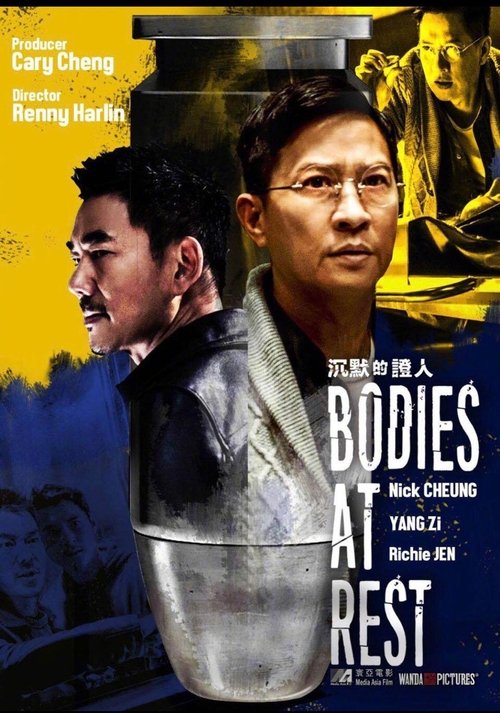
Bodies at Rest
Working in the morgue, a hardworking forensics expert and his assistant are suddenly accosted by masked intruders who demand access to a body involved in a recent crime.
The film earned $25.3M at the global box office.
1 nomination
Plot Structure
Story beats plotted across runtime


Narrative Arc
Emotional journey through the story's key moments
Story Circle
Blueprint 15-beat structure
Arcplot Score Breakdown
Weighted: Precision (70%) + Arc (15%) + Theme (15%)
Bodies at Rest (2019) showcases meticulously timed story structure, characteristic of Renny Harlin's storytelling approach. This structural analysis examines how the film's 15-point plot structure maps to proven narrative frameworks across 1 hour and 33 minutes. With an Arcplot score of 7.7, the film showcases strong structural fundamentals.
Characters
Cast & narrative archetypes

Chen Jia Hao
Lynn Qiao Yan
Santa
Wei
Main Cast & Characters
Chen Jia Hao
Played by Nick Cheung
A forensic scientist working the night shift at a morgue who must protect evidence during a violent siege.
Lynn Qiao Yan
Played by Yang Zi
A young intern forensic scientist who becomes trapped in the morgue during the attack.
Santa
Played by Richie Jen
The ruthless leader of armed criminals who siege the morgue to destroy evidence.
Wei
Played by Carlos Chan
One of Santa's crew members involved in the morgue attack.
Structural Analysis
The Status Quo at 1 minutes (1% through the runtime) establishes Forensic scientist Chen Jia-hao works the night shift at a remote hilltop morgue in Hong Kong during Christmas Eve. He's dedicated, methodical, and isolated in his sterile world of the dead.. Significantly, this early placement immediately immerses viewers in the story world.
The inciting incident occurs at 11 minutes when Armed criminals led by Santa (posing as a patient) violently take over the morgue, killing guards and revealing they're searching for evidence hidden in one of the corpses. The safe haven becomes a death trap.. At 12% through the film, this Disruption aligns precisely with traditional story structure. This beat shifts the emotional landscape, launching the protagonist into the central conflict.
The First Threshold at 23 minutes marks the transition into Act II, occurring at 25% of the runtime. This reveals the protagonist's commitment to Chen makes the active choice to resist and protect the innocent people in the morgue rather than simply comply with the criminals' demands. He begins using his knowledge of the facility to fight back., moving from reaction to action.
At 46 minutes, the Midpoint arrives at 49% of the runtime—precisely centered, creating perfect narrative symmetry. The analysis reveals that this crucial beat The criminals discover which body contains the evidence and capture one of the hostages. Chen realizes the leader has a personal connection to one of the corpses, raising the stakes and revealing deeper layers to the invasion., fundamentally raising what's at risk. The emotional intensity shifts, dividing the narrative into clear before-and-after phases.
The Collapse moment at 69 minutes (74% through) represents the emotional nadir. Here, A major character dies protecting others, and Chen is captured and beaten. The criminals obtain the evidence they came for. All seems lost as the facility floods from the storm and escape routes are cut off., shows the protagonist at their lowest point. This beat's placement in the final quarter sets up the climactic reversal.
The Second Threshold at 74 minutes initiates the final act resolution at 80% of the runtime. Chen discovers the true nature of the evidence and the criminals' real motivation. This knowledge, combined with his forensic expertise and intimate knowledge of the morgue, gives him a new plan for final confrontation., demonstrating the transformation achieved throughout the journey.
Emotional Journey
Bodies at Rest's emotional architecture traces a deliberate progression across 15 carefully calibrated beats.
Narrative Framework
This structural analysis employs proven narrative structure principles that track dramatic progression. By mapping Bodies at Rest against these established plot points, we can identify how Renny Harlin utilizes or subverts traditional narrative conventions. The plot point approach reveals not only adherence to structural principles but also creative choices that distinguish Bodies at Rest within the action genre.
Renny Harlin's Structural Approach
Among the 16 Renny Harlin films analyzed on Arcplot, the average structural score is 7.3, reflecting strong command of classical structure. Bodies at Rest represents one of the director's most structurally precise works. For comparative analysis, explore the complete Renny Harlin filmography.
Comparative Analysis
Additional action films include The Bad Guys, Puss in Boots and Venom: The Last Dance. For more Renny Harlin analyses, see Cutthroat Island, Mindhunters and The Legend of Hercules.
Plot Points by Act
Act I
SetupStatus Quo
Forensic scientist Chen Jia-hao works the night shift at a remote hilltop morgue in Hong Kong during Christmas Eve. He's dedicated, methodical, and isolated in his sterile world of the dead.
Theme
Intern Qiao-lin mentions that "the dead can't hurt you, only the living can" - establishing the theme of truth, trust, and the danger that comes from those still breathing.
Worldbuilding
Introduction to the morgue setting, Chen's professional routine, his strained relationship with his daughter, and the arrival of intern Qiao-lin and security guard Uncle Kwan. A typhoon warning is issued, isolating the facility.
Disruption
Armed criminals led by Santa (posing as a patient) violently take over the morgue, killing guards and revealing they're searching for evidence hidden in one of the corpses. The safe haven becomes a death trap.
Resistance
Chen and the survivors realize the extent of the threat as the criminals reveal their plan. Chen must decide whether to cooperate or resist. The typhoon intensifies, cutting off all outside communication and help.
Act II
ConfrontationFirst Threshold
Chen makes the active choice to resist and protect the innocent people in the morgue rather than simply comply with the criminals' demands. He begins using his knowledge of the facility to fight back.
Mirror World
Chen's relationship with intern Qiao-lin deepens as they work together. She represents innocence and trust, mirroring the thematic question of who can be trusted when death surrounds them.
Premise
Cat-and-mouse games throughout the morgue facility. Chen uses his forensic knowledge and understanding of the building to set traps, hide survivors, and investigate which corpse contains the evidence while evading the armed criminals.
Midpoint
The criminals discover which body contains the evidence and capture one of the hostages. Chen realizes the leader has a personal connection to one of the corpses, raising the stakes and revealing deeper layers to the invasion.
Opposition
The criminals tighten their grip, systematically hunting down survivors. Chen's plans begin to fail as the criminals adapt. Trust between hostages fractures as paranoia sets in. The body count rises.
Collapse
A major character dies protecting others, and Chen is captured and beaten. The criminals obtain the evidence they came for. All seems lost as the facility floods from the storm and escape routes are cut off.
Crisis
Chen, wounded and defeated, must find the will to continue. He processes the loss and considers giving up, but thoughts of his daughter and the innocent lives at stake push him toward one final stand.
Act III
ResolutionSecond Threshold
Chen discovers the true nature of the evidence and the criminals' real motivation. This knowledge, combined with his forensic expertise and intimate knowledge of the morgue, gives him a new plan for final confrontation.
Synthesis
Final confrontation between Chen and the criminal leader. Chen uses every resource in the morgue - chemicals, equipment, the storm itself - to turn the tables. Truth is revealed, justice is served, and survivors fight for their lives.
Transformation
Chen, battered but alive, reconnects with his daughter via phone as dawn breaks and rescue arrives. The sterile morgue that was his isolated prison is now a place he survived through human connection and courage. He is no longer alone.