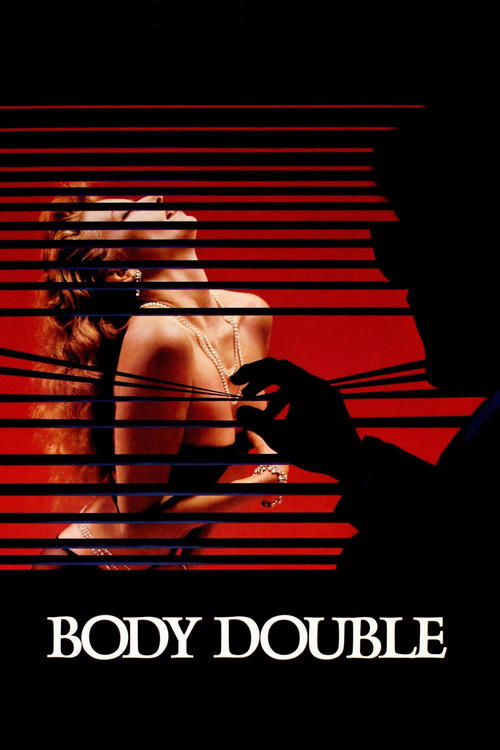
Body Double
After losing an acting role and his girlfriend, Jake Scully finally catches a break: he gets offered a gig house-sitting in the Hollywood Hills. While peering through the beautiful home's telescope one night, he spies a gorgeous woman dancing in her window. But when he witnesses the girl's murder, it leads Scully through the netherworld of the adult entertainment industry on a search for answers—with porn actress Holly Body as his guide.
The film struggled financially against its small-scale budget of $10.0M, earning $8.8M globally (-12% loss).
1 win & 4 nominations


Plot Structure
Story beats plotted across runtime


Narrative Arc
Emotional journey through the story's key moments
Story Circle
Blueprint 15-beat structure
Arcplot Score Breakdown
Weighted: Precision (70%) + Arc (15%) + Theme (15%)
Body Double (1984) demonstrates meticulously timed story structure, characteristic of Brian De Palma's storytelling approach. This structural analysis examines how the film's 10-point plot structure maps to proven narrative frameworks across 1 hour and 54 minutes. With an Arcplot score of 6.4, the film takes an unconventional approach to traditional narrative frameworks.
Characters
Cast & narrative archetypes

Jake Scully

Gloria Revelle

Holly Body

Sam Bouchard
Main Cast & Characters
Jake Scully
Played by Craig Wasson
Struggling actor with claustrophobia who becomes entangled in voyeurism and murder after house-sitting for a stranger
Gloria Revelle
Played by Deborah Shelton
Mysterious and seductive woman who becomes the object of Jake's obsession and the key to unraveling the murder mystery
Holly Body
Played by Melanie Griffith
Adult film actress who bears a striking resemblance to Gloria and helps Jake discover the truth behind the conspiracy
Sam Bouchard
Played by Gregg Henry
Seemingly friendly actor who offers Jake the house-sitting opportunity, but harbors dark secrets and manipulative intentions
Structural Analysis
The Status Quo at 1 minutes (1% through the runtime) establishes Jake Scully suffers a claustrophobic panic attack on the set of a low-budget vampire film, frozen in a coffin unable to perform. His professional inadequacy and psychological fragility are immediately established.. The analysis reveals that this early placement immediately immerses viewers in the story world.
At 57 minutes, the Midpoint arrives at 50% of the runtime—precisely centered, creating perfect narrative symmetry. Notably, this crucial beat Jake witnesses Gloria's brutal murder through the telescope, watching helplessly as the Indian drills through her with a power drill. His claustrophobia traps him in a tunnel as he tries to save her - his voyeurism has made him complicit in her death., fundamentally raising what's at risk. The emotional intensity shifts, dividing the narrative into clear before-and-after phases.
The Collapse moment at 86 minutes (75% through) represents the emotional nadir. Here, Jake discovers the full scope of the conspiracy: Sam is actually Alexander Revelle, Gloria's husband who orchestrated everything to murder his wife and inherit her fortune. Jake realizes he was used as a patsy, set up to be the perfect witness., demonstrates the protagonist at their lowest point. This beat's placement in the final quarter sets up the climactic reversal.
The Synthesis at 91 minutes initiates the final act resolution at 80% of the runtime. Jake and Holly execute their plan. In a confrontation at a reservoir, Jake faces Alexander and must overcome his claustrophobia when trapped underground. He defeats Alexander, conquering both the villain and his own psychological demons., demonstrating the transformation achieved throughout the journey.
Emotional Journey
Body Double's emotional architecture traces a deliberate progression across 10 carefully calibrated beats.
Narrative Framework
This structural analysis employs systematic plot point analysis that identifies crucial turning points. By mapping Body Double against these established plot points, we can identify how Brian De Palma utilizes or subverts traditional narrative conventions. The plot point approach reveals not only adherence to structural principles but also creative choices that distinguish Body Double within the crime genre.
Brian De Palma's Structural Approach
Among the 18 Brian De Palma films analyzed on Arcplot, the average structural score is 6.7, demonstrating varied approaches to story architecture. Body Double takes a more unconventional approach compared to the director's typical style. For comparative analysis, explore the complete Brian De Palma filmography.
Comparative Analysis
Additional crime films include The Bad Guys, Rustom and The Whole Ten Yards. For more Brian De Palma analyses, see Obsession, Carrie and The Black Dahlia.
Plot Points by Act
Act I
SetupStatus Quo
Jake Scully suffers a claustrophobic panic attack on the set of a low-budget vampire film, frozen in a coffin unable to perform. His professional inadequacy and psychological fragility are immediately established.
Theme
Sam tells Jake about the benefits of watching the beautiful neighbor: "You can see everything from up here." The theme of voyeurism as seduction and danger is planted - looking will lead Jake into a web of deception.
Worldbuilding
Jake's world collapses: he loses his job due to his claustrophobia, comes home to find his girlfriend Carol in bed with another man, and becomes homeless. The seedy underbelly of Hollywood is established as a world of broken dreams and exploitation.
Resistance
Sam serves as a false guide, showing Jake the telescope and the nightly ritual of the beautiful neighbor Gloria who performs an erotic dance each night. Jake becomes obsessed with watching her, debating whether to approach or remain a voyeur.
Act II
ConfrontationPremise
Jake plays amateur detective, following Gloria, watching her nightly dance, and becoming increasingly obsessed. He enjoys the voyeuristic fantasy - watching her through the telescope, following her movements, living vicariously through observation.
Midpoint
Jake witnesses Gloria's brutal murder through the telescope, watching helplessly as the Indian drills through her with a power drill. His claustrophobia traps him in a tunnel as he tries to save her - his voyeurism has made him complicit in her death.
Opposition
Jake is a suspect in Gloria's murder. Watching adult films, he recognizes that Holly Body was the woman performing Gloria's nightly dance - it was all staged. He spirals into the porn industry underworld to find answers and confront his own complicity.
Collapse
Jake discovers the full scope of the conspiracy: Sam is actually Alexander Revelle, Gloria's husband who orchestrated everything to murder his wife and inherit her fortune. Jake realizes he was used as a patsy, set up to be the perfect witness.
Crisis
Jake processes his violation - he was manipulated from the beginning, his voyeuristic desires weaponized against him. Holly is also in danger from Sam/Alexander. Jake must overcome his passivity and claustrophobia to act.
Act III
ResolutionSynthesis
Jake and Holly execute their plan. In a confrontation at a reservoir, Jake faces Alexander and must overcome his claustrophobia when trapped underground. He defeats Alexander, conquering both the villain and his own psychological demons.