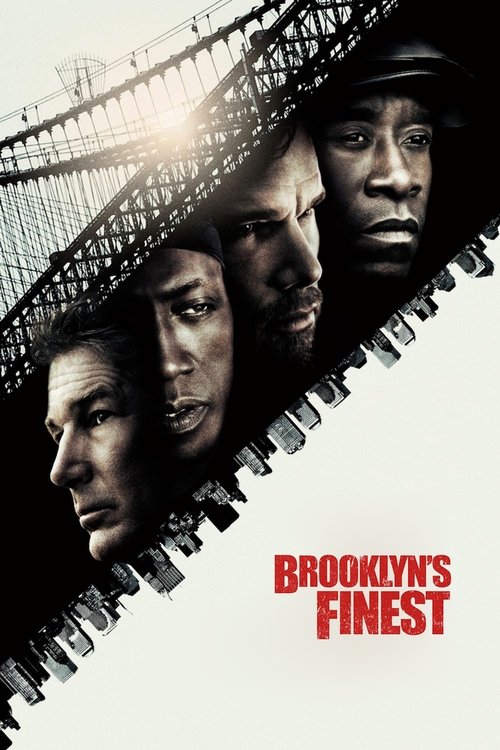
Brooklyn's Finest
Enforcing the law within the notoriously rough Brownsville section of the city and especially within the Van Dyke housing projects is the NYPD's sixty-fifth precinct. Three police officers struggle with the sometimes fine line between right and wrong.
Despite a moderate budget of $17.0M, Brooklyn's Finest became a box office success, earning $45.7M worldwide—a 169% return.
1 win & 10 nominations


Plot Structure
Story beats plotted across runtime


Narrative Arc
Emotional journey through the story's key moments
Story Circle
Blueprint 15-beat structure
Arcplot Score Breakdown
Weighted: Precision (70%) + Arc (15%) + Theme (15%)
Brooklyn's Finest (2010) reveals carefully calibrated dramatic framework, characteristic of Antoine Fuqua's storytelling approach. This structural analysis examines how the film's 15-point plot structure maps to proven narrative frameworks across 2 hours and 12 minutes. With an Arcplot score of 6.9, the film balances conventional beats with creative variation.
Structural Analysis
The Status Quo at 1 minutes (1% through the runtime) establishes Eddie Dugan sits alone in his apartment, gun in mouth, contemplating suicide. Establishes the spiritual death and moral exhaustion of a 22-year veteran cop seven days from retirement.. Of particular interest, this early placement immediately immerses viewers in the story world.
The inciting incident occurs at 15 minutes when Eddie is assigned to training duty with rookie officers in the most dangerous projects. His plan to coast seven days to retirement is disrupted - he must return to active patrol in Brooklyn's most violent neighborhoods.. At 12% through the film, this Disruption aligns precisely with traditional story structure. This beat shifts the emotional landscape, launching the protagonist into the central conflict.
The First Threshold at 33 minutes marks the transition into Act II, occurring at 25% of the runtime. This shows the protagonist's commitment to Eddie makes active choice to engage again when he meets Chantel, a prostitute who reawakens his humanity. Tango commits to helping FBI take down Caz. Sal decides to steal from a drug house. All three cross into moral compromise., moving from reaction to action.
At 66 minutes, the Midpoint arrives at 50% of the runtime—precisely centered, creating perfect narrative symmetry. Structural examination shows that this crucial beat False defeat: Tango's cover is nearly blown during a violent encounter. Eddie's attempt to help Chantel is rejected. Sal's first major theft succeeds but the money isn't enough. Stakes raise - the compromises aren't working and danger intensifies., fundamentally raising what's at risk. The emotional intensity shifts, dividing the narrative into clear before-and-after phases.
The Collapse moment at 99 minutes (75% through) represents the emotional nadir. Here, All is lost: Tango is ordered to set up Caz for execution despite their brotherhood. Eddie's partner is killed in front of him, destroying his last hope of redemption. Sal realizes he must commit murder to get the money he needs. Whiff of death: innocence dies for all three., indicates the protagonist at their lowest point. This beat's placement in the final quarter sets up the climactic reversal.
The Second Threshold at 106 minutes initiates the final act resolution at 80% of the runtime. Break into three: Each commits to their final act. Eddie decides to go out fighting rather than fade away. Tango chooses loyalty over duty, refusing to betray Caz. Sal commits fully to the home invasion. Final choices made - synthesis of who they've become., demonstrating the transformation achieved throughout the journey.
Emotional Journey
Brooklyn's Finest's emotional architecture traces a deliberate progression across 15 carefully calibrated beats.
Narrative Framework
This structural analysis employs systematic plot point analysis that identifies crucial turning points. By mapping Brooklyn's Finest against these established plot points, we can identify how Antoine Fuqua utilizes or subverts traditional narrative conventions. The plot point approach reveals not only adherence to structural principles but also creative choices that distinguish Brooklyn's Finest within the crime genre.
Antoine Fuqua's Structural Approach
Among the 11 Antoine Fuqua films analyzed on Arcplot, the average structural score is 7.1, reflecting strong command of classical structure. Brooklyn's Finest takes a more unconventional approach compared to the director's typical style. For comparative analysis, explore the complete Antoine Fuqua filmography.
Comparative Analysis
Additional crime films include The Bad Guys, Rustom and The Whole Ten Yards. For more Antoine Fuqua analyses, see The Equalizer 2, King Arthur and The Equalizer 3.
Plot Points by Act
Act I
SetupStatus Quo
Eddie Dugan sits alone in his apartment, gun in mouth, contemplating suicide. Establishes the spiritual death and moral exhaustion of a 22-year veteran cop seven days from retirement.
Theme
A superior officer tells Eddie: "You're a good cop, Eddie. You just forgot it." Theme stated: the system corrupts even good people who lose sight of their values.
Worldbuilding
Introduces all three protagonists and their desperate situations: Eddie's suicidal depression and babysitting duty, Tango's dangerous undercover work with Caz, and Sal's financial desperation with pregnant wife needing a bigger house. Establishes the moral compromises each makes daily.
Disruption
Eddie is assigned to training duty with rookie officers in the most dangerous projects. His plan to coast seven days to retirement is disrupted - he must return to active patrol in Brooklyn's most violent neighborhoods.
Resistance
Eddie resists engaging, trying to teach rookies to avoid danger. Tango debates whether to help the FBI betray Caz. Sal considers stealing drug money to afford his family's house. Each character wrestles with crossing their moral lines.
Act II
ConfrontationFirst Threshold
Eddie makes active choice to engage again when he meets Chantel, a prostitute who reawakens his humanity. Tango commits to helping FBI take down Caz. Sal decides to steal from a drug house. All three cross into moral compromise.
Mirror World
Eddie's relationship with Chantel deepens - she represents possibility of redemption and human connection. She shows him what he's lost: the ability to care, to feel, to see people as worth saving.
Premise
The promise of the premise: three cops descending into corruption. Eddie tries to save Chantel. Tango gets deeper with Caz while betraying him. Sal steals from crime scenes. Each explores their compromised new world while rationalizing their choices.
Midpoint
False defeat: Tango's cover is nearly blown during a violent encounter. Eddie's attempt to help Chantel is rejected. Sal's first major theft succeeds but the money isn't enough. Stakes raise - the compromises aren't working and danger intensifies.
Opposition
Pressure mounts on all three. Eddie's rookie partner challenges his cynicism. Tango's FBI handlers push harder while his loyalty to Caz deepens. Sal's desperation grows as his wife's pregnancy complications demand more money. The walls close in.
Collapse
All is lost: Tango is ordered to set up Caz for execution despite their brotherhood. Eddie's partner is killed in front of him, destroying his last hope of redemption. Sal realizes he must commit murder to get the money he needs. Whiff of death: innocence dies for all three.
Crisis
Dark night: Eddie processes his partner's death and his own complicity in creating cynical cops. Tango agonizes over betraying Caz. Sal plans a home invasion murder of drug dealers. Each faces the moral abyss they've reached.
Act III
ResolutionSecond Threshold
Break into three: Each commits to their final act. Eddie decides to go out fighting rather than fade away. Tango chooses loyalty over duty, refusing to betray Caz. Sal commits fully to the home invasion. Final choices made - synthesis of who they've become.
Synthesis
Finale: Eddie confronts criminals in a shootout. Tango tries to save Caz but is forced to shoot him by circumstance. Sal's home invasion goes catastrophically wrong - he murders dealers but is killed by a survivor. All three storylines reach violent, tragic conclusions.
Transformation
Final image mirrors opening: Eddie sits bloodied after the shootout, having survived but hollow. Sal is dead, his family left with nothing. Tango walks away from Caz's body, broken. Transformation complete: the system destroyed them all. Brooklyn remains the same.