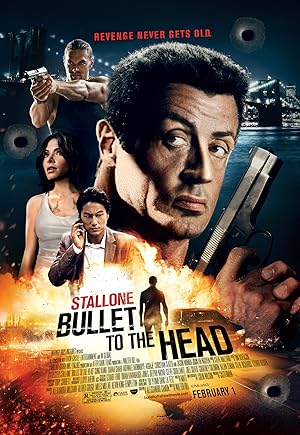
Bullet to the Head
In New Orleans, hit men James Bonomo, a.k.a. Jimmy Bobo, and Louis Blanchard execute dirty cop Hank Greely in a hotel room. But they are betrayed and Louis is stabbed in a bar by a mercenary named Keegan while waiting for the payment of the contract. Meanwhile, Washington D.C. police detective Taylor Kwon comes to New Orleans to investigate the murder of Greely, who had stolen evidence from the New Orleans Police Department. Soon he is shot by two dirty detectives but Jimmy saves his life. Jimmy brings Taylor to the shop of his daughter Lisa and she removes the bullet from his shoulder and nurses him. Taylor and Jimmy form the most unlikely partnership to investigate the crimes and after contacting the intermediate Ronnie Earl that had hired Jimmy and Louis, they discover a network of corruption formed by the lawyer Marcus Baptiste and the entrepreneur Robert Nkomo Morel.
The film financial setback against its moderate budget of $55.0M, earning $9.5M globally (-83% loss). While initial box office returns were modest, the film has gained appreciation for its distinctive approach within the action genre.


Plot Structure
Story beats plotted across runtime


Narrative Arc
Emotional journey through the story's key moments
Story Circle
Blueprint 15-beat structure
Arcplot Score Breakdown
Weighted: Precision (70%) + Arc (15%) + Theme (15%)
Bullet to the Head (2012) exemplifies meticulously timed narrative architecture, characteristic of Walter Hill's storytelling approach. This structural analysis examines how the film's 15-point plot structure maps to proven narrative frameworks across 1 hour and 32 minutes. With an Arcplot score of 7.4, the film balances conventional beats with creative variation.
Characters
Cast & narrative archetypes

Jimmy Bobo
Taylor Kwon
Keegan
Lisa Bobo
Robert Morel
Marcus Baptiste
Main Cast & Characters
Jimmy Bobo
Played by Sylvester Stallone
A hardened New Orleans hitman seeking revenge for his partner's murder while reluctantly teaming with a detective.
Taylor Kwon
Played by Sung Kang
A by-the-book Washington D.C. detective investigating his partner's murder who forms an uneasy alliance with a hitman.
Keegan
Played by Jason Momoa
A ruthless mercenary and killer hired to eliminate loose ends in a corruption scheme.
Lisa Bobo
Played by Sarah Shahi
Jimmy's tattoo artist daughter who gets drawn into danger due to her father's vendetta.
Robert Morel
Played by Adewale Akinnuoye-Agbaje
A corrupt lawyer and power broker orchestrating criminal enterprises in New Orleans.
Marcus Baptiste
Played by Christian Slater
A corrupt former police officer turned criminal fixer working for Morel.
Structural Analysis
The Status Quo at 1 minutes (1% through the runtime) establishes Hitman Jimmy Bobo and partner Louis execute a contract killing in New Orleans. Jimmy operates by a strict code: he's a professional killer who works with loyalty and precision in the criminal underworld.. Significantly, this early placement immediately immerses viewers in the story world.
The inciting incident occurs at 11 minutes when Keegan, a mercenary hired by corrupt businessman Baptiste, murders Louis in a hotel room. Jimmy survives the ambush. His partner is dead, and Jimmy realizes they've been set up—the hit was a trap.. At 11% through the film, this Disruption aligns precisely with traditional story structure. This beat shifts the emotional landscape, launching the protagonist into the central conflict.
The First Threshold at 22 minutes marks the transition into Act II, occurring at 24% of the runtime. This indicates the protagonist's commitment to After a brutal confrontation, Jimmy and Kwon reluctantly agree to work together. Jimmy chooses to partner with a cop—violating his criminal code—because they share a common enemy. They enter the investigation as unlikely allies., moving from reaction to action.
At 47 minutes, the Midpoint arrives at 51% of the runtime—precisely centered, creating perfect narrative symmetry. The analysis reveals that this crucial beat Jimmy and Kwon discover Baptiste's plan: he's eliminating everyone connected to illegal land deals. The stakes raise when Baptiste's men target Jimmy's daughter Lisa. What was professional becomes personal. False defeat: they're outgunned and the enemy knows their moves., fundamentally raising what's at risk. The emotional intensity shifts, dividing the narrative into clear before-and-after phases.
The Collapse moment at 67 minutes (72% through) represents the emotional nadir. Here, Lisa is taken hostage by Baptiste. Jimmy's worst fear realized—his daughter endangered because of his life choices. Kwon is wounded and suspended. Their investigation appears finished, and Jimmy faces losing the only family he has left. Whiff of death: both men could lose everything., shows the protagonist at their lowest point. This beat's placement in the final quarter sets up the climactic reversal.
The Second Threshold at 72 minutes initiates the final act resolution at 78% of the runtime. Jimmy and Kwon synthesize their approaches: Jimmy's street skills and willingness to break rules combined with Kwon's strategic thinking and moral compass. They forge a true partnership, trusting each other completely. They infiltrate Baptiste's compound., demonstrating the transformation achieved throughout the journey.
Emotional Journey
Bullet to the Head's emotional architecture traces a deliberate progression across 15 carefully calibrated beats.
Narrative Framework
This structural analysis employs systematic plot point analysis that identifies crucial turning points. By mapping Bullet to the Head against these established plot points, we can identify how Walter Hill utilizes or subverts traditional narrative conventions. The plot point approach reveals not only adherence to structural principles but also creative choices that distinguish Bullet to the Head within the action genre.
Walter Hill's Structural Approach
Among the 14 Walter Hill films analyzed on Arcplot, the average structural score is 7.1, reflecting strong command of classical structure. Bullet to the Head represents one of the director's most structurally precise works. For comparative analysis, explore the complete Walter Hill filmography.
Comparative Analysis
Additional action films include The Bad Guys, Puss in Boots and Venom: The Last Dance. For more Walter Hill analyses, see The Warriors, Johnny Handsome and The Driver.
Plot Points by Act
Act I
SetupStatus Quo
Hitman Jimmy Bobo and partner Louis execute a contract killing in New Orleans. Jimmy operates by a strict code: he's a professional killer who works with loyalty and precision in the criminal underworld.
Theme
Louis tells Jimmy, "Everyone's got a partner. You can't do this alone." The theme of trust, partnership, and choosing your allies wisely is established—foreshadowing the unlikely partnership to come.
Worldbuilding
Establishing the criminal ecosystem of New Orleans. Jimmy and Louis complete their hit, collect payment, and prepare for their next job. We see Jimmy's estranged relationship with his daughter Lisa and his adherence to old-school criminal ethics.
Disruption
Keegan, a mercenary hired by corrupt businessman Baptiste, murders Louis in a hotel room. Jimmy survives the ambush. His partner is dead, and Jimmy realizes they've been set up—the hit was a trap.
Resistance
Jimmy investigates who betrayed them while Detective Taylor Kwon arrives from Washington D.C. to investigate the same case. Jimmy debates whether to trust anyone or work alone. The two men clash—cop versus criminal—but both seek the truth.
Act II
ConfrontationFirst Threshold
After a brutal confrontation, Jimmy and Kwon reluctantly agree to work together. Jimmy chooses to partner with a cop—violating his criminal code—because they share a common enemy. They enter the investigation as unlikely allies.
Mirror World
Kwon represents everything opposite to Jimmy: law-abiding, by-the-book, idealistic. Their partnership becomes the B-story that explores the theme—can two men from different worlds trust each other when the system is corrupt?
Premise
The "odd couple" premise plays out: Jimmy and Kwon track leads through New Orleans' criminal underworld. Shootouts, interrogations, and conflicts reveal the conspiracy involves corrupt cops, lawyers, and developers. Their contrasting methods create tension and dark humor.
Midpoint
Jimmy and Kwon discover Baptiste's plan: he's eliminating everyone connected to illegal land deals. The stakes raise when Baptiste's men target Jimmy's daughter Lisa. What was professional becomes personal. False defeat: they're outgunned and the enemy knows their moves.
Opposition
Baptiste and Keegan close in. Attempts to gather evidence fail. Corrupt officials block Kwon at every turn. Jimmy's criminal contacts are murdered. Lisa is kidnapped. The bad guys tighten the noose, exploiting both men's weaknesses.
Collapse
Lisa is taken hostage by Baptiste. Jimmy's worst fear realized—his daughter endangered because of his life choices. Kwon is wounded and suspended. Their investigation appears finished, and Jimmy faces losing the only family he has left. Whiff of death: both men could lose everything.
Crisis
Jimmy and Kwon regroup in the darkness. Jimmy questions whether his violent life has poisoned everything he touches. Kwon doubts whether justice can exist in a corrupt system. They must decide: give up or commit fully to stopping Baptiste.
Act III
ResolutionSecond Threshold
Jimmy and Kwon synthesize their approaches: Jimmy's street skills and willingness to break rules combined with Kwon's strategic thinking and moral compass. They forge a true partnership, trusting each other completely. They infiltrate Baptiste's compound.
Synthesis
The finale assault on Baptiste's stronghold. Jimmy and Kwon fight through mercenaries, rescue Lisa, and confront their enemies. Jimmy faces Keegan in a brutal axe fight. Kwon confronts Baptiste. Justice is served through both legal and extralegal means.
Transformation
Jimmy reconciles with Lisa, showing vulnerability and humanity he buried under his killer persona. Kwon and Jimmy part as friends—the cop and the criminal who found mutual respect. Jimmy walks away transformed: still a killer, but no longer alone, having learned the value of true partnership.