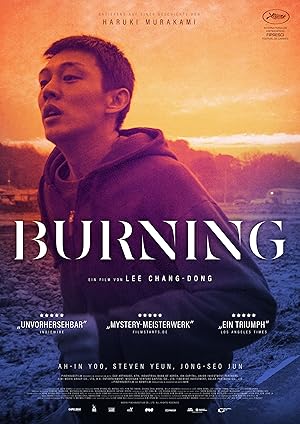
Burning
Deliveryman Jongsu is out on a job when he runs into Haemi, a girl who once lived in his neighbourhood. She asks if he'd mind looking after her cat while she's away on a trip to Africa. On her return, she introduces to Jongsu an enigmatic young man named Ben, who she met during her trip. One day Ben tells Jongsu about his most unusual hobby.
The film underperformed commercially against its modest budget of $7.3M, earning $6.6M globally (-9% loss).
54 wins & 144 nominations


Plot Structure
Story beats plotted across runtime


Narrative Arc
Emotional journey through the story's key moments
Story Circle
Blueprint 15-beat structure
Arcplot Score Breakdown
Weighted: Precision (70%) + Arc (15%) + Theme (15%)
Burning (2018) showcases deliberately positioned story structure, characteristic of Lee Chang-dong's storytelling approach. This structural analysis examines how the film's 15-point plot structure maps to proven narrative frameworks across 2 hours and 28 minutes. With an Arcplot score of 7.1, the film balances conventional beats with creative variation.
Characters
Cast & narrative archetypes

Lee Jong-su
Ben
Shin Haemi
Main Cast & Characters
Lee Jong-su
Played by Yoo Ah-in
An aspiring writer and part-time delivery worker who becomes obsessed with unraveling the mystery of Haemi's disappearance and Ben's true nature.
Ben
Played by Steven Yeun
A wealthy, enigmatic young man with mysterious habits who becomes romantically involved with Haemi and befriends Jong-su.
Shin Haemi
Played by Jun Jong-seo
A free-spirited young woman who reconnects with Jong-su, travels to Africa, and mysteriously vanishes after introducing him to Ben.
Structural Analysis
The Status Quo at 2 minutes (1% through the runtime) establishes Jong-su works a menial delivery job in Seoul, isolated and disconnected, living a monotonous existence as he struggles to write. His alienation and class position are established through his mundane work routine.. Structural examination shows that this early placement immediately immerses viewers in the story world.
The inciting incident occurs at 18 minutes when Hae-mi asks Jong-su to feed her cat while she travels to Africa. He agrees, but discovers her tiny apartment is empty and claustrophobic - and he never sees the cat. Seeds of doubt and mystery are planted.. At 12% through the film, this Disruption aligns precisely with traditional story structure. This beat shifts the emotional landscape, launching the protagonist into the central conflict.
The First Threshold at 38 minutes marks the transition into Act II, occurring at 26% of the runtime. This reveals the protagonist's commitment to Hae-mi returns from Africa with Ben, a wealthy and enigmatic young man who represents everything Jong-su is not. Jong-su reluctantly enters into this triangular relationship, unable to pull away despite his discomfort and jealousy., moving from reaction to action.
At 75 minutes, the Midpoint arrives at 50% of the runtime—precisely centered, creating perfect narrative symmetry. Structural examination shows that this crucial beat Hae-mi disappears without a trace. Jong-su cannot reach her; her phone is disconnected, her apartment is empty. What seemed like a strange romance becomes a mystery - possibly a crime. The tone shifts from contemplative to investigative., fundamentally raising what's at risk. The emotional intensity shifts, dividing the narrative into clear before-and-after phases.
The Collapse moment at 111 minutes (75% through) represents the emotional nadir. Here, Jong-su discovers Hae-mi's belongings - including her watch and makeup - in Ben's bathroom among items from other women. The whiff of death: Hae-mi is almost certainly dead, erased like a burned greenhouse. Jong-su's worst suspicions are confirmed., reveals the protagonist at their lowest point. This beat's placement in the final quarter sets up the climactic reversal.
The Second Threshold at 118 minutes initiates the final act resolution at 80% of the runtime. Jong-su makes a cold, calculated decision to act. He obtains his father's knife and begins to stalk Ben with murderous intent. The passive observer becomes an active agent, crossing into violence to answer erasure with erasure., demonstrating the transformation achieved throughout the journey.
Emotional Journey
Burning's emotional architecture traces a deliberate progression across 15 carefully calibrated beats.
Narrative Framework
This structural analysis employs structural analysis methodology used to understand storytelling architecture. By mapping Burning against these established plot points, we can identify how Lee Chang-dong utilizes or subverts traditional narrative conventions. The plot point approach reveals not only adherence to structural principles but also creative choices that distinguish Burning within the drama genre.
Lee Chang-dong's Structural Approach
Among the 2 Lee Chang-dong films analyzed on Arcplot, the average structural score is 7.0, reflecting strong command of classical structure. Burning represents one of the director's most structurally precise works. For comparative analysis, explore the complete Lee Chang-dong filmography.
Comparative Analysis
Additional drama films include After Thomas, South Pacific and Dirty Dancing: Havana Nights. For more Lee Chang-dong analyses, see Secret Sunshine.
Plot Points by Act
Act I
SetupStatus Quo
Jong-su works a menial delivery job in Seoul, isolated and disconnected, living a monotonous existence as he struggles to write. His alienation and class position are established through his mundane work routine.
Theme
Hae-mi talks about the "little hunger" versus "the great hunger" - physical hunger versus existential emptiness. This encapsulates the film's exploration of class, desire, and the void that wealth cannot fill.
Worldbuilding
Jong-su reconnects with Hae-mi, who barely remembers him from childhood. They spend time together in Seoul; she reveals her life as a shopgirl with dreams of travel. Their tentative relationship develops, marked by class differences and unfulfilled longing.
Disruption
Hae-mi asks Jong-su to feed her cat while she travels to Africa. He agrees, but discovers her tiny apartment is empty and claustrophobic - and he never sees the cat. Seeds of doubt and mystery are planted.
Resistance
Jong-su visits Hae-mi's apartment daily, searching for the invisible cat. He contemplates the mystery while dealing with his troubled father's legal problems. Jong-su's isolation deepens as he waits for Hae-mi's return from Africa.
Act II
ConfrontationFirst Threshold
Hae-mi returns from Africa with Ben, a wealthy and enigmatic young man who represents everything Jong-su is not. Jong-su reluctantly enters into this triangular relationship, unable to pull away despite his discomfort and jealousy.
Mirror World
Ben reveals his hobby: he burns down abandoned greenhouses every two months because they are "useless" and no one cares. This disturbing confession introduces Ben as a figure of casual destruction, mirroring the film's themes of erasure and disposability.
Premise
Jong-su observes the strange relationship between Hae-mi and Ben. The three spend time together at Ben's luxurious home, where Jong-su's class resentment and obsession grow. Hae-mi performs a sunset dance that reveals her vulnerability and spiritual seeking.
Midpoint
Hae-mi disappears without a trace. Jong-su cannot reach her; her phone is disconnected, her apartment is empty. What seemed like a strange romance becomes a mystery - possibly a crime. The tone shifts from contemplative to investigative.
Opposition
Jong-su becomes consumed with finding Hae-mi and investigating Ben. He searches for clues, stalks Ben, and visits Hae-mi's family. Ben remains elusive and unbothered, cryptically suggesting Hae-mi was "useless" like the greenhouses. Jong-su's paranoia and rage intensify.
Collapse
Jong-su discovers Hae-mi's belongings - including her watch and makeup - in Ben's bathroom among items from other women. The whiff of death: Hae-mi is almost certainly dead, erased like a burned greenhouse. Jong-su's worst suspicions are confirmed.
Crisis
Jong-su withdraws into dark contemplation. He processes the horror of Hae-mi's likely murder and Ben's sociopathic nature. His impotent rage against class inequality, his father's violence, and his own invisibility reaches a breaking point.
Act III
ResolutionSecond Threshold
Jong-su makes a cold, calculated decision to act. He obtains his father's knife and begins to stalk Ben with murderous intent. The passive observer becomes an active agent, crossing into violence to answer erasure with erasure.
Synthesis
Jong-su tracks Ben to an isolated location at sunset. He confronts him, stabs him to death, and burns Ben's car with the body inside - using Ben's own method of destruction. Jong-su completes the act methodically, finally burning away his rage.
Transformation
Jong-su drives away in the dark, his face illuminated by the flames behind him. He has transformed from passive victim to murderer, but remains empty. The great hunger persists - violence has solved nothing, only perpetuated the cycle.