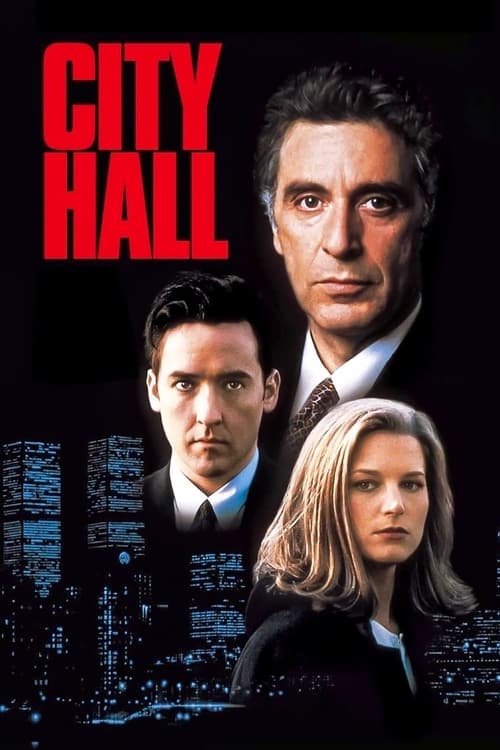
City Hall
The accidental shooting of a boy in New York City leads to an investigation by the Deputy Mayor, and unexpectedly far-reaching consequences.
The film underperformed commercially against its moderate budget of $40.0M, earning $33.4M globally (-16% loss).


Plot Structure
Story beats plotted across runtime


Narrative Arc
Emotional journey through the story's key moments
Story Circle
Blueprint 15-beat structure
Arcplot Score Breakdown
Weighted: Precision (70%) + Arc (15%) + Theme (15%)
City Hall (1996) reveals meticulously timed narrative design, characteristic of Harold Becker's storytelling approach. This structural analysis examines how the film's 15-point plot structure maps to proven narrative frameworks across 1 hour and 51 minutes. With an Arcplot score of 7.4, the film balances conventional beats with creative variation.
Characters
Cast & narrative archetypes

John Pappas
Kevin Calhoun
Marybeth Cogan
Frank Anselmo
Judge Walter Stern
Paul Zapatti
Main Cast & Characters
John Pappas
Played by Al Pacino
The charismatic Mayor of New York City who becomes embroiled in a corruption scandal. A political operator who genuinely believes in the power of government to help people.
Kevin Calhoun
Played by John Cusack
The Mayor's idealistic deputy mayor and protégé who must navigate loyalty and truth when corruption is revealed. Struggles between his political aspirations and his conscience.
Marybeth Cogan
Played by Bridget Fonda
A determined lawyer investigating the corruption case. She represents justice and becomes a key figure in uncovering the truth behind the scandal.
Frank Anselmo
Played by Danny Aiello
The Mayor's powerful and ruthless political fixer who operates in the shadows. He embodies the corrupt machinery of urban politics.
Judge Walter Stern
Played by Martin Landau
A principled and wise judge who serves as a moral compass in the corruption investigation. Represents institutional integrity.
Paul Zapatti
Played by Tony Franciosa
A political operative and friend to the Mayor who becomes entangled in the corruption scandal. His connections prove problematic.
Structural Analysis
The Status Quo at 1 minutes (1% through the runtime) establishes Mayor Pappas delivers an inspiring speech at a groundbreaking ceremony, showcasing his charisma and idealistic vision for New York. Deputy Mayor Kevin Calhoun watches admiringly, fully committed to the administration.. Of particular interest, this early placement immediately immerses viewers in the story world.
The inciting incident occurs at 12 minutes when A Brooklyn shootout leaves three people dead: a detective, a drug dealer, and six-year-old James Bone, an innocent child caught in the crossfire. The tragedy demands a response from City Hall.. At 11% through the film, this Disruption aligns precisely with traditional story structure. This beat shifts the emotional landscape, launching the protagonist into the central conflict.
The First Threshold at 28 minutes marks the transition into Act II, occurring at 25% of the runtime. This shows the protagonist's commitment to Kevin decides to dig deeper into the case despite warnings to let it go. He discovers that the probation of the drug dealer Tino Zapatti was suspicious and chooses to actively investigate the corruption trail, crossing the point of no return., moving from reaction to action.
At 56 minutes, the Midpoint arrives at 50% of the runtime—precisely centered, creating perfect narrative symmetry. Notably, this crucial beat Kevin confronts Frank Anselmo directly and realizes the corruption goes deeper than imagined. Anselmo hints that Mayor Pappas may be involved. The stakes escalate from a simple shooting to potential destruction of the administration Kevin believes in., fundamentally raising what's at risk. The emotional intensity shifts, dividing the narrative into clear before-and-after phases.
The Collapse moment at 83 minutes (75% through) represents the emotional nadir. Here, Kevin discovers irrefutable proof that Mayor Pappas knowingly accepted illegal campaign contributions from Anselmo, making him complicit in the corruption that led to the boy's death. His mentor and hero is corrupt. Kevin's idealism dies., indicates the protagonist at their lowest point. This beat's placement in the final quarter sets up the climactic reversal.
The Second Threshold at 89 minutes initiates the final act resolution at 80% of the runtime. Kevin realizes that true public service means choosing integrity over loyalty. He decides to testify truthfully, synthesizing his legal training with his newfound understanding that the system only works when individuals choose principle over pragmatism., demonstrating the transformation achieved throughout the journey.
Emotional Journey
City Hall's emotional architecture traces a deliberate progression across 15 carefully calibrated beats.
Narrative Framework
This structural analysis employs systematic plot point analysis that identifies crucial turning points. By mapping City Hall against these established plot points, we can identify how Harold Becker utilizes or subverts traditional narrative conventions. The plot point approach reveals not only adherence to structural principles but also creative choices that distinguish City Hall within the drama genre.
Harold Becker's Structural Approach
Among the 6 Harold Becker films analyzed on Arcplot, the average structural score is 7.0, demonstrating varied approaches to story architecture. City Hall represents one of the director's most structurally precise works. For comparative analysis, explore the complete Harold Becker filmography.
Comparative Analysis
Additional drama films include After Thomas, South Pacific and Dirty Dancing: Havana Nights. For more Harold Becker analyses, see Malice, Domestic Disturbance and Mercury Rising.
Plot Points by Act
Act I
SetupStatus Quo
Mayor Pappas delivers an inspiring speech at a groundbreaking ceremony, showcasing his charisma and idealistic vision for New York. Deputy Mayor Kevin Calhoun watches admiringly, fully committed to the administration.
Theme
A colleague tells Kevin, "This is how the game is played," hinting at the compromises required in politics. The theme of integrity versus political pragmatism is introduced.
Worldbuilding
Establishment of the political world of New York City Hall. Kevin is shown as an idealistic lawyer working closely with the charismatic Mayor Pappas. The daily operations, relationships with the press, community leaders, and the power dynamics are set up.
Disruption
A Brooklyn shootout leaves three people dead: a detective, a drug dealer, and six-year-old James Bone, an innocent child caught in the crossfire. The tragedy demands a response from City Hall.
Resistance
Kevin is tasked with investigating the incident and managing the political fallout. Mayor Pappas delivers a powerful eulogy at the boy's funeral. Kevin begins gathering information, meeting with various officials, and sensing something doesn't add up about the shooting.
Act II
ConfrontationFirst Threshold
Kevin decides to dig deeper into the case despite warnings to let it go. He discovers that the probation of the drug dealer Tino Zapatti was suspicious and chooses to actively investigate the corruption trail, crossing the point of no return.
Mirror World
Kevin's relationship with Marybeth Cogan, a probation officer, deepens. She represents moral clarity and honesty, serving as a thematic mirror to Kevin's journey toward choosing truth over political loyalty.
Premise
Kevin investigates the web of corruption connecting the probation department, Brooklyn political boss Frank Anselmo, and City Hall. He navigates the dangerous world of political favors, organized crime connections, and cover-ups while trying to maintain loyalty to the Mayor.
Midpoint
Kevin confronts Frank Anselmo directly and realizes the corruption goes deeper than imagined. Anselmo hints that Mayor Pappas may be involved. The stakes escalate from a simple shooting to potential destruction of the administration Kevin believes in.
Opposition
Pressure mounts on Kevin from all sides. Political operatives try to intimidate him. Anselmo is found dead in an apparent suicide. Kevin uncovers evidence linking campaign contributions to the corruption scheme. The Mayor becomes evasive and defensive.
Collapse
Kevin discovers irrefutable proof that Mayor Pappas knowingly accepted illegal campaign contributions from Anselmo, making him complicit in the corruption that led to the boy's death. His mentor and hero is corrupt. Kevin's idealism dies.
Crisis
Kevin struggles with the devastating truth. He must choose between protecting the Mayor he admires and serving justice for the dead child. He processes the loss of his idealistic worldview.
Act III
ResolutionSecond Threshold
Kevin realizes that true public service means choosing integrity over loyalty. He decides to testify truthfully, synthesizing his legal training with his newfound understanding that the system only works when individuals choose principle over pragmatism.
Synthesis
Kevin confronts Mayor Pappas with the evidence. The Mayor gives a final speech about the compromises of power before committing suicide. Kevin cooperates with investigators. The corruption is exposed, and the administration falls.
Transformation
Kevin walks away from City Hall, alone but with integrity intact. The closing image mirrors the opening but shows transformation: where he once looked at the Mayor with admiration, he now walks independently, disillusioned but honest, having chosen truth over political expedience.