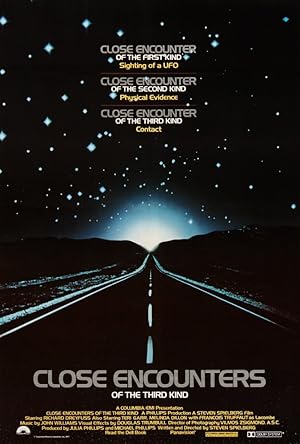
Close Encounters of the Third Kind
Two parallel stories are told. In the first, a group of research scientists from a variety of backgrounds are investigating the strange appearance of items in remote locations, primarily desert regions. In continuing their investigation, one of the lead scientists, a Frenchman named Claude Lacombe, incorporates the Kodály method of music education as a means of communication in their work. The response, in turn, at first baffles the researchers, until American cartographer David Laughlin deciphers the meaning of the response. In the second, electric company lineman and family man Roy Neary and single mother Jillian Guiler are among some individuals in Muncie, Indiana who experience some paranormal activity before some flashes of bright lights in the sky, which they believe to be a UFO. Roy becomes obsessed with what he saw, unlike some others, especially in some form of authority, who refuse to acknowledge their belief that it was a UFO in not wanting to appear crazy. That obsession both for Roy and Jillian is ratcheted up a notch when they begin to have a vision of a mound with vertical striations on its side as a key to what is going on. While the obsession negatively affects Roy's life as he knows it in its entirety, Jillian knows she has to find the answer as to its meaning, especially as it relates to her only child, three year old Barry Guiler, who may be more attuned to what is happening than the adult figures around him. These two stories have the potential to intersect if Roy and Jillian can discover where they've seen that mound before, and if they can overcome what they believe to be the lies perpetrated by those in authority in covering up what is going on.
Despite a mid-range budget of $20.0M, Close Encounters of the Third Kind became a massive hit, earning $306.9M worldwide—a remarkable 1434% return.
1 Oscar. 16 wins & 40 nominations


Plot Structure
Story beats plotted across runtime


Narrative Arc
Emotional journey through the story's key moments
Story Circle
Blueprint 15-beat structure
Arcplot Score Breakdown
Weighted: Precision (70%) + Arc (15%) + Theme (15%)
Close Encounters of the Third Kind (1977) showcases meticulously timed narrative architecture, characteristic of Steven Spielberg's storytelling approach. This structural analysis examines how the film's 15-point plot structure maps to proven narrative frameworks across 2 hours and 17 minutes. With an Arcplot score of 5.8, the film takes an unconventional approach to traditional narrative frameworks.
Characters
Cast & narrative archetypes

Roy Neary
Claude Lacombe
Jillian Guiler
David Laughlin
Ronnie Neary
Barry Guiler
Main Cast & Characters
Roy Neary
Played by Richard Dreyfuss
An electrical lineman who becomes obsessed with UFOs after a close encounter, abandoning his family to pursue the vision of Devils Tower.
Claude Lacombe
Played by François Truffaut
A French scientist leading the international investigation into UFO phenomena with patience, wisdom, and open-minded curiosity.
Jillian Guiler
Played by Melinda Dillon
A single mother whose young son is abducted by aliens, driving her desperate search and connection to the UFO phenomenon.
David Laughlin
Played by Bob Balaban
A cartographer and translator who serves as Lacombe's right-hand man and interpreter throughout the investigation.
Ronnie Neary
Played by Teri Garr
Roy's increasingly frustrated wife who cannot understand his obsession and ultimately leaves him with their children.
Barry Guiler
Played by Cary Guffey
Jillian's three-year-old son who is fascinated and unafraid of the aliens, ultimately abducted and later returned by them.
Structural Analysis
The Status Quo at 1 minutes (1% through the runtime) establishes Roy Neary is introduced as an ordinary Indiana electrical lineman living a mundane suburban life with his wife Ronnie and three children, responding to a routine power outage call.. Of particular interest, this early placement immediately immerses viewers in the story world.
The inciting incident occurs at 15 minutes when Roy has his first close encounter on a dark country road - his truck stalls and multiple UFOs fly directly overhead, bathing him in brilliant light and leaving him sunburned and transformed. He becomes obsessed with what he's witnessed.. At 11% through the film, this Disruption aligns precisely with traditional story structure. This beat shifts the emotional landscape, launching the protagonist into the central conflict.
The First Threshold at 32 minutes marks the transition into Act II, occurring at 23% of the runtime. This shows the protagonist's commitment to Roy's obsession destroys his family - Ronnie takes their children and leaves him after he brings dirt and debris into their living room to build his mountain. He actively chooses to pursue his vision over his marriage and normalcy., moving from reaction to action.
At 62 minutes, the Midpoint arrives at 45% of the runtime—arriving early, accelerating into Act IIb complications. Significantly, this crucial beat Roy and Jillian simultaneously recognize Devil's Tower on television - the mountain from their visions. They now know exactly where they must go, transforming their abstract compulsion into a concrete destination. The mystery has an answer., fundamentally raising what's at risk. The emotional intensity shifts, dividing the narrative into clear before-and-after phases.
The Collapse moment at 94 minutes (69% through) represents the emotional nadir. Here, Roy and Jillian are held in a military detention facility, separated from Devil's Tower and seemingly defeated. Roy appears to have sacrificed everything - family, job, sanity - for nothing. His quest seems to have ended in failure and humiliation., illustrates the protagonist at their lowest point. This beat's placement in the final quarter sets up the climactic reversal.
The Second Threshold at 100 minutes initiates the final act resolution at 73% of the runtime. Roy and Jillian escape the detention facility and climb Devil's Tower, choosing absolute commitment to their inexplicable calling. They reach the hidden landing site just as the aliens arrive, vindicating their faith., demonstrating the transformation achieved throughout the journey.
Emotional Journey
Close Encounters of the Third Kind's emotional architecture traces a deliberate progression across 15 carefully calibrated beats.
Narrative Framework
This structural analysis employs systematic plot point analysis that identifies crucial turning points. By mapping Close Encounters of the Third Kind against these established plot points, we can identify how Steven Spielberg utilizes or subverts traditional narrative conventions. The plot point approach reveals not only adherence to structural principles but also creative choices that distinguish Close Encounters of the Third Kind within the drama genre.
Steven Spielberg's Structural Approach
Among the 33 Steven Spielberg films analyzed on Arcplot, the average structural score is 5.8, showcasing experimental approaches to narrative form. Close Encounters of the Third Kind takes a more unconventional approach compared to the director's typical style. For comparative analysis, explore the complete Steven Spielberg filmography.
Comparative Analysis
Additional drama films include After Thomas, South Pacific and Dirty Dancing: Havana Nights. For more Steven Spielberg analyses, see The Adventures of Tintin, War Horse and Ready Player One.
Plot Points by Act
Act I
SetupStatus Quo
Roy Neary is introduced as an ordinary Indiana electrical lineman living a mundane suburban life with his wife Ronnie and three children, responding to a routine power outage call.
Theme
French scientist Claude Lacombe says "I don't believe in coincidences" when investigating the miraculous return of lost WWII planes in the Sonoran Desert, establishing the film's theme about responding to inexplicable phenomena with faith rather than dismissal.
Worldbuilding
Parallel introductions establish the global phenomenon: scientists discover missing WWII planes in Mexico, air traffic controllers encounter UFOs over Indianapolis, and we meet Roy's ordinary family life and Jillian Guiler with her young son Barry in rural Indiana.
Disruption
Roy has his first close encounter on a dark country road - his truck stalls and multiple UFOs fly directly overhead, bathing him in brilliant light and leaving him sunburned and transformed. He becomes obsessed with what he's witnessed.
Resistance
Roy attempts to convince his skeptical family of what he saw while experiencing bizarre compulsions to create a strange mountain shape. Simultaneously, Barry is taken by the UFOs despite Jillian's attempts to protect him. Roy debates whether to pursue his obsession or maintain his normal life.
Act II
ConfrontationFirst Threshold
Roy's obsession destroys his family - Ronnie takes their children and leaves him after he brings dirt and debris into their living room to build his mountain. He actively chooses to pursue his vision over his marriage and normalcy.
Mirror World
Roy encounters Jillian at a UFO meeting, discovering she shares his vision of the mountain shape and his compulsion. She becomes his thematic mirror - another person who chose faith in the inexplicable over conventional life.
Premise
Roy and Jillian work together to understand their shared vision, sculpting the mountain form obsessively. Meanwhile, Lacombe's team decodes the five-tone signal and discovers coordinates pointing to Devil's Tower, Wyoming. The government begins evacuating the area.
Midpoint
Roy and Jillian simultaneously recognize Devil's Tower on television - the mountain from their visions. They now know exactly where they must go, transforming their abstract compulsion into a concrete destination. The mystery has an answer.
Opposition
Roy and Jillian journey to Devil's Tower despite military roadblocks and a fake toxic gas contamination story designed to keep civilians away. They are captured, detained, and processed by authorities who try to convince them to abandon their quest.
Collapse
Roy and Jillian are held in a military detention facility, separated from Devil's Tower and seemingly defeated. Roy appears to have sacrificed everything - family, job, sanity - for nothing. His quest seems to have ended in failure and humiliation.
Crisis
In their darkest moment, Roy and Jillian face a choice: accept defeat and be sent home, or risk everything to escape and reach Devil's Tower. Roy processes what he's lost and what faith truly means.
Act III
ResolutionSecond Threshold
Roy and Jillian escape the detention facility and climb Devil's Tower, choosing absolute commitment to their inexplicable calling. They reach the hidden landing site just as the aliens arrive, vindicating their faith.
Synthesis
The massive mothership arrives at Devil's Tower. Communication through music occurs between humans and aliens. Abductees including Barry are returned. Lacombe recognizes Roy as one of the "invited" and allows him to join the chosen team boarding the ship.
Transformation
Roy, bathed in transcendent light, walks up the ramp into the alien mothership alongside the aliens - transformed from ordinary suburban electrician to cosmic voyager, completing his journey from mundane existence to ultimate transcendence.