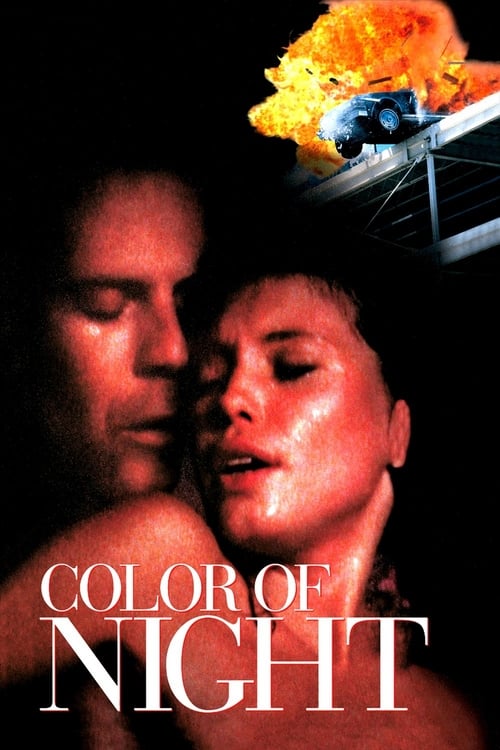
Color of Night
A color-blind psychiatrist is stalked by an unknown killer after taking over his murdered friend's therapy group and becomes embroiled in an intense affair with a mysterious woman who may be connected to the crime.
The film commercial failure against its moderate budget of $40.0M, earning $19.7M globally (-51% loss). While initial box office returns were modest, the film has gained appreciation for its compelling narrative within the romance genre.
2 wins & 11 nominations


Plot Structure
Story beats plotted across runtime


Narrative Arc
Emotional journey through the story's key moments
Story Circle
Blueprint 15-beat structure
Arcplot Score Breakdown
Weighted: Precision (70%) + Arc (15%) + Theme (15%)
Color of Night (1994) reveals precise dramatic framework, characteristic of Richard Rush's storytelling approach. This structural analysis examines how the film's 15-point plot structure maps to proven narrative frameworks across 2 hours and 1 minutes. With an Arcplot score of 7.0, the film balances conventional beats with creative variation.
Characters
Cast & narrative archetypes

Dr. Bill Capa
Rose
Dr. Bob Moore
Detective Martinez
Richie
Casey
Buck
Main Cast & Characters
Dr. Bill Capa
Played by Bruce Willis
A traumatized psychologist who loses his ability to see color after a patient's suicide, seeking redemption by treating his colleague's therapy group.
Rose
Played by Jane March
A mysterious and seductive woman from the therapy group who becomes romantically involved with Dr. Capa while harboring dangerous secrets.
Dr. Bob Moore
Played by Scott Bakula
Bill's colleague and friend who is murdered, leaving Bill to take over his therapy group and unravel the mystery of who killed him.
Detective Martinez
Played by Ruben Blades
The investigating detective pursuing the murder case, suspicious of Dr. Capa and the therapy group members.
Richie
Played by Lesley Ann Warren
A volatile and aggressive member of the therapy group with anger management issues and violent tendencies.
Casey
Played by Brad Dourif
An obsessive-compulsive patient in the therapy group who displays paranoid and controlling behaviors.
Buck
Played by Lance Henriksen
A sexually compulsive member of the therapy group who struggles with impulse control and boundary issues.
Structural Analysis
The Status Quo at 1 minutes (1% through the runtime) establishes Dr. Bill Capa conducts a therapy session in his New York office, establishing him as a confident, successful psychologist before trauma shatters his world.. Of particular interest, this early placement immediately immerses viewers in the story world.
The inciting incident occurs at 15 minutes when Dr. Bob Moore is brutally murdered, stabbed to death with a letter opener. Bill discovers his friend's body and is drawn into investigating the killing.. At 12% through the film, this Disruption aligns precisely with traditional story structure. This beat shifts the emotional landscape, launching the protagonist into the central conflict.
The First Threshold at 30 minutes marks the transition into Act II, occurring at 25% of the runtime. This illustrates the protagonist's commitment to Bill makes the active choice to take over Bob's therapy group, inserting himself into the world of the suspects to find the killer while also beginning a passionate affair with the mysterious Rose., moving from reaction to action.
At 61 minutes, the Midpoint arrives at 50% of the runtime—precisely centered, creating perfect narrative symmetry. The analysis reveals that this crucial beat Bill discovers that someone has been stalking him and Rose. A false defeat as he realizes the killer is aware of his investigation and his relationship, raising the stakes dramatically and making him a target., fundamentally raising what's at risk. The emotional intensity shifts, dividing the narrative into clear before-and-after phases.
The Collapse moment at 91 minutes (75% through) represents the emotional nadir. Here, Bill is nearly killed and discovers devastating revelations about the people he trusted. Rose disappears, and Bill fears she may be dead or complicit in the murders. His investigation seems to have cost him everything., demonstrates the protagonist at their lowest point. This beat's placement in the final quarter sets up the climactic reversal.
The Second Threshold at 97 minutes initiates the final act resolution at 80% of the runtime. Bill finally sees the truth: Rose is actually Richie, a member of Bob's therapy group disguised as a woman due to past trauma and gender identity issues. This revelation also points to the real killer's identity., demonstrating the transformation achieved throughout the journey.
Emotional Journey
Color of Night's emotional architecture traces a deliberate progression across 15 carefully calibrated beats.
Narrative Framework
This structural analysis employs proven narrative structure principles that track dramatic progression. By mapping Color of Night against these established plot points, we can identify how Richard Rush utilizes or subverts traditional narrative conventions. The plot point approach reveals not only adherence to structural principles but also creative choices that distinguish Color of Night within the romance genre.
Richard Rush's Structural Approach
Among the 2 Richard Rush films analyzed on Arcplot, the average structural score is 6.8, demonstrating varied approaches to story architecture. Color of Night represents one of the director's most structurally precise works. For comparative analysis, explore the complete Richard Rush filmography.
Comparative Analysis
Additional romance films include South Pacific, Dirty Dancing: Havana Nights and The Evening Star. For more Richard Rush analyses, see Getting Straight.
Plot Points by Act
Act I
SetupStatus Quo
Dr. Bill Capa conducts a therapy session in his New York office, establishing him as a confident, successful psychologist before trauma shatters his world.
Theme
A colleague remarks that we can't save everyone, and sometimes we must save ourselves first—foreshadowing Bill's journey toward healing his own psychological wounds.
Worldbuilding
Bill's patient Michelle commits suicide by jumping through his office window. The trauma causes Bill to develop color blindness, specifically losing the ability to see red. He relocates to Los Angeles to recover with his friend Dr. Bob Moore.
Disruption
Dr. Bob Moore is brutally murdered, stabbed to death with a letter opener. Bill discovers his friend's body and is drawn into investigating the killing.
Resistance
Bill debates whether to get involved in solving Bob's murder. He meets the eccentric members of Bob's Monday night therapy group—each a potential suspect. Detective Martinez investigates while Bill wrestles with his own psychological damage.
Act II
ConfrontationFirst Threshold
Bill makes the active choice to take over Bob's therapy group, inserting himself into the world of the suspects to find the killer while also beginning a passionate affair with the mysterious Rose.
Mirror World
Bill's intense romantic relationship with Rose deepens. She represents both his chance at emotional healing and the thematic connection between love, vulnerability, and the danger of not truly seeing those closest to us.
Premise
Bill conducts therapy sessions with the group members—Sondra, Clark, Buck, Casey, and others—while pursuing his affair with Rose and investigating the murder. Each session reveals secrets and potential motives as Bill plays detective and therapist simultaneously.
Midpoint
Bill discovers that someone has been stalking him and Rose. A false defeat as he realizes the killer is aware of his investigation and his relationship, raising the stakes dramatically and making him a target.
Opposition
The killer escalates violence, attempting to murder Bill in increasingly dangerous ways. Suspicion falls on various group members. Bill's relationship with Rose intensifies even as he struggles to uncover her mysterious past and true identity.
Collapse
Bill is nearly killed and discovers devastating revelations about the people he trusted. Rose disappears, and Bill fears she may be dead or complicit in the murders. His investigation seems to have cost him everything.
Crisis
Bill processes the apparent loss of Rose and the failure of his investigation. He must confront his own blindness—both literal and metaphorical—to the truth that has been in front of him all along.
Act III
ResolutionSecond Threshold
Bill finally sees the truth: Rose is actually Richie, a member of Bob's therapy group disguised as a woman due to past trauma and gender identity issues. This revelation also points to the real killer's identity.
Synthesis
Bill confronts the true killer in a climactic showdown. The murderer is revealed to be Dale Dexter, Rose/Richie's abusive brother. Bill must fight to save both himself and Rose while the full truth of the trauma and violence is exposed.
Transformation
Bill's color blindness is cured—he can finally see red again. This symbolizes his psychological healing and his ability to truly see Rose for who she is. They embrace, united and healed through their shared journey.