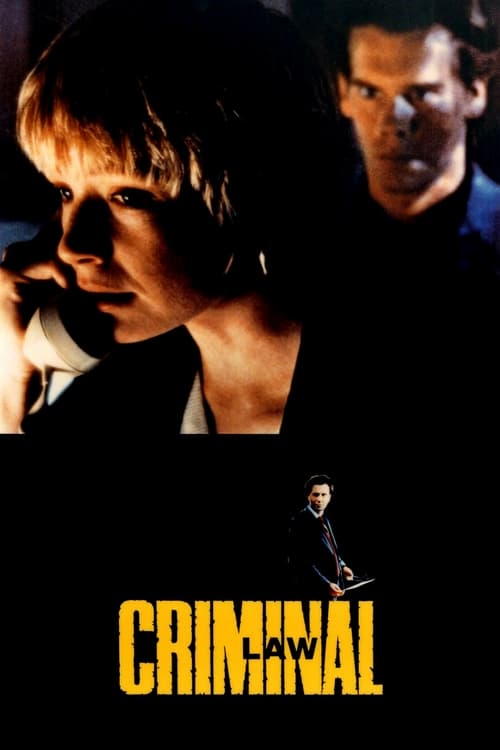
Criminal Law
Ben Chase is an on-the-rise Boston attorney currently defending a wealthy client in a high-profile murder case. Martin Thiel is the wealthy young man on trial for a particularly brutal murder. The verdict sets Thiel free. Within 24 hours another grizzly and all-too-familiar murder has taken place with striking similarities to the first crime. Chase inexplicably agrees to act as his defense attorney; but this time it will be to gather evidence that will put away his client for good.
Working with a small-scale budget of $5.0M, the film achieved a modest success with $10.0M in global revenue (+99% profit margin).


Plot Structure
Story beats plotted across runtime


Narrative Arc
Emotional journey through the story's key moments
Story Circle
Blueprint 15-beat structure
Arcplot Score Breakdown
Weighted: Precision (70%) + Arc (15%) + Theme (15%)
Criminal Law (1989) demonstrates precise dramatic framework, characteristic of Martin Campbell's storytelling approach. This structural analysis examines how the film's 15-point plot structure maps to proven narrative frameworks across 1 hour and 54 minutes. With an Arcplot score of 7.1, the film balances conventional beats with creative variation.
Characters
Cast & narrative archetypes

Martin Thiel
Ben Chase
Detective Stilwell
Ellen Faulkner
Main Cast & Characters
Martin Thiel
Played by Gary Oldman
A successful defense attorney who gets his client acquitted of murder, only to suspect he may actually be guilty when similar murders continue.
Ben Chase
Played by Kevin Bacon
A wealthy, charming young man accused of murder who becomes the defense attorney's client and possible serial killer.
Detective Stilwell
Played by Joe Don Baker
A seasoned homicide detective investigating the series of murders and suspicious of the defense attorney's role.
Ellen Faulkner
Played by Karen Young
An assistant district attorney who works with Martin Thiel and becomes romantically involved with him.
Structural Analysis
The Status Quo at 1 minutes (1% through the runtime) establishes Ben Chase is a confident, successful defense attorney at the height of his career, preparing for a high-profile murder trial with his reputation for winning seemingly unwinnable cases.. Notably, this early placement immediately immerses viewers in the story world.
The inciting incident occurs at 14 minutes when Ben successfully gets Martin Thiel acquitted of murder through his brilliant defense work, winning what appears to be a major victory. The jury returns a not-guilty verdict.. At 12% through the film, this Disruption aligns precisely with traditional story structure. This beat shifts the emotional landscape, launching the protagonist into the central conflict.
The First Threshold at 28 minutes marks the transition into Act II, occurring at 25% of the runtime. This reveals the protagonist's commitment to Ben makes the active choice to investigate Martin himself after becoming convinced his client is the real killer. He crosses from defense attorney to amateur detective, entering a dangerous new world., moving from reaction to action.
At 58 minutes, the Midpoint arrives at 50% of the runtime—precisely centered, creating perfect narrative symmetry. The analysis reveals that this crucial beat Martin kills again, and Ben either witnesses evidence or confronts Martin directly. The stakes raise dramatically - Ben now knows with certainty his client is a serial killer, but he's trapped by his professional obligations. False defeat: Ben seems powerless., fundamentally raising what's at risk. The emotional intensity shifts, dividing the narrative into clear before-and-after phases.
The Collapse moment at 85 minutes (74% through) represents the emotional nadir. Here, Martin kills someone close to Ben, or nearly succeeds in killing Ben himself. The whiff of death - Ben's faith in the legal system dies, or an innocent person dies because of Ben's choices. His darkest moment of failure and guilt., reveals the protagonist at their lowest point. This beat's placement in the final quarter sets up the climactic reversal.
The Second Threshold at 91 minutes initiates the final act resolution at 80% of the runtime. Ben discovers a way to stop Martin outside the legal system, or finds evidence that breaks attorney-client privilege. He synthesizes his legal knowledge with his new moral clarity. Armed with new information or resolve, he takes action., demonstrating the transformation achieved throughout the journey.
Emotional Journey
Criminal Law's emotional architecture traces a deliberate progression across 15 carefully calibrated beats.
Narrative Framework
This structural analysis employs a 15-point narrative structure framework that maps key story moments. By mapping Criminal Law against these established plot points, we can identify how Martin Campbell utilizes or subverts traditional narrative conventions. The plot point approach reveals not only adherence to structural principles but also creative choices that distinguish Criminal Law within the drama genre.
Martin Campbell's Structural Approach
Among the 12 Martin Campbell films analyzed on Arcplot, the average structural score is 7.1, reflecting strong command of classical structure. Criminal Law exemplifies the director's characteristic narrative technique. For comparative analysis, explore the complete Martin Campbell filmography.
Comparative Analysis
Additional drama films include After Thomas, South Pacific and Dirty Dancing: Havana Nights. For more Martin Campbell analyses, see Green Lantern, Dirty Angels and The Mask of Zorro.
Plot Points by Act
Act I
SetupStatus Quo
Ben Chase is a confident, successful defense attorney at the height of his career, preparing for a high-profile murder trial with his reputation for winning seemingly unwinnable cases.
Theme
A colleague or prosecutor questions the ethics of defending guilty clients, stating something like "The law isn't about truth, it's about what you can prove" - establishing the film's central moral question about justice versus legal technicality.
Worldbuilding
Establishment of Ben's world: his legal prowess, courtroom tactics, relationship with his assistant, and the details of Martin Thiel's murder case. We see Ben's confidence and skill as he prepares his defense strategy.
Disruption
Ben successfully gets Martin Thiel acquitted of murder through his brilliant defense work, winning what appears to be a major victory. The jury returns a not-guilty verdict.
Resistance
Ben celebrates his victory but begins noticing disturbing behavior from Martin. Another murder occurs with the same M.O. Ben resists the possibility that his client is guilty, debates with himself and others about his responsibility.
Act II
ConfrontationFirst Threshold
Ben makes the active choice to investigate Martin himself after becoming convinced his client is the real killer. He crosses from defense attorney to amateur detective, entering a dangerous new world.
Mirror World
Introduction or deepening of relationship with a character who represents moral clarity - possibly a love interest, detective, or victim's family member who embodies the thematic counterpoint to Ben's legal cynicism.
Premise
Ben investigates Martin while maintaining their attorney-client relationship. Cat-and-mouse games between the two. Ben gathers evidence but is frustrated by attorney-client privilege and lack of legal recourse.
Midpoint
Martin kills again, and Ben either witnesses evidence or confronts Martin directly. The stakes raise dramatically - Ben now knows with certainty his client is a serial killer, but he's trapped by his professional obligations. False defeat: Ben seems powerless.
Opposition
Martin becomes increasingly bold and threatens Ben. Police suspect Ben of obstruction. Ben's personal and professional life unravels. Martin may threaten people Ben cares about. The psychological pressure intensifies.
Collapse
Martin kills someone close to Ben, or nearly succeeds in killing Ben himself. The whiff of death - Ben's faith in the legal system dies, or an innocent person dies because of Ben's choices. His darkest moment of failure and guilt.
Crisis
Ben processes his guilt and despair. He must choose between his career, his ethics, and stopping a killer. Dark night wrestling with the consequences of his actions and the failure of the system he believed in.
Act III
ResolutionSecond Threshold
Ben discovers a way to stop Martin outside the legal system, or finds evidence that breaks attorney-client privilege. He synthesizes his legal knowledge with his new moral clarity. Armed with new information or resolve, he takes action.
Synthesis
The finale confrontation between Ben and Martin. Ben uses his legal mind and knowledge of Martin to trap or stop him. The cat-and-mouse game reaches its climax, possibly in a physical confrontation or psychological showdown.
Transformation
Final image shows Ben transformed - no longer the cocky attorney who valued winning over truth. He's morally compromised or has left the law entirely, understanding the cost of putting legal technicality above justice. A sobering mirror to his confident opening.