Do the Right Thing
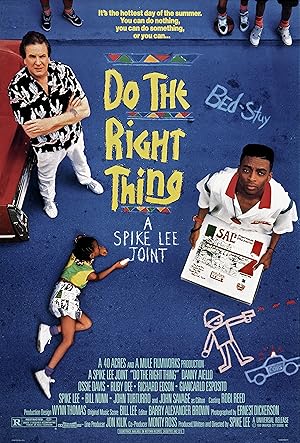
This film looks at life in the Bedford-Stuyvesant district of Brooklyn on a hot summer Sunday. As he does everyday, Sal Fragione opens the pizza parlor he's owned for 25 years. The neighborhood has changed considerably in the time he's been there and is now composed primarily of African-Americans and Hispanics. His son Pino hates it there and would like nothing better than to relocate the eatery to their own neighborhood. For Sal however, the restaurant represents something that is part of his life and sees it as a part of the community. What begins as a simple complaint by one of his customers, Buggin Out - who wonders why he has only pictures of famous Italian-Americans on the wall when most of his customers are black - eventually disintegrates into violence as frustration seemingly brings out the worst in everyone.
Despite its modest budget of $6.5M, Do the Right Thing became a financial success, earning $37.3M worldwide—a 474% return. The film's distinctive approach attracted moviegoers, proving that strong storytelling can transcend budget limitations.
Nominated for 2 Oscars. 21 wins & 19 nominations


Plot Structure
Story beats plotted across runtime


Narrative Arc
Emotional journey through the story's key moments
Story Circle
Blueprint 15-beat structure
Arcplot Score Breakdown
Weighted: Precision (70%) + Arc (15%) + Theme (15%)
Do the Right Thing (1989) demonstrates meticulously timed narrative architecture, characteristic of Spike Lee's storytelling approach. This structural analysis examines how the film's 15-point plot structure maps to proven narrative frameworks across 2 hours. With an Arcplot score of 6.5, the film balances conventional beats with creative variation.
Characters
Cast & narrative archetypes

Mookie

Sal
Radio Raheem

Buggin' Out

Pino

Tina

Mother Sister
Da Mayor
Main Cast & Characters
Mookie
Played by Spike Lee
A pizza delivery man caught between his Italian employers and his Black community on the hottest day of summer.
Sal
Played by Danny Aiello
The Italian-American owner of Sal's Famous Pizzeria who takes pride in serving the neighborhood for 25 years.
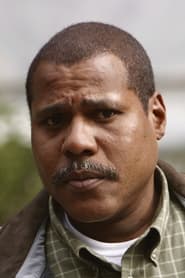
Radio Raheem
Played by Bill Nunn
A neighborhood fixture who carries a boom box blasting Public Enemy's "Fight the Power" wherever he goes.
Buggin' Out
Played by Giancarlo Esposito
An outspoken activist who demands Black representation on Sal's Wall of Fame and organizes a boycott.
Pino
Played by John Turturro
Sal's eldest son who harbors deep resentment about working in a Black neighborhood and frequently clashes with his father.
Tina
Played by Rosie Perez
Mookie's girlfriend and the mother of his child who demands more responsibility and presence from him.
Mother Sister
Played by Ruby Dee
An elderly matriarch who watches the neighborhood from her window and serves as its moral conscience.
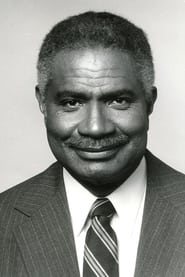
Da Mayor
Played by Ossie Davis
A wise, alcoholic neighborhood elder who acts as a street philosopher and peacemaker despite being dismissed by many.
Structural Analysis
The Status Quo at 1 minutes (1% through the runtime) establishes Mister Señor Love Daddy opens his radio show announcing the hottest day of the year as the neighborhood wakes. The block is introduced through routine morning rituals - a community about to face its breaking point.. Significantly, this early placement immediately immerses viewers in the story world.
The inciting incident occurs at 14 minutes when Buggin' Out notices the Wall of Fame in Sal's pizzeria features only Italian-Americans and demands Black faces be included. Sal refuses. This seemingly minor confrontation plants the seed that will grow into tragedy.. At 12% through the film, this Disruption aligns precisely with traditional story structure. This beat shifts the emotional landscape, launching the protagonist into the central conflict.
The First Threshold at 30 minutes marks the transition into Act II, occurring at 25% of the runtime. This indicates the protagonist's commitment to Radio Raheem commits to supporting Buggin' Out's cause, transforming a one-man complaint into a potential movement. The conflict shifts from personal grievance to community action, crossing the point of no return., moving from reaction to action.
At 60 minutes, the Midpoint arrives at 50% of the runtime—precisely centered, creating perfect narrative symmetry. Significantly, this crucial beat A white man accidentally scuffs Buggin' Out's new Air Jordans and racial confrontation erupts in the street. The false peace is shattered - the day's tensions can no longer be contained through avoidance. Violence becomes inevitable., fundamentally raising what's at risk. The emotional intensity shifts, dividing the narrative into clear before-and-after phases.
The Collapse moment at 90 minutes (75% through) represents the emotional nadir. Here, Radio Raheem and Buggin' Out return to Sal's with the boombox blasting. Sal destroys the radio with a baseball bat, triggering a brawl. Police arrive and choke Radio Raheem to death with a nightstick - the "whiff of death" becomes actual murder., illustrates the protagonist at their lowest point. This beat's placement in the final quarter sets up the climactic reversal.
The Second Threshold at 96 minutes initiates the final act resolution at 80% of the runtime. Mookie makes his choice: he picks up a trash can and hurls it through Sal's window, redirecting the crowd's rage from the Italians to the property. Is this the right thing? The film refuses to answer., demonstrating the transformation achieved throughout the journey.
Emotional Journey
Do the Right Thing's emotional architecture traces a deliberate progression across 15 carefully calibrated beats.
Narrative Framework
This structural analysis employs proven narrative structure principles that track dramatic progression. By mapping Do the Right Thing against these established plot points, we can identify how Spike Lee utilizes or subverts traditional narrative conventions. The plot point approach reveals not only adherence to structural principles but also creative choices that distinguish Do the Right Thing within the comedy genre.
Spike Lee's Structural Approach
Among the 13 Spike Lee films analyzed on Arcplot, the average structural score is 7.0, demonstrating varied approaches to story architecture. Do the Right Thing takes a more unconventional approach compared to the director's typical style. For comparative analysis, explore the complete Spike Lee filmography.
Comparative Analysis
Additional comedy films include The Bad Guys, Ella Enchanted and The Evening Star. For more Spike Lee analyses, see Summer of Sam, Inside Man and Clockers.
Plot Points by Act
Act I
SetupStatus Quo
Mister Señor Love Daddy opens his radio show announcing the hottest day of the year as the neighborhood wakes. The block is introduced through routine morning rituals - a community about to face its breaking point.
Theme
Da Mayor tells Mookie to "always do the right thing." This seemingly simple advice becomes the film's central, unanswerable question - what IS the right thing when violence and non-violence collide?
Worldbuilding
The Bed-Stuy block is established: Sal's Famous Pizzeria with its Italian-American owners, the Korean grocery, the corner men, Radio Raheem with his boombox, Buggin' Out, and Mookie navigating between worlds. Racial tensions simmer beneath the summer heat.
Disruption
Buggin' Out notices the Wall of Fame in Sal's pizzeria features only Italian-Americans and demands Black faces be included. Sal refuses. This seemingly minor confrontation plants the seed that will grow into tragedy.
Resistance
Buggin' Out tries to organize a boycott but finds no support. The community debates whether the demand is reasonable. Mookie tries to stay neutral, focused only on getting paid. Various characters offer perspectives on race, respect, and survival.
Act II
ConfrontationFirst Threshold
Radio Raheem commits to supporting Buggin' Out's cause, transforming a one-man complaint into a potential movement. The conflict shifts from personal grievance to community action, crossing the point of no return.
Mirror World
Da Mayor saves a child from being hit by a car, and Mother Sister finally acknowledges him with respect. Their quiet romance subplot represents the possibility of reconciliation and dignity that the main plot will ultimately destroy.
Premise
The hottest day of summer unfolds. Mookie delivers pizzas, flirts with Tina, avoids responsibility. Radio Raheem delivers his iconic "Love and Hate" speech. The racial slur montage exposes the mutual prejudices simmering in the neighborhood. Heat and tension rise together.
Midpoint
A white man accidentally scuffs Buggin' Out's new Air Jordans and racial confrontation erupts in the street. The false peace is shattered - the day's tensions can no longer be contained through avoidance. Violence becomes inevitable.
Opposition
Tensions escalate relentlessly. Sal and Pino's racism becomes more overt. Radio Raheem's confrontations intensify. Mookie's attempts at neutrality grow increasingly untenable. The heat becomes a pressure cooker with no release valve.
Collapse
Radio Raheem and Buggin' Out return to Sal's with the boombox blasting. Sal destroys the radio with a baseball bat, triggering a brawl. Police arrive and choke Radio Raheem to death with a nightstick - the "whiff of death" becomes actual murder.
Crisis
The crowd watches in horror as Radio Raheem's body is thrown in a police car. Grief transforms to rage. The community stands on the precipice - justice denied, a young man dead, and Sal's pizzeria representing 25 years of complicated relationships.
Act III
ResolutionSecond Threshold
Mookie makes his choice: he picks up a trash can and hurls it through Sal's window, redirecting the crowd's rage from the Italians to the property. Is this the right thing? The film refuses to answer.
Synthesis
The pizzeria burns. The Korean grocer is spared when he declares solidarity. Morning arrives. Mookie returns to Sal for his pay. Their exchange is loaded with unresolved grief, blame, and the impossible question of what was "right." Life continues, changed forever.
Transformation
Dual quotes from Martin Luther King Jr. and Malcolm X close the film, offering competing philosophies on violence and non-violence. The transformation is not resolution but confrontation - the audience must decide what "the right thing" means.